


Why Savers Finally Have Alternatives Again
In 1975, the British comedy troupe Monty Python released Monty Python and the Holy Grail, their wonderfully absurd take on the legend of King Arthur and his search for the Holy Grail.
One of my favorite scenes occurs when King Arthur encounters a group of peasants working in a field. Arthur attempts to explain that he is their king, which leads to an increasingly ridiculous debate with a particularly argumentative peasant named Dennis over exactly where political authority comes from.
Eventually, an exasperated Arthur grabs Dennis by the collar. Dennis immediately begins yelling:
"Help! Help! I'm being repressed!"

Source: Pinterest
For those of you who could use a laugh to start your day, I have included a short YouTube clip of the scene below.
Help! I'm Being Repressed! (Short Version)
For much of the past 15 years, I suspect some of my clients could relate.
Not because King Arthur was dragging them through the mud, but because something much less obvious was happening to people who had spent their lives doing many of the things we encourage people to do financially.
They saved money. They lived within their means. They paid down debt. They accumulated cash reserves. And as they approached or entered retirement, they expected those savings to generate a reasonable amount of income without requiring them to take significant investment risk.
Then came the Global Financial Crisis.
The collapse of the subprime mortgage market eventually contributed to the failure of Bear Stearns, the government conservatorship of Fannie Mae and Freddie Mac, the bankruptcy of Lehman Brothers, and the rescue of AIG. By late 2008, the global financial system was in serious trouble.
The Federal Reserve responded aggressively.
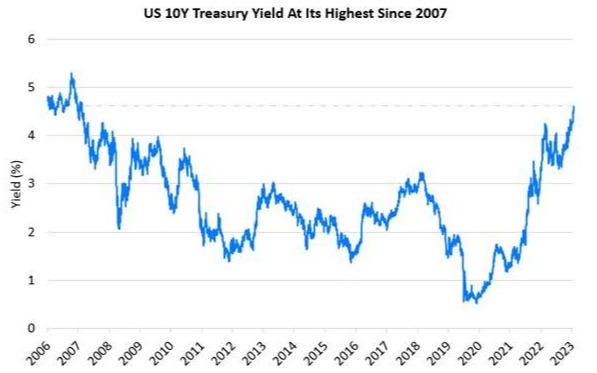
In December 2008, the Fed lowered its target for the federal funds rate to essentially 0%, where it remained until December 2015. This became known as ZIRP, zero-interest-rate policy. Rates gradually increased over the next several years before the COVID shutdowns brought another economic emergency. In March 2020, the Fed returned rates to essentially zero, where they remained until March 2022.
There were very good reasons for many of these actions. Policymakers were trying to stabilize the financial system, support the economy, encourage lending, and prevent severe recessions from becoming something worse.
These policies contributed to dramatically lower interest rates across the bond yield curve, as you can see in this chart of 10-year Treasury yields, arguably the most important interest rate in the world, from 2007 to 2023.
Source: BondBlox
But economic medicine can have side effects.
And one of the biggest side effects fell squarely on savers. Economists have a term for what happens when government and central-bank policies keep interest rates unusually low, particularly when those rates fall below inflation.
Financial repression.
The term sounds like something Dennis might have invented, but it is quite real.
Economists Carmen Reinhart, Jacob Kirkegaard, and Belen Sbrancia have described financial repression as policies that can hold interest rates below what freer markets might otherwise produce. When interest rates remain below inflation, the result can effectively transfer purchasing power from creditors and savers to borrowers, including the government.
Mohamed El-Erian, who was CEO and co-chief investment officer of PIMCO during the Global Financial Crisis, was also warning about this more than a decade ago.
At PIMCO's 2011 Secular Forum, El-Erian described financial repression as policymakers "imposing negative real rates of return on savers." He worried that heavily indebted governments could use unusually low interest rates to manage their debt burdens, but that doing so came at a cost to people trying to save and invest conservatively.
That sounds remarkably similar to the conversations that I would have with clients for the next dozen years.
In plain English, borrowers benefit from unusually cheap money. Savers help pay for it through unusually low returns.
For years, I watched this play out with our clients. People who had been financially responsible would look at the interest being paid on savings accounts, money-market accounts, and CDs and ask a perfectly reasonable question:
"Why can't I earn anything on my money anymore?"
I understood their frustration. It seemed unfair that my clients and their good savings habits were being punished. At the same time, financial institutions that had overleveraged their balance sheets during the subprime mortgage crisis were able to rebuild capital, in part by benefiting from wider spreads between what they earned on assets and what they paid depositors.
For much of my career, conservative investors could reasonably expect the safer portion of their portfolios to generate meaningful income. After 2008, that became much more difficult. And something else began to happen. Investors began moving farther out on the risk spectrum.
If cash paid virtually nothing and high-quality bonds didn't offer much more, investors looking for reasonable returns had to consider other possibilities: lower-quality bonds, dividend-paying stocks, equities in general, real estate, and eventually a growing menu of alternative investments.
Wall Street developed an acronym for this environment:
TINA. There Is No Alternative. If investors wanted returns, the argument went, there was simply no attractive alternative to taking more risk.
John Mauldin, whose economic research I have followed for many years, recently revisited this subject. He has criticized ultra-low interest rates since around 2010 because of their impact on savers and retirees. He also believes those policies contributed to rising stock prices because investors received so little return from fixed-income investments that they were encouraged to take additional risk.
But something important has changed. Today, there are alternatives.
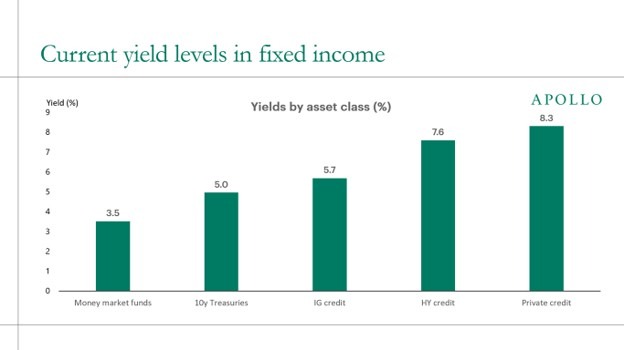
As Mauldin recently pointed out, two-year U.S. Treasury securities are yielding more than 4.5%. Investors can once again earn meaningful income from government securities and other high-quality fixed-income investments without moving nearly as far out on the risk spectrum, as shown in the chart below from Apollo Asset Management.
Source: Apollo Asset Management
Think about how remarkable that change is. For someone who has spent the last 15 years watching savings accounts and bonds pay next to nothing, a Treasury security yielding close to 5% may seem almost too good to be true.
However, for someone trying to buy their first home, today's interest rates may seem painfully high.
Both people are looking at the same interest-rate environment. They're simply standing on opposite sides of the transaction.
That is also a wonderful example of something we frequently discuss in behavioral finance: recency bias. If you became an adult, bought your first home, or began investing after the Global Financial Crisis, ultra-low interest rates may feel normal because that is the financial world you grew up in.
But they weren't necessarily normal.
In many respects, the extraordinarily low rates of the post-2008 period were the historical anomaly. That matters for investors today because the investment landscape has changed.
This doesn't mean investors should sell their stocks and put everything into Treasury bonds. Stocks continue to play an important role in generating long-term growth and helping portfolios stay ahead of inflation. Bonds have their own risks, including interest-rate and inflation risk.
It does mean, however, that investors once again have choices they haven't enjoyed in many years.
Cash can generate income. Bonds can generate income. High-quality fixed-income investments can potentially provide both portfolio diversification and meaningful cash flow.
And perhaps most importantly, investors seeking reasonable returns aren't necessarily being pushed as aggressively toward riskier assets simply because safer alternatives pay virtually nothing.
TINA may finally have met her match.
Instead of There Is No Alternative, perhaps the better acronym today would be: TAA. There Are Alternatives.
Whether this environment lasts forever is another question.
The United States carries an enormous federal debt load, and higher interest rates make servicing that debt considerably more expensive. That creates powerful incentives for policymakers to prefer lower borrowing costs in the future. Financial repression has appeared at other points in economic history, and there is no guarantee Dennis won't have reason to start shouting again someday.
But for now, the world has changed. After years of hearing savers ask why prudence seemed to be punished, we can finally give them a different answer.
You have alternatives again.
You can earn meaningful income without necessarily taking the level of investment risk that investors often felt compelled to take during much of the previous decade and a half. And that gives us more tools as we build financial plans designed not merely for today's markets, but for whatever markets come next.
So perhaps our friend Dennis can finally stop yelling, "Help! Help! I'm being repressed!"
At least for now, savers may finally be able to put that line back where it belongs… in one of the funniest movies ever made.
And we can get back to Moving Life Forward.
© 2026 Jesse Hurst
Senior Wealth Manager
The opinions voiced in this material are for general information only and are not intended to provide specific advice or recommendations for any individual. All performance referenced is historical and is no guarantee of future results. All indices are unmanaged and may not be invested into directly.
Bonds are subject to market and interest rate risk if sold prior to maturity. Bond values will decline as interest rates rise and bonds are subject to availability and change in price.
Bond yields are subject to change. Certain call or special redemption features may exist which could impact yield.
Government bonds and Treasury bills are guaranteed by the US government as to the timely payment of principal and interest and, if held to maturity, offer a fixed rate of return and fixed principal value.
There is no guarantee that a diversified portfolio will enhance overall returns or outperform a non-diversified portfolio. Diversification does not protect against market risk.
Featured Blog Image Source: iStock.com/nicoletaionescu