


Part Two of a Three-Part Series on America's Federal Debt
One reason The Dark Knight has endured as one of the greatest superhero movies ever made is that it was never really about superheroes.

Source: Amazon.com
It was about choices.
Throughout the film, Batman is repeatedly confronted with situations where every available option comes at a cost. Protect one person, and someone else may suffer. Preserve one principle, and another may have to be sacrificed. The real villain isn't simply the Joker. It's the uncomfortable reality that sometimes there are no perfect solutions.
That may be the best way to think about America's growing federal debt.
In Part One of this series, we looked at how the United States accumulated more than $39 trillion in federal debt and why the underlying arithmetic deserves our attention regardless of political affiliation.
As I often remind clients, numbers don't vote. Neither do difficult choices. Math belongs to neither Democrats nor Republicans.
The good news is that America is not standing on the edge of a financial cliff. The challenge is more subtle—and, in many ways, more manageable. We are standing at a crossroads where the choices we make over the next decade will matter enormously.
That distinction matters because many headlines encourage us to believe there are only two possible outcomes. Either Washington somehow eliminates the debt problem overnight, or the United States suddenly experiences an economic catastrophe.
History suggests something much different.
One of my favorite economists, Dr. David Kelly, Chief Global Strategist at J.P. Morgan Asset Management, has written extensively about how countries work through large debt burdens. His conclusion is both reassuring and realistic. His work reminds us that debt crises are rarely solved by one dramatic event. They are usually resolved through years of incremental decisions, each carrying its own costs and compromises.
The first and most desirable solution is faster economic growth.
If the economy grows more rapidly than the debt, the debt burden gradually becomes easier to manage. Strong productivity, technological innovation, artificial intelligence, energy development, medical breakthroughs, and a growing workforce all have the potential to expand America's economic output faster than many economists currently expect.
This is everyone's favorite solution because it creates the fewest losers.
As someone who remains optimistic about America's long-term future, I believe stronger economic growth will almost certainly be part of the answer. I don't believe it will be the entire answer.
Another possibility is somewhat higher inflation over an extended period of time.
Inflation quietly reduces the real value of outstanding debt because tomorrow's dollars purchase less than today's dollars. Governments throughout history have often benefited when inflation modestly exceeded expectations, making debt accumulated in yesterday's dollars easier to repay with tomorrow's dollars.
Of course, inflation is hardly painless. Savers, retirees living on fixed incomes, and anyone whose income fails to keep pace with rising prices often bear much of the burden. Few politicians openly advocate for inflation. Many simply learn to live with it.
A third possibility is something economists call financial repression.
Despite its intimidating name, the concept is actually fairly straightforward. Policies that keep interest rates lower than inflation, encourage financial institutions to hold more government debt, or otherwise make it easier for governments to finance large deficits can gradually reduce debt burdens over time.
Most Americans have probably never heard the term. We have recently lived through a period that shared some of its characteristics.
After the 2008 Great Financial Crisis, the Federal Reserve instituted quantitative easing and lowered short-term interest rates to nearly 0%. These policies helped stabilize the financial system and allowed many of the institutions at the center of the crisis to rebuild capital, repair their balance sheets, and return to profitability.
While these policies supported economic recovery and stabilized financial markets, they also had unintended consequences. As several of my clients have pointed out, savers and retirees who had done the right thing by living within their means suddenly found themselves earning very little on their CDs, money market funds, and savings accounts. To many, it felt like an invisible tax on prudence: the income they had expected from a lifetime of saving was sacrificed to help repair a financial system whose excesses they had not created.
A fourth option involves some combination of higher taxes, lower government spending, or reforms to entitlement programs.
This is where political disagreements become most visible. Should taxes increase? Should certain government programs be reduced? Should eligibility ages gradually change? Should defense spending be trimmed? Should other discretionary spending be cut? Reasonable people can disagree on every one of those questions.
What cannot be debated is the underlying arithmetic. Every dollar the federal government spends must ultimately be financed through taxes, borrowing, or money creation. There is no fourth source of funding.
Perhaps the most likely outcome is that America doesn't choose just one of these paths. Instead, we may gradually experience some combination of stronger economic growth, modest inflation, selective tax increases, measured spending restraint, entitlement reforms, and financial policies that make today's debt easier to finance over time.
History suggests countries usually muddle through. They rarely solve debt problems with a single grand bargain. They adjust gradually, often using several imperfect solutions rather than one sweeping reform.
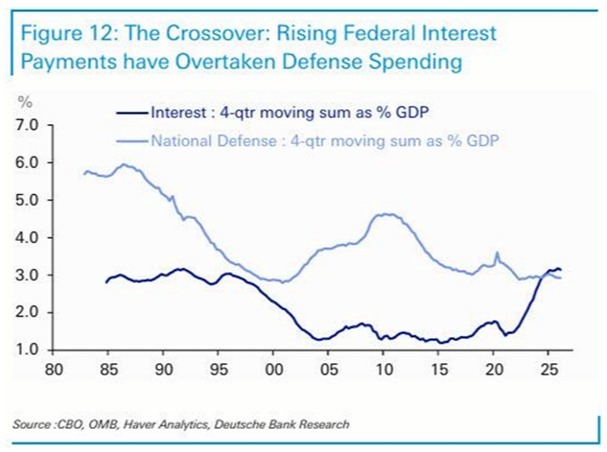
The following chart illustrates why this conversation has become increasingly important.
Source: Barchart
For decades, national defense represented one of the federal government's largest ongoing commitments. Today, interest payments on the national debt have surpassed defense spending as a share of our economy. That crossover did not occur because military spending suddenly exploded.
It happened because the Federal Reserve's necessary campaign to combat inflation beginning in 2022 sharply increased interest rates. Since much of our federal debt matures over time, older debt issued at historically low interest rates is now being refinanced at considerably higher borrowing costs.
Yesterday's borrowing has become today's interest bill.
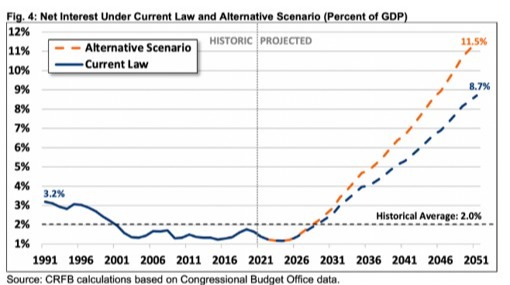
A second chart tells and equally important story.
Source: CRFB and CBO
According to the Congressional Budget Office, interest payments are projected to continue growing faster than many other categories of federal spending over the coming decades. That doesn't mean America is headed toward bankruptcy. It does mean that an increasing share of every tax dollar collected will be devoted simply to paying interest on money we've already borrowed.
That leaves fewer resources available for virtually every other national priority.
None of this means the United States is destined to follow the path of Greece, Argentina, or other countries frequently cited in sensational headlines.
America remains fundamentally different. The challenge, therefore, isn't whether America can solve this problem. The challenge is whether we choose to address it while we still have the flexibility to do so.
We still possess the world's largest economy, the global reserve currency, the deepest and most liquid capital markets, an unparalleled capacity for innovation, and an unmatched ability to generate wealth and taxable income. Those advantages are substantial and should never be dismissed.
But neither should the arithmetic. Those strengths give us time. They do not eliminate the need to act.
Toward the end of The Dark Knight, Batman realizes that leadership is not about waiting for perfect choices to appear. It is about making the best decisions possible when every option involves sacrifice. America's debt challenge may ultimately require the same kind of realism.
The encouraging news is that we still have options. The difficult news is that none of them are completely painless. More than two centuries ago, Thomas Jefferson recognized this tension when he wrote:
“To preserve our independence, we must not let our rulers load us with perpetual debt. We must make our election between economy and liberty, or profusion and servitude.”
Next week, in the final installment of this series, we'll explore what a realistic long-term solution might actually look like. Because while understanding the problem is essential, preserving America's financial future will ultimately depend on our willingness to confront it thoughtfully, honestly, and together.
After all, Gotham wasn't saved by pretending the danger didn't exist. It was saved because people eventually found the courage to face reality before time ran out. The courage to create those types of solutions is how we keep Moving Life Forward.
© 2026 Jesse Hurst
Senior Wealth Manager
The views stated are not necessarily the opinion of LPL Financial and should not be construed directly or indirectly as an offer to buy or sell any securities mentioned herein. Due to volatility within the markets mentioned, opinions are subject to change without notice. Information is based on sources believed to be reliable; however, their accuracy or completeness cannot be guaranteed. Past performance does not guarantee future results.
Investors cannot directly invest in indices.
Featured Blog Image Source: iStock.com/stockakia