


In 1964, The Beatles released A Hard Day's Night, a soundtrack to a whirlwind year that captured the frenzy of Beatlemania. Buried among the album's better-known hits was a John Lennon song called “When I Get Home”. The song is energetic, upbeat, and driven by a simple desire: after a long and exhausting journey, he just wants to get home.

As the song is now more than 60 years old, some readers may not remember it—or may never have heard it at all. I have included a YouTube link below to help set the mood for the rest of today's story.
When I Get Home (Remastered 2009)
More than sixty years later, many young Americans share that same desire. The difference is that today's journey home is proving far more difficult than Lennon could have imagined.
For generations, buying a first home was considered one of the defining milestones of adulthood. It wasn't easy, but it was attainable. A starter home represented more than four walls and a roof. It was a foundation for building wealth, raising a family, and creating a sense of stability and belonging.
After nearly four decades of working with families, I have observed that most families build their wealth primarily through two pillars. The first is the equity they build in their homes as prices rise over time and their mortgages are paid down a little each month. The second is the regular deposits they make to their 401(k) plans through payroll deduction over decades of employment.
Today, that first step onto the property ladder is becoming increasingly difficult.
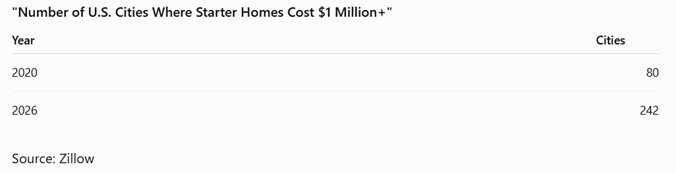
According to a recent Zillow report, there are now 242 cities across the United States where a starter home costs $1 million or more. Before the pandemic, that number stood at just 80. In just a few years, the number of cities where a modest entry-level home carries a seven-figure price tag has more than tripled, as shown in the chart below.
The challenge facing young families extends well beyond the purchase price itself. Home values have risen substantially over the past decade but so have many of the ongoing costs associated with homeownership. Property taxes have increased in many areas. Homeowners insurance premiums have surged, particularly in regions facing greater weather-related risks. Utility bills are higher than they were just a few years ago. Maintenance and repair costs continue to climb as labor and material expenses remain elevated.
Then there is the mortgage.
For much of the decade following the Great Financial Crisis (GFC), prospective buyers could borrow money at historically low interest rates. While home prices were rising, monthly payments remained relatively manageable because financing costs were exceptionally low. That equation has changed dramatically. Higher interest rates combined with higher home prices have pushed monthly mortgage payments to levels that would have seemed unimaginable only a few years ago.
I find it interesting that many young families are struggling to come to terms with mortgage rates in the 6% range. I started working as a financial advisor in 1987. In the late 1980s, 30-year fixed mortgage rates ranged from 9.03% to 10.34%. The decade started with an all-time peak of 18.63% in October 1981. For most of the next two decades, up until the subprime mortgage crisis, rates were in the 5% to 7% range. This was considered normal.
After the government bailouts, banking reforms, and the Federal Reserve Bank's monetary policy following the GFC, most of the next dozen years or so saw mortgage interest rates hovering just above or below 3%. This allowed young families to afford mortgages on homes even if home prices had risen. Over time, this period of abnormally low interest rates became embedded in consumers' minds as normal—a psychological phenomenon known as recency bias.
When mortgage interest rates drifted back up toward a range that was considered normal just twenty years earlier, it created sticker shock for young families today.
As a result, many young families find themselves squeezed from both directions. Saving for a down payment has become more difficult because everyday living expenses consume a larger share of household income. Student loan payments, childcare costs, and rising insurance premiums often leave little room for accumulating the savings needed to purchase a first home.
At the same time, even those who successfully save enough for a down payment often discover that the monthly mortgage payment remains out of reach.
In many ways, this story is about more than housing.
Homeownership has historically been one of the primary ways middle-class Americans build wealth. A home is often the largest asset a family will ever own. It provides the opportunity to accumulate equity, benefit from appreciation over time, and create financial flexibility for future goals. Delaying homeownership by five, ten, or even fifteen years can have meaningful consequences for long-term wealth creation.
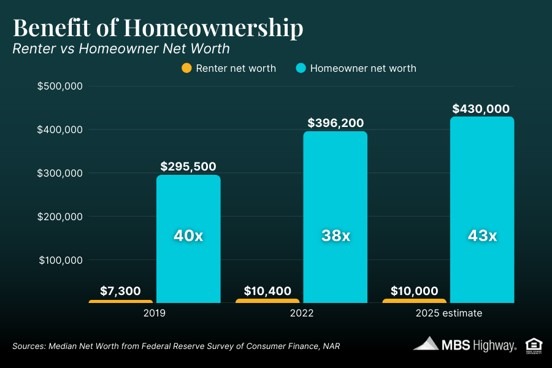
Barry Habib is the CEO of MBS Highway, an organization that conducts economic research and forecasting on the real estate and mortgage markets. According to their research, homeownership remains one of the most powerful wealth-building tools available to middle-class families—with the average homeowner's net worth measuring 43 times that of a renter, as shown in our final chart below. Property ownership serves as a forced savings plan, an inflation buffer, and a stability anchor for long-term financial well-being.
This is one reason housing affordability has become such an important economic issue. It is not simply about real estate markets or mortgage rates. It is about whether younger generations will have access to the same wealth-building opportunities that previous generations enjoyed.
Of course, every generation faces its own challenges. The path to homeownership has never been perfectly smooth. Markets change, interest rates fluctuate, and economic conditions evolve. Yet the combination of higher prices, higher financing costs, and higher ongoing ownership expenses has created a particularly difficult environment for today's first-time buyers.
I have had many conversations with clients who have children and grandchildren struggling to buy their first home. They understand the frustration and, at times, the feeling that the math simply doesn't work. However, one of the great things about the financial planning process is that it helps clients understand how much they need to work toward their retirement goals. If they know they have surplus funds, we can have constructive conversations about how best to use these excess resources to help their loved ones on their road to financial independence.
In conversations with clients, I rarely hear their children asking for luxury homes or extravagant lifestyles. More often, they are simply looking for the same opportunity previous generations had—a reasonable chance to buy a first home and begin building a life.
Many young families are simply looking for a place to start. They are looking for a place to put down roots, build a life, and create a sense of permanence. In other words, they simply want to get home.
Back in 1964, Lennon sang about the anticipation of finally reaching the place where he wanted to be. For many young Americans today, that same destination remains the goal.
The desire has not changed. Young families still want a place to put down roots, raise their children, and build a future. The journey, however, has become much longer and, in many cases, has delayed their ability to keep "Moving Life Forward."
© 2026 Jesse Hurst
Senior Wealth Manager
The views stated are not necessarily the opinion of LPL Financial and should not be construed directly or indirectly as an offer to buy or sell any securities mentioned herein. Due to volatility within the markets mentioned, opinions are subject to change without notice. Information is based on sources believed to be reliable; however, their accuracy or completeness cannot be guaranteed. Past performance does not guarantee future results.
Investors cannot directly invest in indices.
Securities and advisory services offered through LPL Financial, a registered investment advisor. Member FINRA/SIPC.
Featured Blog Image Source: iStock.com/dpproductions