


In August of 1981, MTV launched, and like millions of other teenagers, I was glued to the television. One of the bands that appeared regularly in those early days was The Specials, whose song A Message to You, Rudy carried a simple warning:

Source: Wikipedia
"Stop your messing around. Better think of your future."
If you are not familiar with this somewhat obscure, reggae and British punk-inspired song from more than 40 years ago, below is a YouTube link to the video that played in heavy rotation in the early days of MTV.
The Specials - A Message To You Rudy (Official Music Video)
More than forty years later, those lyrics have been bouncing around in my head as I watch my three-month-old grandson, Sonny James, sleep peacefully in a world that often seems anything but peaceful.
Like every grandparent, I find myself wondering what kind of future he will inherit. More importantly, I wonder what lessons I can pass along to him, to my children, to my client's children and grandchildren, and to the young adults of Generation Z, who are trying to find their footing in an increasingly complicated world.
If there is one thing I have learned over the years, it is that every generation is convinced its challenges are unique and its future is uncertain.
Generation Z certainly has reasons to feel that way.
Born between 1997 and 2012, Gen Z has spent much of its life surrounded by economic and social disruption. They grew up in the shadow of 9/11 and the Great Financial Crisis. They watched governments bail out banks while families struggled to recover. They entered adulthood during a global pandemic that shut down schools, workplaces, and entire economies. More recently, they have faced rising housing costs, inflation, student debt, and growing concerns about job security in a rapidly changing world.
On top of all that, they carry something previous generations never had to contend with: a constant stream of information, comparison, and negativity delivered directly to their phones twenty-four hours a day.

Source: donotshowmytherapist
It's no surprise that many young people feel anxious about the future. Some don't believe Social Security will exist when they retire. Others assume they will never own a home. Many question whether investing even makes sense in a world that often feels unstable and unpredictable.
But here's where I would offer a different perspective.
The future has always looked uncertain.
My parents' generation practiced nuclear attack drills in school. Their parents endured the Great Depression and World War II. In the 1970s, Americans faced double-digit inflation, energy shortages, and predictions that the nation's best days were behind it.
When I was in high school in the early 1980s, many experts believed Japan would dominate the global economy and leave the United States permanently behind. During the Great Financial Crisis of 2008, many, including financial and government insiders, genuinely questioned whether the financial system itself would survive.
Yet through every crisis, setback, and recession, people adapted. Businesses innovated. New industries emerged. Living standards improved. Progress continued.
Not perfectly. Not smoothly. But steadily.
One of the greatest mistakes we make is allowing today's headlines to overwhelm centuries of evidence.
History is noisy. Progress is quiet.
Yet when you zoom out, history shows that progress is what wins.
The reality is that human beings are remarkably good problem-solvers.
Housing affordability is a challenge. Student debt is a challenge. Healthcare costs, government deficits, and economic uncertainty are real concerns. But history shows that when problems become large enough, societies find ways to address them. Innovation doesn't happen despite challenges—it often happens because of them.
That is one reason I remain optimistic about the future my grandson and Generation Z will inherit.
We are living through an extraordinary period of technological advancement. Artificial intelligence is transforming industries at a pace few imagined possible. Advances in robotics, biotechnology, and computing are creating opportunities and careers that didn't exist a decade ago.
Brian T. Szytel, Managing Director, Partner at The Bahnsen Group, recently said in The Dividend Cafe newsletter:
"The good news — and I really mean this — is that the future for college grads has never been brighter in my opinion. There will be more opportunities, more jobs, more income, and a higher standard of living for them than there were for their parents."
Medical breakthroughs continue to improve and extend lives. The combination of biomedical engineering, genomics, stem cell therapies, CRISPR gene editing tools, and AI assisted drug development could allow life expectancies, which have nearly doubled in the last 100 years, as you can see in the chart below, to continue to increase dramatically.
Imagine that for a moment. If medical advances allow you to live longer, healthier, and more productive lives, perhaps the better question isn't whether you'll have enough years. It's what you'll choose to do with them.
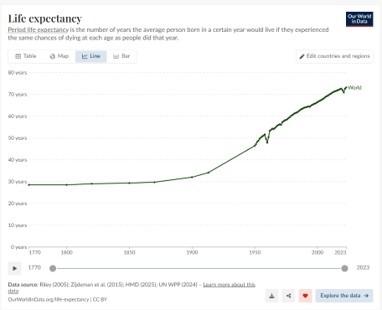
Source: OurWorldInData.org
Energy technologies are becoming more efficient. The price of lithium-ion batteries has fallen at least 97% since 1990. And cost declines aren’t just continuing; they’re accelerating. This will allow alternative energy forms, such as wind, solar, and geothermal to be stored and used as needed. This will ultimately help make energy cheaper and more abundant and help lift more people out of poverty in the coming decades.
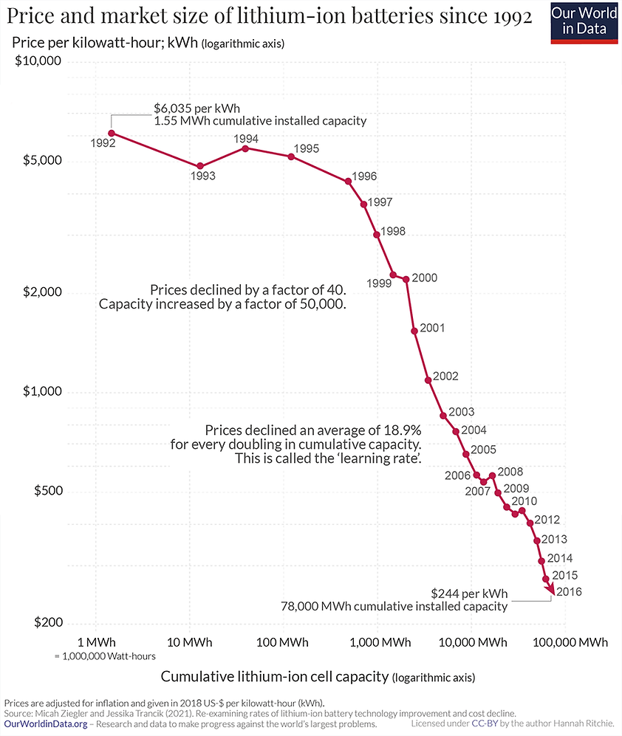
Source: OurWorldInData.org
Most people focus on what is getting more expensive, while overlooking what is becoming dramatically better, faster, and more accessible. Don't forget, the smartphone in your pocket contains more technology than was in NASA Headquarters during the Apollo missions. Information that once required a trip to a library can now be accessed in seconds.
Organizations like The Rational Optimist Society and publications such as Metatrends remind us of something the headlines often miss: there are extraordinary things happening in the world every day. You will feel better if you know about them!
There are amazing things going on in the world... you just aren't being fed this information by the algorithms.
And don't forget, these tools and technologies will only get faster, cheaper, and better over time!
Eventually you may come to believe, as I do, that optimism is the only realism!!
The future isn't standing still. It's accelerating. But optimism alone is not a financial plan.
One challenge unique to Gen Z is that previous generations compared themselves to their neighbors. Today's young adults compare themselves to the entire internet. A twenty-five-year-old making smart financial decisions can feel like a failure after spending ten minutes scrolling through videos of influencers, entrepreneurs, and traders claiming overnight success.
Most of it isn't real, but the anxiety it creates certainly is. Comparison has always been the thief of joy. Social media simply gave it better technology.
That's where the boring stuff comes in. And despite what social media might suggest, the boring stuff still works.
Spend less than you earn. Save consistently. Pay down high-interest debt. Build an emergency fund. Invest regularly. Own productive assets. Avoid emotional decisions. Give compounding time to do what it has always done.
None of these ideas are flashy. They won't generate millions of views online. They won't make you wealthy overnight. That's why none of those strategies are on the front of financial magazines. If they were, you would only have to buy the publication once... because the strategies and wisdom apply for life.
What they will do is help you build financial independence over time.
The irony is that while technology changes at breathtaking speed, the principles of successful money management have barely changed at all. The tools evolve. Human behavior doesn't.
Which brings me back to my grandson, and those lyrics from The Specials.
Someday he will hear people tell him why the future is hopeless. He will encounter headlines predicting economic collapse, technological disruption, and societal decline. Every generation does.
My hope is that he learns to separate noise from reality. I will do everything in my power to help him see the world through a lens that is grounded in reality, informed by history, and open to optimism!
The story of humanity is not a story of perfection. It is a story of progress. Messy, frustrating, uneven progress—but progress nonetheless.
Someday Sonny James will inherit technologies that don't yet exist, opportunities we can't yet imagine, and challenges we haven't yet discovered.
That's true for every generation.
My hope is that he approaches that future with curiosity and wonder rather than fear, optimism rather than cynicism, and confidence rather than despair.
So, this is my "Message to You, Gen Z", to my children, to my clients’ children, and to my grandson.
"Stop your messing around. Better think of your future."
Not because the future is doomed, but because it is worth preparing for, worth building, worth believing in, and worth being excited about!
And despite what the algorithms may be telling you, I still believe the best days are ahead as we continue "Moving Life Forward."
© 2026 Jesse Hurst
Senior Wealth Manager
The views stated are not necessarily the opinion of Cetera and should not be construed directly or indirectly as an offer to buy or sell any securities mentioned herein. Due to volatility within the markets mentioned, opinions are subject to change without notice. Information is based on sources believed to be reliable; however, their accuracy or completeness cannot be guaranteed. Past performance does not guarantee future results.
Investors cannot directly invest in indices.
Featured Blog Image Source: iStock.com/TarikVision