


"Don't put all your eggs in one basket" is a financial adage that means you should diversify your investments across a variety of assets to mitigate risk. The core idea is to avoid putting all your capital into a single investment, asset class, or security type. If you invest all your money in just one company's stock, for example, and that company goes bankrupt, you could lose everything. By spreading your investments across different areas, the potential loss in one area is offset by gains or stability in another.

Source: Facebook
It has historically been considered excellent advice and a cornerstone of sound financial planning. Most financial advisors and academics agree on its importance for long-term wealth building and security. A well-diversified portfolio provides the following three primary benefits.
Risk Reduction: Diversification is a primary strategy for managing and reducing risk without necessarily sacrificing potential returns. It helps protect your portfolio from the extreme volatility of a single investment.
Smoother Returns: A diversified portfolio tends to experience less severe downturns than a concentrated one, helping investors stay calm and avoid emotional, costly decisions during market fluctuations.
Long-Term Stability: Over time, a balanced mix of assets helps ensure that even if one segment of the market is underperforming, others can help the overall portfolio grow.
While diversification doesn't guarantee a profit or protect against all losses in a widespread market crash, it remains one of the most effective and universally accepted methods for long-term risk management in investing.
Modern Portfolio Theory (MPT), introduced by Nobel laureate Harry Markowitz in the 1950s, posits that diversification is a critical tool for reducing a portfolio's overall risk without necessarily sacrificing expected returns. This concept has historically improved a portfolio's risk-adjusted returns.
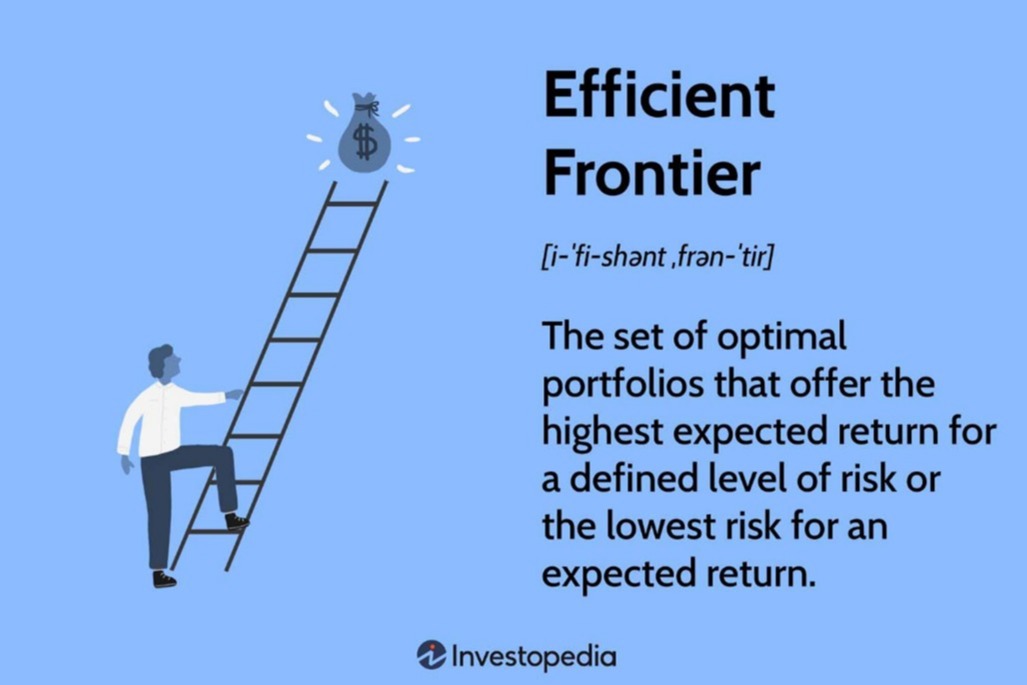
MPT mathematically demonstrates that combining assets with low or negative correlations helps mitigate unsystematic risk (also known as specific, unique, or idiosyncratic risk), which is specific to individual companies or sectors. This type of risk can be partially eliminated through proper diversification. MPT provides a framework for constructing "optimal" portfolios, known as the efficient frontier, which offer the highest possible expected return for a given level of risk, or the lowest possible risk for a desired return.
So, how has this worked out for investors in recent years? Great question, let's begin by looking at the chart below, which shows the annual return of a 60% U.S. stock, 40% US bond portfolio since 1978.
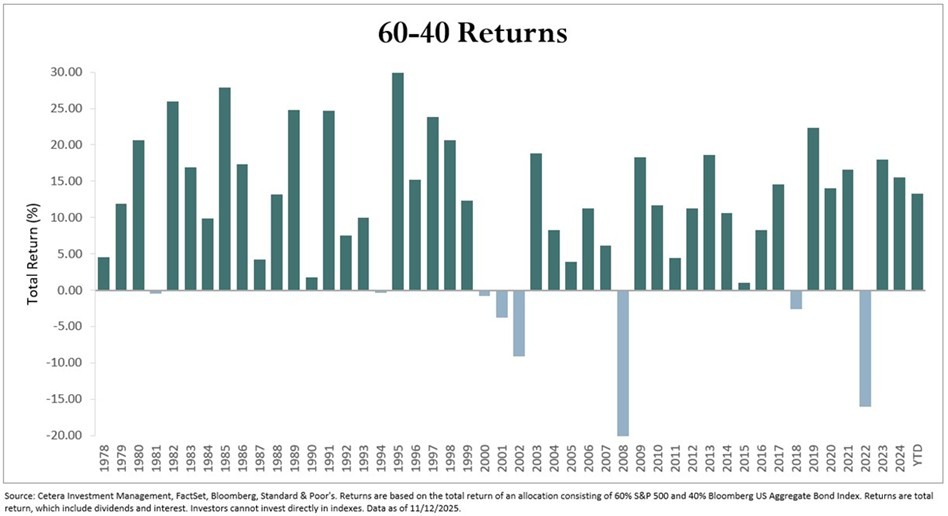
As you can see, since 1978, declines of more than 5% have occurred just 3 times. This means that this strategy doesn't always produce the desired results. Years of extreme market volatility, such as the 2008 Global Financial Crisis and 2022, when Russia invaded Ukraine, and the Fed began raising interest rates aggressively to combat rising and persistent inflation, left investors with double-digit losses. Such circumstances are rare, but it is essential to remember that they can occur.
Those years with losses were also accompanied by annual gains of more than 10%, which have occurred 28 times since 1978. You will also notice that the balanced 60/40 stock/bond allocation has delivered double-digit gains for three straight years, rebounding from a 16% drop in 2022.
Behavioral finance tells us that the human brain is a "prediction machine" that naturally observes current financial conditions and extrapolates them into the future. The last three years of double-digit returns have led people to believe this should guide their future expectations. This is not the case. From a historical standpoint, a 60/40 portfolio should average approximately 6%-8% per year, not the outsized, double-digit returns of the recent past.
In essence, MPT moves beyond simply picking good investment assets to focusing on how different assets interact within a portfolio, making diversification a cornerstone of sound investment strategy. It is not a cure-all that prevents market volatility from affecting your portfolio, but it does have a strong track record of good results. Sometimes a dose of patience is required to obtain those results. I thought this was a good reminder for all of us as we continue “Moving Life Forward.”
© 2026 Jesse Hurst
Senior Wealth Manager
The views stated are not necessarily the opinion of Cetera and should not be construed directly or indirectly as an offer to buy or sell any securities mentioned herein. Due to volatility within the markets mentioned, opinions are subject to change without notice. Information is based on sources believed to be reliable; however, their accuracy or completeness cannot be guaranteed. Past performance does not guarantee future results.
Neither Cetera Advisors LLC nor any of its representatives may give legal or tax advice. This information is not intended as tax or legal advice. Please consult legal or tax professionals for specific information regarding your individual situation.
Investors cannot directly invest in indices.
Featured Blog Image Source: iStock.com/zhuweiyi49