


"Field of Dreams" is a 1989 American fantasy drama film that has since evolved into a real-world cultural landmark and a venue for professional baseball. Written and directed by Phil Alden Robinson, the movie is based on W.P. Kinsella's 1982 novel Shoeless Joe. It stars Kevin Costner as Ray Kinsella, an Iowa farmer who hears a mysterious voice whispering, "If you build it, he will come.” Interpreting this as a command, he builds a baseball diamond in his cornfield, which attracts the ghosts of legendary players, including "Shoeless" Joe Jackson.

Source: Amazon.com
This is one of my favorite movies. Rachel knows that if we find it on TV, I will make her watch for at least a few minutes. There are many great scenes and memorable lines throughout. If you are not familiar with the scene referenced above, I have included a YouTube link below so you can see it.
If You Build It, He Will Come - Field of Dreams CLIP (1989) HD
"If you build it, he will come."
That line from Field of Dreams has a way of lingering. It sounds simple, almost folksy. But it isn’t really about baseball. It’s about faith—faith that if you create something real in the physical world, people, capital, and opportunity will follow. For a long time, that idea felt deeply American. Today, though, it’s worth asking a more complicated question: what happens when you can’t build it?
Not because there’s no demand. Not because there’s no money. But because the rules make it so complex, so expensive, and so slow, building becomes the exception rather than the norm. When that happens, they don’t come. Not the families. Not the workers. Not the next generation chasing the American Dream. And that’s the real danger of overregulation…nowhere more visible, or more damaging, than in housing.
Our elected officials, lending institutions, economists, and homebuilders spend an extraordinary amount of time arguing about housing. We debate demand, interest rates, investors, and who’s to blame. But the core problem is simpler, and more uncomfortable: we don’t build enough homes. Not where the jobs are. Not where people want to live. Not where young families are trying to start their lives.
In many of our most productive cities, housing has become a museum exhibit. Frozen in place by zoning rules, endless approvals, overlapping reviews, and the modern cousin of NIMBY (not in my backyard)ism: BANANA—Build Absolutely Nothing Anywhere Near Anything. We didn’t run out of land. We ran out of permission. Most of these rules began with good intentions. They were designed to preserve neighborhood character, protect the environment, and ensure safety and quality, all reasonable goals. The problem is what happened next. Over time, layers piled on top of layers. What began as sensible guardrails slowly turned into roadblocks.
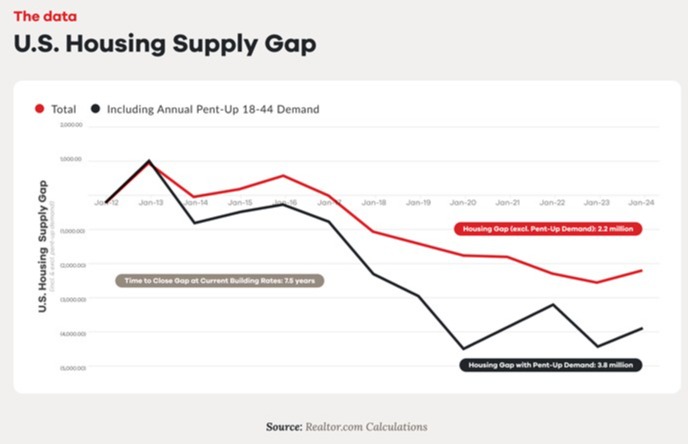
Zoning regulations and other housing restrictions have limited the degree to which new construction can relieve pressure on housing supply in many areas, exacerbating the issue. All told, the housing supply gap reached nearly 4 million homes in 2024, as shown in the chart below. Young households have been hit the hardest by the housing shortage as purchasing a house on a typical early- to mid-career salary has become increasingly unaffordable.
Environmental reviews now stretch on for years, even for projects in places that already have roads, utilities, and transit. Zoning rules in many cities effectively outlaw building housing near jobs. Public comment processes, meant to give communities a voice, often empower a small, motivated minority to stop projects altogether. The outcome is entirely predictable. Projects take a decade to approve. Costs explode long before a shovel ever hits the ground. Smaller builders walk away. And when it costs more to get permission than to pour concrete, affordability never had a chance.
Housing doesn’t just shelter people. It anchors labor markets. When housing is scarce, workers can’t move to opportunity, employers struggle to hire, and cities slowly become exclusive instead of aspirational. We talk about inequality as if it’s abstract, but in housing it’s painfully concrete. If you restrict housing supply in the places with the best jobs, you limit upward mobility. Teachers, nurses, and young families aren’t being priced out because they failed. They’re being priced out because we made it illegal—or functionally impossible—to build enough homes.
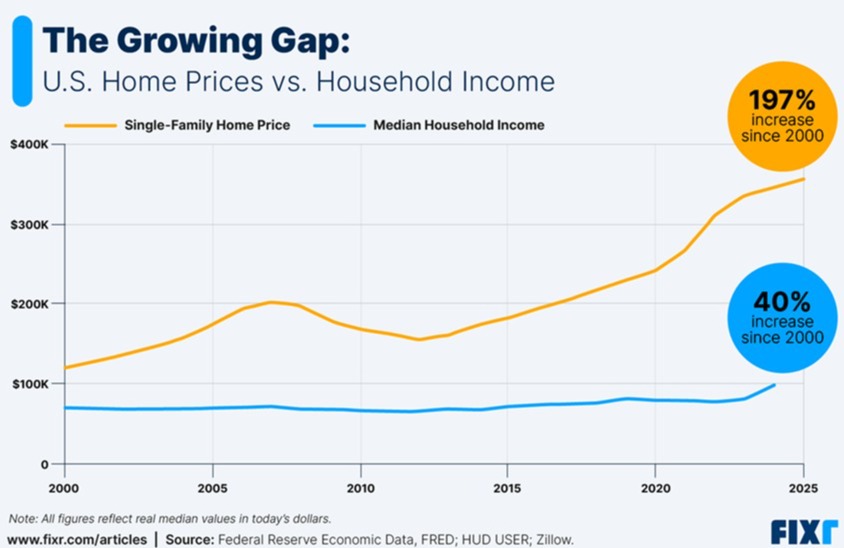
Homeownership has declined dramatically over the past 25 years. While housing prices have increased by 197% (much of this driven by rising regulatory costs), while median household income has increased by only 40%. That gap means down payments are harder to save for and monthly payments are harder to make, especially with rising insurance costs and the bump in the general cost of living. Buying a home now is significantly more difficult than it was 25 years ago, as you can see in our next chart.
Some places are getting this right, and Austin is one of them. If you go there, you can feel the difference. Construction cranes aren’t treated like an invasion. New apartments aren’t automatically framed as a threat to the soul of the city. Growth is accepted as a byproduct of success.
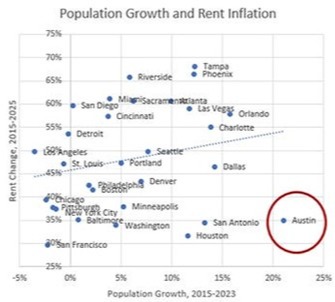
Austin is a city that says yes—yes to density, yes to building, and yes to the idea that affordability comes from abundance. It has made it easier to add housing where people actually want to live, close to jobs and opportunities. That willingness to say yes shows up in the numbers. Supply responds faster. Prices, while not cheap, haven’t detached from reality the way they have in cities that made it nearly impossible to build, as shown in our last chart below.
Source: Rational Optimist
Austin isn’t perfect, but it demonstrates a fundamental principle that too many policymakers avoid: if you want affordable housing, you have to build housing. Not someday. Not after another study. Now. This isn’t ideology. It’s math.
In Field of Dreams, the real risk wasn’t building the baseball field. The risk was not building it, and watching the farm slowly fail anyway. America faces a similar choice.
We can keep telling ourselves that preservation equals progress. That saying “no” protects something sacred. Or we can recognize that refusing to build doesn’t preserve the American Dream—it prices it out.
Housing isn’t speculative tech. It’s infrastructure. And infrastructure only works if you let people build it. This isn’t a call for chaos. Standards matter—safety matters. The environment matters. But process matters too. When regulation becomes so complex that only the largest, most capitalized players can navigate it, the system stops protecting the public and starts entrenching scarcity. Good intentions don’t excuse bad outcomes.
Housing may sound like a political issue, but it’s also an economic one. Markets that make it difficult to build don’t just create higher home prices. They create labor shortages, slower growth, and cost pressures that spill into wages, inflation, and corporate margins. Over time, capital flows from scarcity to flexibility. Cities and regions that can add housing attract workers, businesses, and long-term investment.

Source: YouTube.com
Smart reform isn’t about eliminating rules. It’s about making them work. Faster and more predictable permitting. Zoning that reflects how people actually live today. By-right building where infrastructure already exists. Clear timelines instead of endless discretion. Because if you can’t build it, they can’t come. Not the teachers. Not the nurses. Not the young families. Not the entrepreneurs. And eventually, not the growth.
The lesson of Field of Dreams wasn’t magic. It was courage. America still has plenty of it. We just need to clear the infield. Thanks for letting me share some thoughts on this complex topic as we continue “Moving Life Forward.”
© 2026 Jesse Hurst
Senior Wealth Manager
Related Content
The views stated are not necessarily the opinion of Cetera and should not be construed directly or indirectly as an offer to buy or sell any securities mentioned herein. Due to volatility within the markets mentioned, opinions are subject to change without notice. Information is based on sources believed to be reliable; however, their accuracy or completeness cannot be guaranteed. Past performance does not guarantee future results.
Neither Cetera Advisors LLC nor any of its representatives may give legal or tax advice. This information is not intended as tax or legal advice. Please consult legal or tax professionals for specific information regarding your individual situation.
Investors cannot directly invest in indices.
The performance of any index is not indicative of the performance of any investment and does not take into account the effects of inflation and the fees and expenses associated with investing.
Featured Blog Image Source: iStock.com/Feverpitched