



Source: Amazon.com
Each Christmas, my Mom pulled out a stack of classic albums from artists such as Johnny Mathis, Nat King Cole, Mitch Miller, and, of course, Andy Williams. As soon as you heard the first notes of "It's the Most Wonderful Time of the Year,” you knew the holiday season was upon us. The song was written in 1963 by Edward Pola and George Wyle and was recorded and released that year by pop singer Andy Williams for his first Christmas album, The Andy Williams Christmas Album. The song is a celebration of activities associated with the Christmas season, focusing primarily on get-togethers between friends and families. For those of you who have not heard the song enough during the Christmas season, a YouTube link to the song is included below.
Andy Williams - It's the Most Wonderful Time of the Year (Official Audio)
Source: Amazon.com
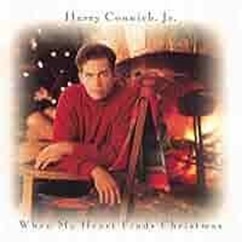
As adults, Rachel and I have a similar affinity for Christmas music. I have dozens of Christmas albums and CDs. However, we mostly listen to them through streaming services such as Pandora or Apple Music. Although I always loved the classic music I grew up with, my taste for Christmas music has evolved to include many different genres and artists, including Elvis, Vince Guaraldi, Brian Setzer, and Harry Connick Jr. As a matter of fact, Sleigh Ride, from Harry Connick Junior's first Christmas album, When My Heart Finds Christmas, has replaced the Andy Williams classic in our house as the song that signals the beginning of the Christmas season. Below is a link to a live version of Harry's performance on his TV show in 2016 with his big band.
From a historical perspective, this also happens to be a wonderful time of the year for the stock market. There are many reasons for this, and today, we will explore three of them. Let's begin by looking at the stock market's historical returns over the last 50 years, from the day of the election to the day of the President's inauguration. This has been a historic year for global elections—with more than half of the world's population voting—new governments were formed in Taiwan, South Korea, the Netherlands, India, the European Union, the United Kingdom, France, Japan and the United States.
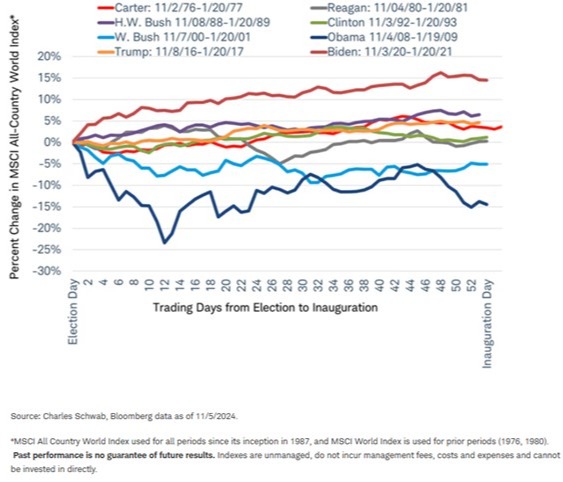
Despite changing parties and policies multiple times throughout various election cycles, the only two negative presidential transition periods for global stocks in the past 50 years were during the recessionary bear markets of 2000-2001, which coincided with the dot.com, 9/11 episodes, and 2008-2009 during the Great Financial Crisis. As a reminder, economics usually has more of an impact on elections than the other way around.
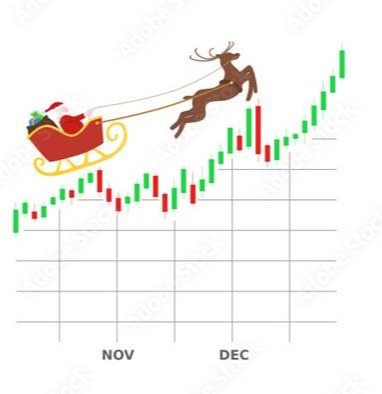
The second seasonality factor we will examine is known as the Santa Claus Rally. According to the Corporate Finance Institute, the Santa Claus Rally describes the tendency for stock markets to rise in the last trading week of December and the first two trading days of the new year. It was first defined in the 1972 Stock Trader's Almanac. The Santa Claus rally can also be used as an early indicator of what may happen in the new year.
Source: Investopedia
Historically, the S&P 500 has shown average gains of about 1.3% during this seven-day period, which is notably higher than the average weekly performance throughout the year. Over 70% of the time, the markets have posted positive returns during this period.
Finally, the stock market is also entering a historically strong period of performance. You may find it strange that the stock market, as measured by the S&P 500 index, has experienced notably stronger performance from November 1st to April 30th, both since 1926 and over the last 40 years. Since this time starts with Thanksgiving month and ends with the month we file our tax returns, this is sometimes known as “Turkey to Tax.”
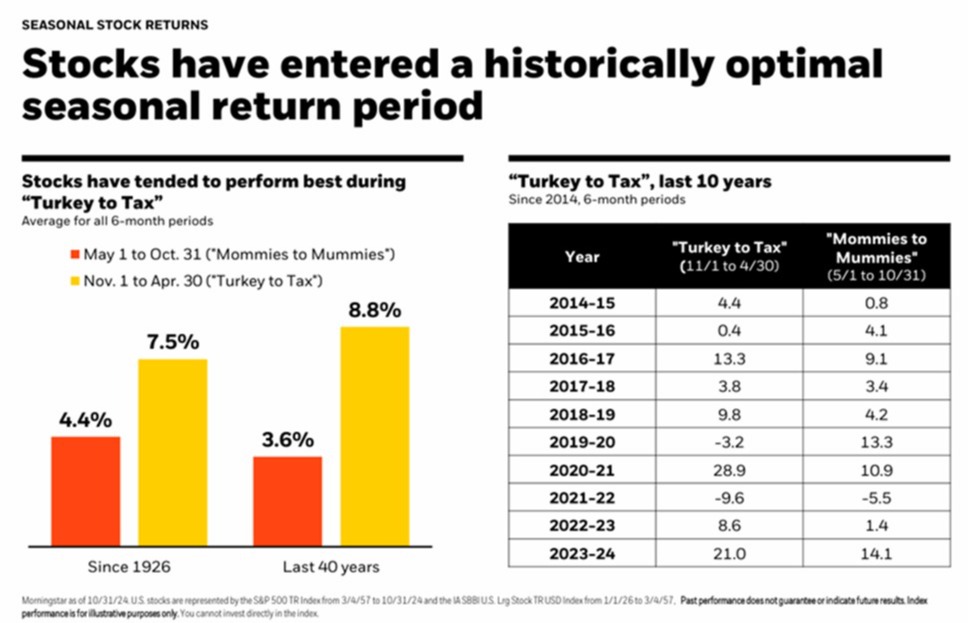
The period from May, Mother's Day, to Halloween at the end of October has still seen positive performance on average, just not nearly as strong as the other six months of the year. The lower average performance, along with historically negative events that occurred during this time frame, such as the stock market crash of 1987 and the failure of AIG/Lehman Brothers, gave rise to the phrase “sell in May and go away.”
While some stock market traders feel they can avoid the markets' lower returns and higher volatility six months of the year and still get reasonable returns, it is important to remember that these seasonality factors are not guaranteed and do not work every year. 2024 is an excellent example of why you shouldn't blindly follow every Wall Street axiom. As you can see below, the S&P 500 index rose from 5018 on May 1st to 5705 on October 31st, a gain of 687 points, or more than 12%.
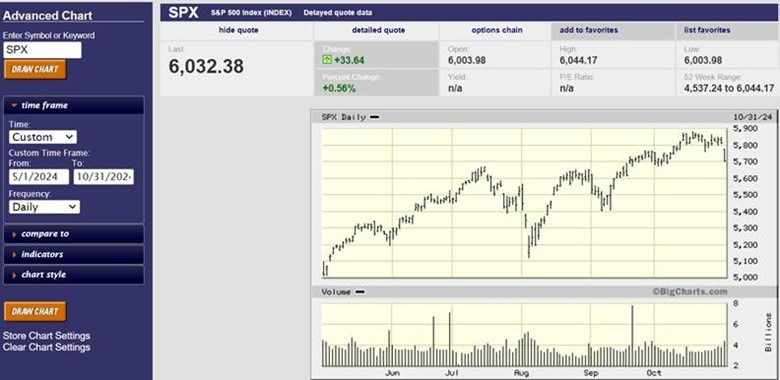
Source: BigCharts.com
During this time of year, you may hear economic and stock market prognosticators touting these trading patterns and signals on financial news networks or online. While I find the stock market's historical patterns and returns interesting, they are not reliable enough to be trusted as short-term trading signals.
As we head toward Christmas and New Year's Day in the next Presidential inauguration, I wanted to share this information with you to provide a backdrop and context. I hope that you get to enjoy the most wonderful time of the year with your family and loved ones as we continue “Moving Life Forward.”
© 2024 Jesse Hurst
Senior Wealth Manager
The views stated are not necessarily the opinion of Cetera and should not be construed directly or indirectly as an offer to buy or sell any securities mentioned herein. Due to volatility within the markets mentioned, opinions are subject to change without notice. Information is based on sources believed to be reliable; however, their accuracy or completeness cannot be guaranteed. Past performance does not guarantee future results.
Neither Cetera Advisors LLC nor any of its representatives may give legal or tax advice. This information is not intended as tax or legal advice. Please consult legal or tax professionals for specific information regarding your individual situation.
Investors cannot directly invest in indices.
Featured Blog Image Source: iStock.com/Regina Tolgyesi