


Since his passing on December 29, 2024, much has been written about Jimmy Carter. He was an American politician and philanthropist who served as the 39th president of the United States from 1977 to 1981. A member of the Democratic Party, Carter served as the 76th governor of Georgia from 1971 to 1975 and in the Georgia State Senate from 1963 to 1967.
After his presidency ended in 1981, he was universally admired and respected for his diplomatic and charitable work. However, his administration’s economic and financial track record has been historically remembered less kindly. While it is true that his presidency coincided with a period of high inflation and energy prices, which led to the infamous message of “wear a sweater and turn down your thermostat,” I would like to share a different view on his economic policies from an unexpected source.
Brian Wesbury, First Trust's Chief Economist, is a well-known and well-respected economist with an unabashedly conservative/libertarian worldview. Brian is also an economic and investment historian who shares his surprisingly positive historical view of President Carter below. Jimmy Carter inherited a slew of economic problems and issues and dealt with them in a moderate and centrist way. I thought this was worth sharing with you.
I am including a chart of the stock market's historical returns under various presidential administrations below to further support this thought process. As you can see, the stock market fared reasonably well during his four years in office.
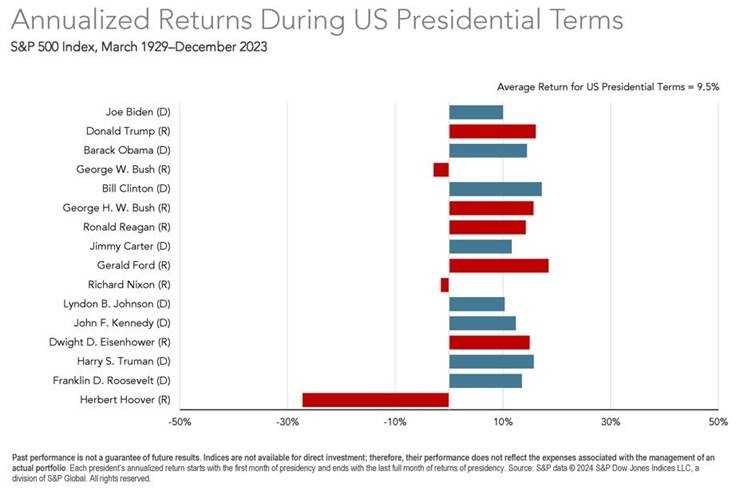
Over the coming days, much will be written and said about President Carter’s character, humanitarian work, legacy as a loving husband, and dedication to helping others. I thought that some perspective on his economic and financial policies was worth sharing as well as we continue “Moving Life Forward.”
The following report was prepared by First Trust Advisors L.P. , a non-affiliate of Cetera Advisors LLC for informational purposes only.
Jimmy Carter, RIP
Jimmy Carter, the thirty-ninth president of the United States passed away this weekend, at age 100, the first former president to ever reach that milestone.
The Election of 1976, when Carter won, seems like it happened in a different country. The Democrats swept all the states of the Confederacy with the exception of Virginia. The Republican candidate, Gerald Ford, won a large group of states that included Illinois, Vermont, Connecticut, New Jersey, California, Oregon, and Washington. (Look it up if you don’t believe it!)
Although many political and economic conservatives still associate the Carter presidency with economic mismanagement, high inflation, and recession, his Administration’s policy choices and experience were not unique to his Administration.
Yes, inflation hit double-digits under Carter, but it did so in the Nixon Administration, as well. Yes, Carter tried to fight inflation by imposing credit controls on the banking system, but the Nixon Administration imposed economy-wide wage and price controls to try to address inflation.
Yes, Carter’s first choice to lead the Federal Reserve was G. William Miller, a lawyer with no particular insight into monetary policy or fighting inflation. But, when the going got rough, he replaced Miller with Paul Volker, who brought inflation back under control and was later re-appointed by President Reagan. Nixon’s Fed chief was Arthur Burns, who supported tight money when he was an academic but then bent over backwards to appease Nixon’s desire for loose money when running the Fed.
In the meantime, Carter was willing to take on many special-interest economic sacred cows and deregulate major parts of the US economy. Believe it or not, before Carter, bureaucrats in Washington, DC at the Civil Aeronautics Board (CAB) would set the ticket price for every seat on every airline that flew. They controlled which airlines flew which routes and only allowed airlines to use amenities, like food or seat-types, to compete. That’s why back then flying was expensive and unusual for the broad middle-class and below.
Carter appointed Alfred Kahn, who despised regulation, as his inflation czar. While most don’t remember, Kahn was a lightning rod, much like Elon Musk is today. He was outspoken and got in trouble for talking about “recession,” so he started to call it a “banana.” The banana industry got upset, so he then called it a “kumquat.” And all this happened before Twitter or X, or any modern social media existed.
Kahn tried to resign, but Carter wouldn’t let him, and appointed him to head the CAB. He is the only agency head in the history of Washington, DC to take over an agency and then dismantle it. The Civil Aeronautics Board is gone, and airline deregulation happened because of Kahn and President Carter.
The Carter Administration also led on deregulating trucking. We understand this is going to sound completely ridiculous, maybe even made-up, but before Carter a truck that left one state with a load and delivered it elsewhere was required to go back empty to the original state before it could make another round trip. (Seriously, we are not making this up!)
In addition, the Carter Administration led the fight to deregulate government rate-setting for trains and remove restrictions on long distance phone service. Older readers will remember their parents telling them to hurry up when talking to friends or relatives long-distance because it cost so much more!
The Carter-era, in general, happened before tribal politics made it impossible for the left to trust free markets. In addition to deregulating so many sectors, Carter supported a cut in the capital gains tax rate, in effect reducing the top tax rate on long-term gains to 28% from a prior 35%. Yes, Reagan then cut it to 20% for several years, but Carter cut it first.
Today the greatest economic challenges are different than in the late 1970s, but in remembrance of President Carter, we suggest politicians in DC think back to that era. Learning from history is important. Deregulating industries helped the American people with lower prices and more choices. Today, the US economy is like Gulliver tied up by a thousand strands of thread by the Lilliputians. Carter was the one who started to cut those threads.
Let’s do it again.
This report was prepared by First Trust Advisors L. P. and reflects the current opinion of the authors. It is based upon sources and data believed to be accurate and reliable. Opinions and forward looking statements expressed are subject to change without notice. This information does not constitute a solicitation or an offer to buy or sell any security.
© 2025 Jesse Hurst
Senior Wealth Manager
Related Content
- Celebrating Jesse Hurst’s 2025 Forbes Best-in-State Wealth Advisor Recognition
- Is Abundance Rational?
The views stated are not necessarily the opinion of Cetera and should not be construed directly or indirectly as an offer to buy or sell any securities mentioned herein. Due to volatility within the markets mentioned, opinions are subject to change without notice. Information is based on sources believed to be reliable; however, their accuracy or completeness cannot be guaranteed. Past performance does not guarantee future results.
Neither Cetera Advisors LLC nor any of its representatives may give legal or tax advice. This information is not intended as tax or legal advice. Please consult legal or tax professionals for specific information regarding your individual situation.
Investors cannot directly invest in indices.
Featured Blog Image Source: iStock.com/RoschetzkyIstockPhoto