


Weekend Update is a Saturday Night Live comedy program that comments on and parodies current news and events. It is the show's longest-running recurring sketch, having been on since the show's first broadcast. Chevy Chase originally anchored the comedy news broadcast, which has subsequently been anchored by such well-known comedians as Jane Curtin, Dan Ackroyd, Dennis Miller, Kevin Nealon, Norm MacDonald, Tina Fey, Jimmy Fallon, and Amy Poehler.

Source: YouTube.com
Many Weekend Update episodes began and ended with Chevy Chase announcing, “Our top story tonight”. This was usually some comical take on the current event. In the YouTube link below, Chevy is assisted by Garrett Morris, the Headmaster of the New York School for the Hard of Hearing, who shouts the headlines at the audience. (Sorry for the Spanish subtitles; it was the best video I could find.)
El Generalisimo Francisco Franco Still Dead SNL
This is a very early and old-school example of Saturday Night Live comedy. On a much less funny note, it seems like somebody needs to shout some fundamental truths to our elected officials on Capitol Hill about government spending and deficits. A December 11th headline from CNBC stated the following:
Budget deficit swells in November, pushing fiscal 2025 shortfall 64% higher than a year ago
No, that is not a misprint or a joke. Below is a direct quote from the article:
“The U.S. budget deficit swelled in November, putting fiscal 2025 already at a much faster pace than a year ago when the shortfall topped $1.8 trillion, the Treasury Department reported Wednesday.
For the month, the deficit totaled $366.8 billion, 17% higher than November 2023 and taking the total for the first two months of the fiscal year more than 64% higher than the same period a year ago on an unadjusted basis.
The increase came despite receipts that totaled $301.8 billion, about $27 billion more than last November. Outlays totaled $668.5 billion, or nearly $80 billion more from a year ago.
The increase in red ink brought the national debt to $36.1 trillion as the month drew to a close.”
The article tells us that the federal government does not have a revenue problem. According to the quote above, receipts were $27 billion higher in November 2024 than the previous November. All businesses, including Impel Wealth Management, must follow budgets and produce profit and loss statements, often called P&Ls. There is nothing magical about this. For an entity to be sustainable in the long term, it must produce more revenue than expense. That is, unless you are the federal government, and your Treasury Department owns its printing press.
Balancing a budget, or creating as much revenue as there is expense, is not something any part of the federal government, Democrat or Republican, has taken seriously in more than twenty years. As you can see in our first chart below, the government's annual budget deficit, which was running at an already high level of just under $1 trillion per year, shot higher in the immediate aftermath of the COVID-19 epic. It fell back towards its pre-COVID trend line for one year before accelerating once again in the face of multiple government spending packages.
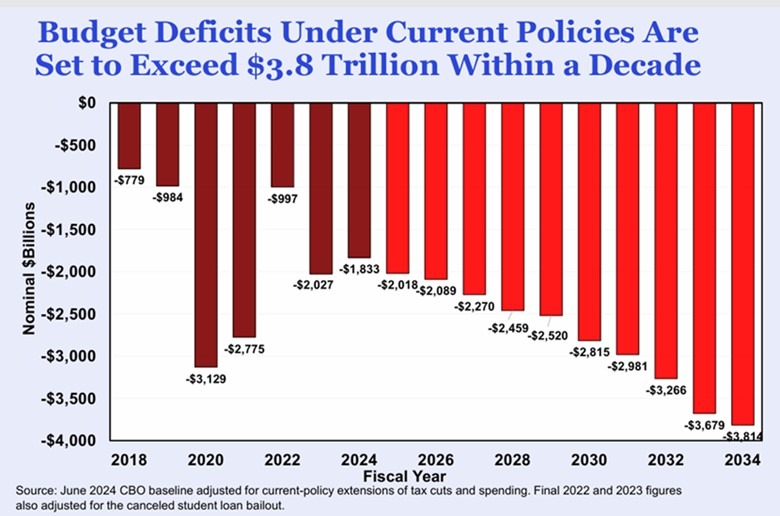
Source: Congressional Budget Office
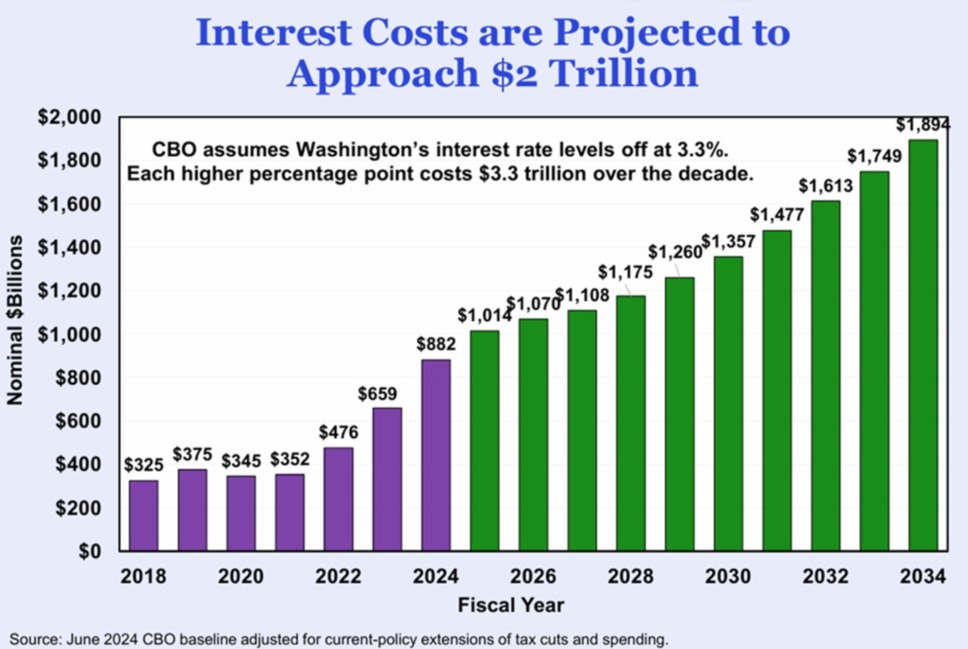
Controlling budget deficits will be much more complicated in the future as interest on the debt has moved significantly higher. The Federal Reserve Bank increased interest rates dramatically in 2022 and 2023 to fight persistent and rising inflation pressures. The Congressional Budget Office expects the Treasury Department to pay more than $1 trillion in interest expense on the federal debt this year, as shown in our second chart below. You will also note that the amount of interest paid by the federal government this year is nearly triple that of just a few years ago when interest rates were much lower. Remember that we get no goods or services from our government for the interest they are paying.
As the federal government spends more money on interest payments, entitlement programs such as Social Security, Medicare, and Medicaid, and national defense, budget deficits are likely to continue increasing to levels that we have only seen during times of economic crisis or wars, as you will see in our final chart below. All this mandatory spending also means there is minimal financial margin for our elected officials to try reducing spending on other programs.
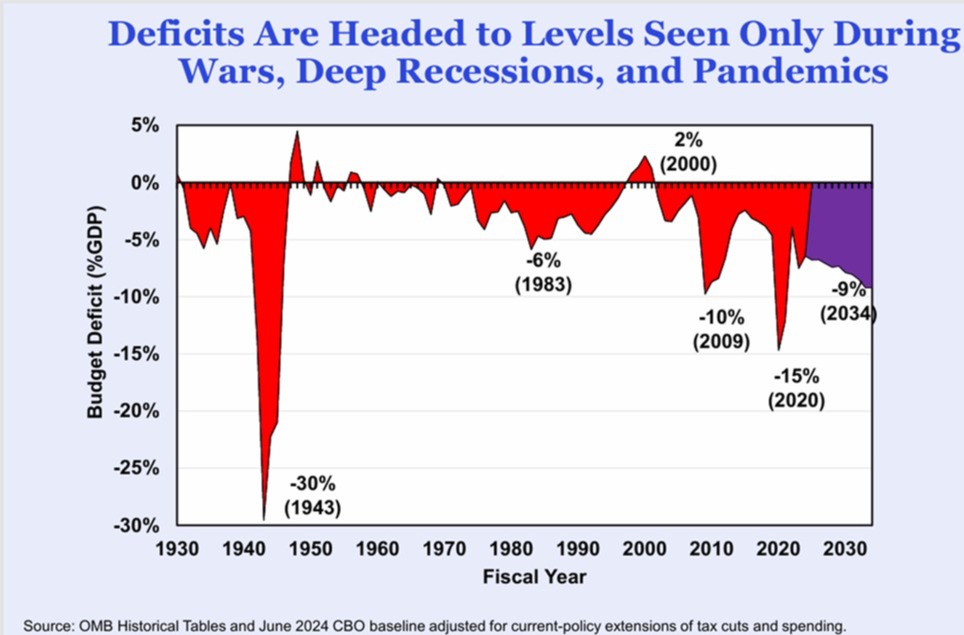
The government has spent the last several years creating budget deficits while economic growth ran at above-trend rates and unemployment was near 4%. Historically, the government only spent money at this rate to shore up the economy during times of crisis. Using all our financial ammunition during times of economic growth leaves little remaining for the next time we go through a severe or significant economic downturn or geopolitical event.
The incoming administration is creating a Department of Government Efficiency, or DOGE. Whatever you think of the people and personalities running this effort, they have promised to keep the voting public informed of their efforts to reduce government waste and unnecessary spending, of which anecdotal evidence suggests there is plenty of room for cuts. I think it is incumbent upon all of us to do our best Garrett Morris impression and shout to our elected officials on Capitol Hill, “Our Top Story Tonight- There are STILL Just 100 Pennies in a Dollar!!”
I will share much more with you about government spending and efforts to reduce it in the coming months. In the meantime, I wanted to bring a little humor to a very sober and serious topic. We aim to keep you informed as we continue “Moving Life Forward.”
© 2025 Jesse Hurst
Senior Wealth Manager
Related Content
The views stated are not necessarily the opinion of Cetera and should not be construed directly or indirectly as an offer to buy or sell any securities mentioned herein. Due to volatility within the markets mentioned, opinions are subject to change without notice. Information is based on sources believed to be reliable; however, their accuracy or completeness cannot be guaranteed. Past performance does not guarantee future results.
Neither Cetera Advisors LLC nor any of its representatives may give legal or tax advice. This information is not intended as tax or legal advice. Please consult legal or tax professionals for specific information regarding your individual situation.
Investors cannot directly invest in indices.
Featured Blog Image Source: iStock.com/digitalrini