


When I was nine years old in 1974, the Saturday morning TV show Shazam! premiered on CBS. The show was about Billy Batson, a teenage boy who could transform himself into the superhero Captain Marvel by speaking the magic word "Shazam!” Anytime Billy saw someone in trouble, he would shout Shazam to be magically jolted into his alter ego, complete with a lightning bolt on the front of his superhero costume. He traveled the country in a 1973 Dodge Open Road motorhome with his guardian, "Mentor," looking for injustices to resolve. The show ran from 1974 to 1976 on CBS's Saturday morning lineup.

Source: YouTube
For those of you, like Rachel, who have absolutely no idea what TV show I am talking about, I have included a YouTube link to the show's opening credits below.
1970s SHAZAM TV Series Opening Segment
Just as Billy was transformed into a superhero in each episode, the job market has gone through its own series of JOLTS in the years following the COVID-19 coronavirus pandemic. Most people are familiar with the monthly unemployment report which the Bureau of Labor Statistics releases on the first Friday of each month. This report, eagerly anticipated by both economists and politicians, provides a number of crucial statistical measures of employment health. This includes the number of jobs created each month, wage growth, and the all important unemployment rate. These numbers often serve as the basis for policy justifications, predictions, or even blame games among those with opposing views.
What is not so widely known is that the Bureau of Labor Statistics releases a second report towards the end of the month that is equally important but seldom reported. This is known as the JOLTS Report or the Job Openings and Labor Turnover Survey. According to the BLS, the JOLTS report is a monthly survey of job openings, hiring, and job separations (quits, layoffs, discharges) released by the BLS. Unlike the unemployment rate, which measures the supply side of the labor market, JOLTS data helps gauge labor demand. Let's begin our exploration of this report by reviewing the chart below which tracks the number of job openings since 2000.
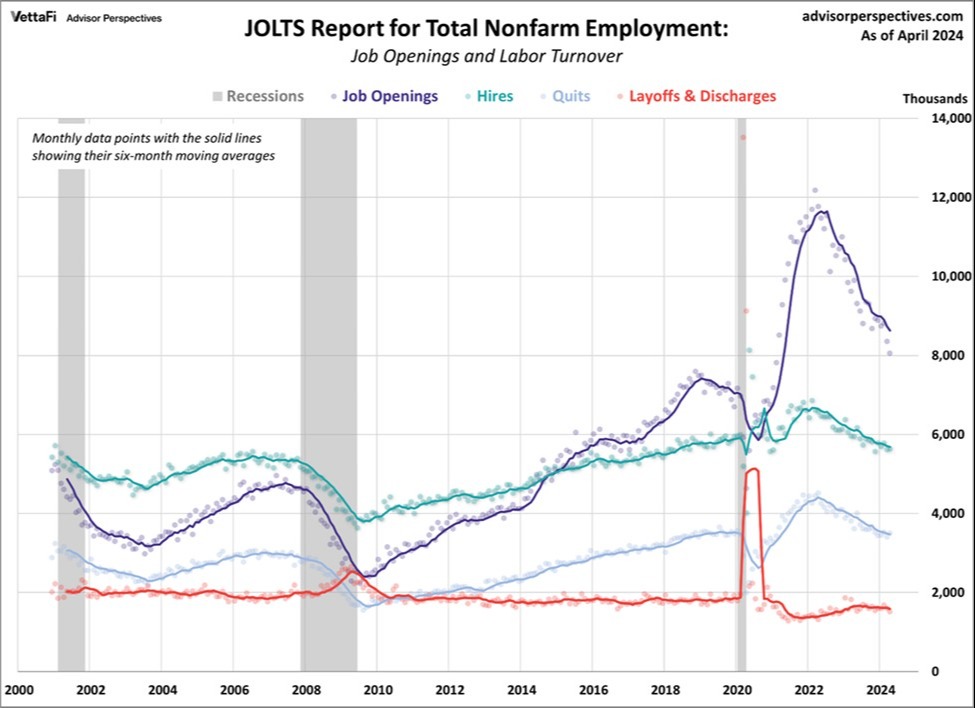
To understand the significance of the JOLTS report, let's take a historical perspective. If you follow the purple line in the graphic above, you will see that after dipping significantly during the Great Financial Crisis of 2008-2009, the number of job openings slowly recovered to its historical norm around 2014. The number then began to increase steadily until 2019. This trend, many economists believe, was driven by economic growth and fewer workers available as baby boomers started to turn age 65 and retire. This historical context sets the stage for our understanding of the JOLTS report and its implications for the job market.
As expected, it fell again when the economy was shut down due to the pandemic. The number was jolted higher as the economy reopened, but fewer workers were available to fill jobs for employers. This was partially explained by people passing away due to COVID-19 and more than 3 million people over age 60 retiring, and therefore no longer being part of the workforce. It was also driven in part by the significant and generous unemployment benefits that were given to people for an extended period of time during and after the pandemic. At its peak, this led to there being nearly two jobs available for every person looking for work, as you can see in our second chart below.
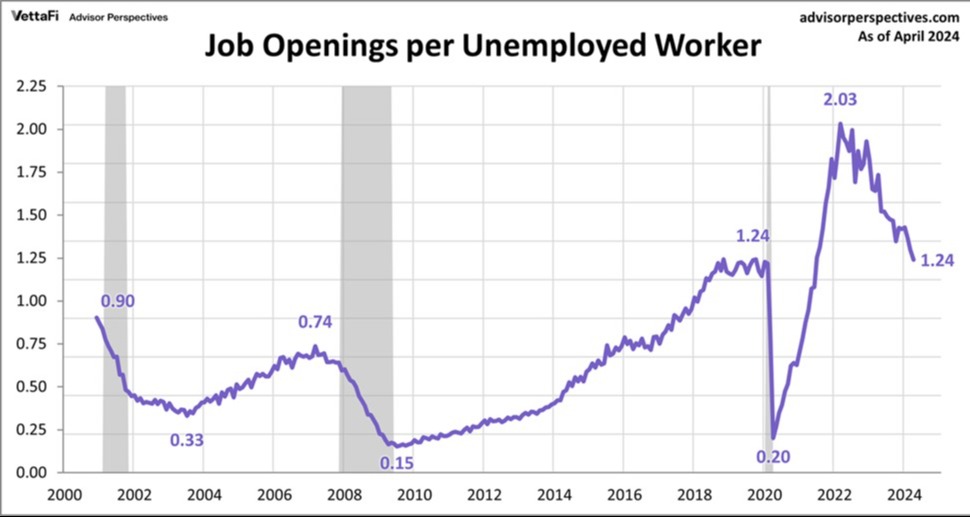
As you can see in the chart above, this trend began to dramatically reverse in early 2022. Several factors may have contributed to the downturn in job availability. One is inflation, which rose significantly and peaked in June 2022 at 9.1%. The second is an economic slowdown, accompanied by geopolitical uncertainty and wars in Eastern Europe and the Middle East. This has made employers a little more hesitant to hire aggressively like they were in the initial post-pandemic recovery.
The third factor is the availability of workers. Once enhanced unemployment benefits ran out, and younger workers ran through their pandemic stimulus checks and savings, they had to return to the workforce. We also know the significant number of migrants entering the country has filled some of the job openings, which has also taken job opportunities away from U.S. citizens. This has proven very difficult for economists to track. However, this factor has been referenced by numerous economists and even by Federal Reserve Chairman Jay Powell in his recent press conferences.
All of this has shrunk thenumber of jobs available back down to its pre-pandemic level of 1.24 jobs available per every person looking for work. This is a massive shift in a two-year period. However, since 2020, we have witnessed many economic numbers move in ways we had not seen previously. As I have shared these numbers with clients in meetings over the last couple of years, many have stated they had never heard of the JOLT's report before. Therefore, I thought that made these important data points to share with you.

Source: Wikipedia
Just as Billy Baston was jolted into a superhero by uttering a single word, our job market has been similarly JOLTED both up and down over the last several years. You are going to hear politicians on both sides of the aisle making statements and claims about the economy and the state of the job market in the months leading up to the election. We always want you to be armed with facts and data to evaluate what you hear from both politicians and economists. We feel it is important to be educated and informed as we continue “Moving Life Forward.”
© 2024 Jesse Hurst
Senior Wealth Manager and CEO
The views stated are not necessarily the opinion of Cetera and should not be construed directly or indirectly as an offer to buy or sell any securities mentioned herein. Due to volatility within the markets mentioned, opinions are subject to change without notice. Information is based on sources believed to be reliable; however, their accuracy or completeness cannot be guaranteed. Past performance does not guarantee future results.
Neither Cetera Advisors LLC nor any of its representatives may give legal or tax advice. This information is not intended as tax or legal advice. Please consult legal or tax professionals for specific information regarding your individual situation.
Investors cannot directly invest in indices.
Featured Blog Image Source: iStock.com/Tavrius