


In part one of this blog series, I shared that the book The Runway Decade, by my good friends and business partners Pete Bush and Bill Bush, provides an insider's look at simplifying the complex process of retirement planning. The book’s premise is that as you enter your 50s, you have approximately 10 years of runway left before you take off into your retirement journey.

Source: Amazon.com
In mid-May, the Trustees of the Social Security trust fund issued their annual report on its current and projected financial status. Based on the report, it appears that Social Security is also in the midst of its own “Runway Decade”. The current trustee's report once again shows that the trust fund will only be able to pay 100% of its total scheduled benefits until just 2033. At that time, the fund's previously accumulated surplus will be depleted, and the continuing FICA and self-employment taxes being paid into the system by current workers will only be sufficient to pay just 79% of the scheduled benefits.
This would lead to a more than 20% reduction in benefits for Social Security recipients. We know that this is not a palatable solution for those who have paid into this system for decades and are counting on it as a foundational resource to their retirement income plans. In Part 1 of this blog post series, I focused on how we ended up in this mess. In Part 2, I will explore the potential ways we can solve the problem and fill the Social Security funding gap.
A report released by the US General Accountability Office on July 31st stressed that acting sooner than later to solve the shortfalls will give Americans more time to plan for any changes that might affect their retirement income security. It would also allow changes to future Social Security recipients to be gradually phased in. The sooner our elected officials on Capitol Hill take action, the less stress it will cause for everybody. Each year that action is delayed will increase the impact of the future changes to the system.
The Great Financial Crisis of 2008, which culminated with the failures of AIG and Lehman Brothers and government bailouts, led to the worst recession since the Great Depression. As a result of the massive job loss that accompanied the recession, many people aged 62 to age 67 who were planning to continue to work for several more years decided to retire. This led to Social Security paying out more benefits sooner than expected. It also meant there were fewer workers paying FICA taxes into the system. This resulted in Social Security paying out more money than it brought in starting in 2010, nearly a decade before this was originally projected to occur.
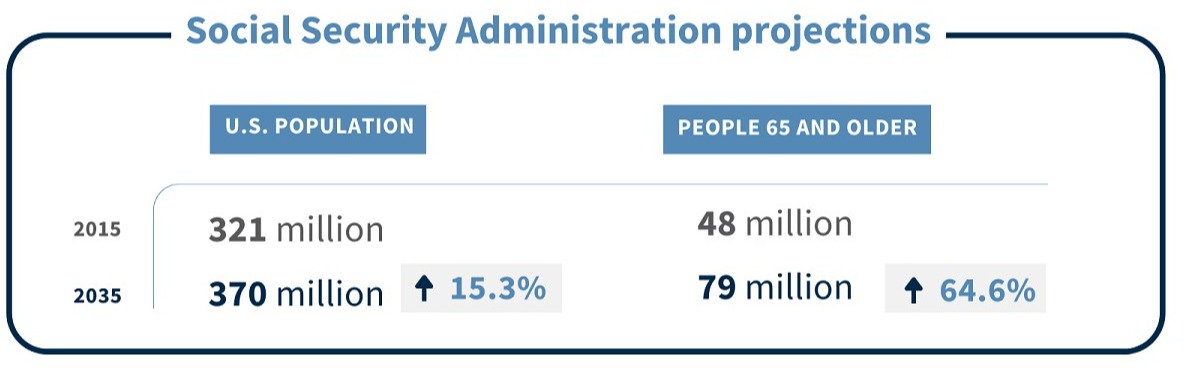
We are also dealing with the demographics of an aging population. As you can see in the chart below from the Social Security Administration, projections are that the US population will grow by approximately 15% over the 20 years ending 2035. However, the number of people over age 65 who are eligible for both Social Security and Medicare will grow by more than 64%. This means fewer people will be working and paying FICA taxes to support more and more people eligible for and collecting these benefits.
A number of levers can be pulled in some combination to help fix the Social Security system's future funding shortfall. These can be looked at as options to reduce program costs, or options to increase program revenues. These include the following:
- Reducing Social Security benefits or the income replacement percentage used to calculate benefits.
- Reducing benefits further for those who retire early and, therefore, receive potential benefits for a longer period of time.
- Increasing the age for full retirement benefits from age 67, for those born in 1960 or later, to age 69 or age 70.
- Increasing the early retirement age for Social Security benefits from age 62, to age 64 or age 65.
- Increasing the payroll tax for both employers and employees from 6.2% each to some higher amount.
- Raising or eliminating the cap on the amount of wages you pay FICA tax, which is currently $168,000 in 2024.
- Investing the current Social Security surplus, which is currently invested in lower-yielding treasury bonds, in a similar manner that most endowments and pension funds are allocated.
At the end of the day, implementing some combination of the options above would allow us to move toward the fully funded Social Security system that most retirees count on as a foundational part of their retirement income plan. The longer we wait to take action, the more difficult the decisions will be. You can see this clearly in the chart below, which shows how much FICA taxes alone would have to rise to solve the Social Security funding gap. Over the last 14 years, the tax increase, which would be split equally between the employee and employer, has gone from 1.92% in 2010 to 3.5% in 2024, an increase of more than 80%. The longer we wait, the worse it will get.

I often compare this to flying an airplane from Cleveland to Los Angeles. It is way easier to make a minor mid-course correction over Chicago than wait until you are out over the Rockies and find that you are hundreds of miles off course. The same holds true with implementing changes to Social Security, which we know has less than 10 years of full funding remaining.
The resulting solution will probably not make anybody or everybody completely happy. There will likely be plenty of shared pain to go around. This is most likely why politicians continue to ignore the situation and kick the can down the road. Changing benefit levels or tax rates, is never a fun conversation for any politician to have with their constituents.
I do want to address an issue that many younger people seem to be concerned about. They hear that the Social Security surplus trust fund is going to be depleted by 2033, and they assume that there will be no Social Security benefits for them in the future. This is simply not true. Even if Congress does nothing, the ongoing FICA taxes that we all pay during our working years are projected to pay just under 80% of the current projected benefits. This would be a difficult pill for people to swallow. But I want to reiterate that the system would not go from paying full benefits to paying no benefits at all.
It is also important to remember that the main goal of politicians on Capitol Hill once they are elected is to get reelected. Not addressing Social Security funding and then seeing benefits reduced for their constituents is a surefire way to reduce job security for our elected officials. Regrettably, it will likely take things getting much closer to the crisis stage before the necessary bipartisan actions are taken. This is just the sad, sorry state of the political climate in Washington, D.C., today.
As the Social Security system navigates its own “Runway Decade”, I will do my best to keep you informed. I strongly encourage you, regardless of political party or affiliation, to continue to pressure your elected officials to take action sooner rather than later. This would be helpful for all Americans as we continue “Moving Life Forward.”
© 2024 Jesse Hurst
Senior Wealth Manager
The views stated are not necessarily the opinion of Cetera and should not be construed directly or indirectly as an offer to buy or sell any securities mentioned herein. Due to volatility within the markets mentioned, opinions are subject to change without notice. Information is based on sources believed to be reliable; however, their accuracy or completeness cannot be guaranteed. Past performance does not guarantee future results.
Neither Cetera Advisors LLC nor any of its representatives may give legal or tax advice. This information is not intended as tax or legal advice. Please consult legal or tax professionals for specific information regarding your individual situation.
Investors cannot directly invest in indices.
Featured blog image source: iStock.com/mrdoomits