


Why Reports of the Dollar's Demise Continue to Be Greatly Exaggerated
In 1958, Bobby Darin recorded the classic American standard I'm Sitting on Top of the World. It was an upbeat song filled with confidence and optimism, reflecting a country that had emerged from World War II as the world's dominant economic power. America's industries were booming, its middle class was expanding, and the U.S. dollar had become the foundation of the global financial system.

Sources: wikipedia & YouTube
If you are not familiar with this tune from the Great American Songbook, I invite you to click the YouTube link below to listen to Bobby Darin's version of the song, originally recorded in the 1920s.
I'm Sitting On Top Of The World (Remastered)
I'm sitting on top of the world
Just rolling along
Just rolling along
Nearly seventy years later, that optimism has become much harder to find.
Every few years, especially during periods of economic uncertainty or geopolitical conflict, I begin hearing the same question from clients.
"Is the U.S. dollar about to lose its status as the world's reserve currency?"
The headlines certainly make it sound that way. Cable news commentators, financial websites, and social media influencers regularly warn that America's best days are behind it. They point to our growing national debt, persistent budget deficits, rising geopolitical tensions, the emergence of the BRICS nations, cryptocurrency, central bank purchases of gold, and increasing efforts by some countries to settle international trade without using dollars.
Those concerns are real. They deserve thoughtful discussion rather than dismissal. But they also deserve context.
The first question most people ask is whether the U.S. dollar has problems.
The answer is easy. Of course it does.
Our national debt has climbed to levels that should concern every American. Nobody in Washington has shown a willingness to address long-term fiscal challenges. Political dysfunction has become almost routine.
Following Russia's invasion of Ukraine, the United States and its allies froze hundreds of billions of dollars of Russian assets held within the global banking system. That decision caused many countries around the world to quietly ask an important question:
"If it happened to Russia, could it someday happen to us?"
That single event accelerated conversations about reducing dependence on the U.S. dollar. Those concerns should not be ignored.
But I believe investors are asking the wrong question.
The real question isn't whether America has challenges. The real question is this:
If the dollar is going to lose its reserve currency status...what exactly replaces it?
You can't replace something with nothing.
That is where many of the more sensational headlines begin to fall apart.
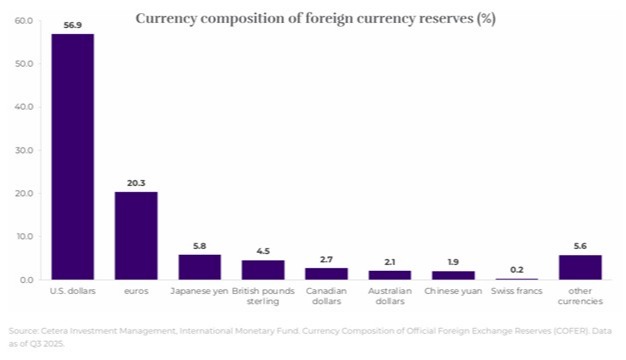
For all of America's fiscal shortcomings, no other currency currently possesses the combination of size, liquidity, transparency, legal protections, and global acceptance that the U.S. dollar still enjoys. As shown in our first chart below, the U.S. dollar continues to dominate foreign currency reserves around the globe.
Consider the alternatives.
The euro is often mentioned as the most logical successor. Yet Europe remains a collection of independent nations sharing a common currency but pursuing different fiscal policies, economic priorities, and political agendas.
Many European countries also face slower economic growth, aging populations, and debt burdens that rival—or in some cases exceed—those of the United States.
China's renminbi is another frequently discussed challenger. China is unquestionably one of the world's great economic powers, but reserve currencies require more than economic size alone. Investors and central banks need confidence that money can move freely across borders, contracts will be enforced consistently, and capital can be invested and withdrawn without government restrictions. China's capital controls and state-directed financial system make the renminbi a difficult candidate for global reserve status.
Others point to Bitcoin or other cryptocurrencies. While blockchain technology continues to evolve, extreme price volatility makes cryptocurrencies impractical as reserve assets for central banks responsible for maintaining financial stability.
Gold has experienced a resurgence as central banks have increased purchases in recent years. This trend accelerated post-COVID and following the freezing of Russian assets through the SWIFT banking system after Russia's invasion of Ukraine in 2022, as you can see in our next chart below.
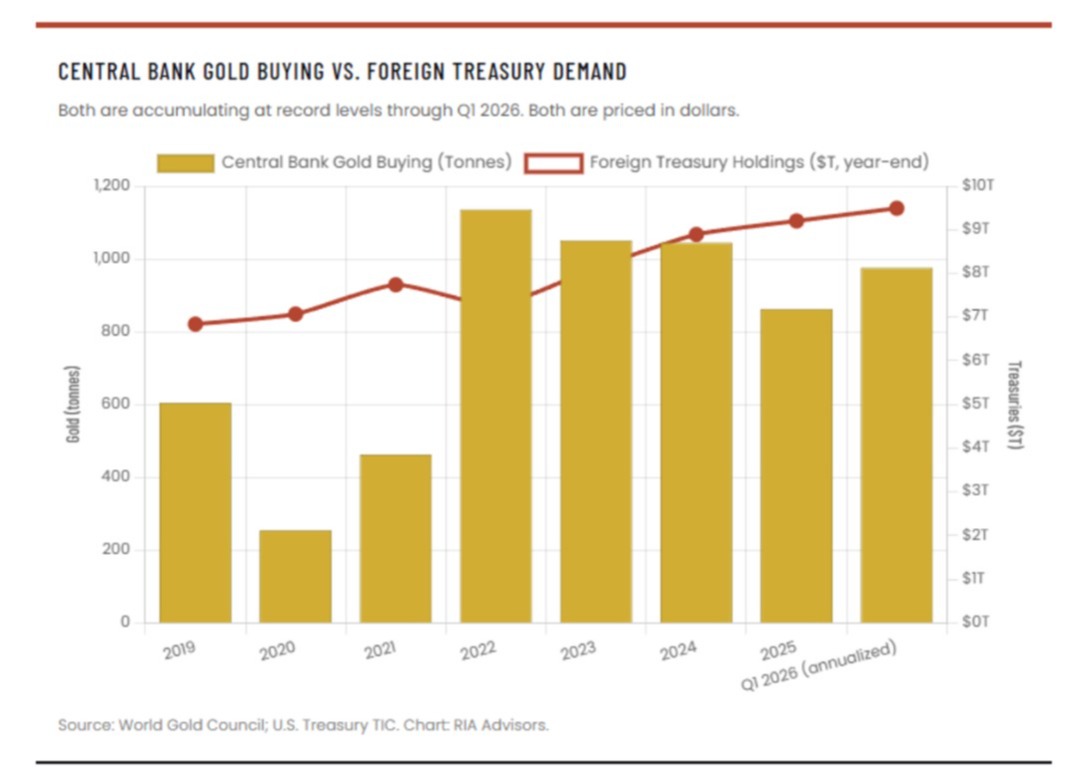
We'll discuss that trend in more detail in Part 2 next week. Gold has served as a store of value for thousands of years and remains an important diversifier. But gold is not a modern transactional currency. It cannot provide the liquidity, payment infrastructure, or financial flexibility required to support today's global economy.
In other words, every proposed replacement has significant limitations of its own.
Meanwhile, the advantages supporting the U.S. dollar remain remarkably durable.
The United States still has the world's largest economy. It possesses the deepest and most liquid government bond market ever created. U.S. Treasury securities remain the benchmark against which virtually every other fixed-income investment is measured. The dollar is involved in approximately 90% of global foreign exchange transactions.
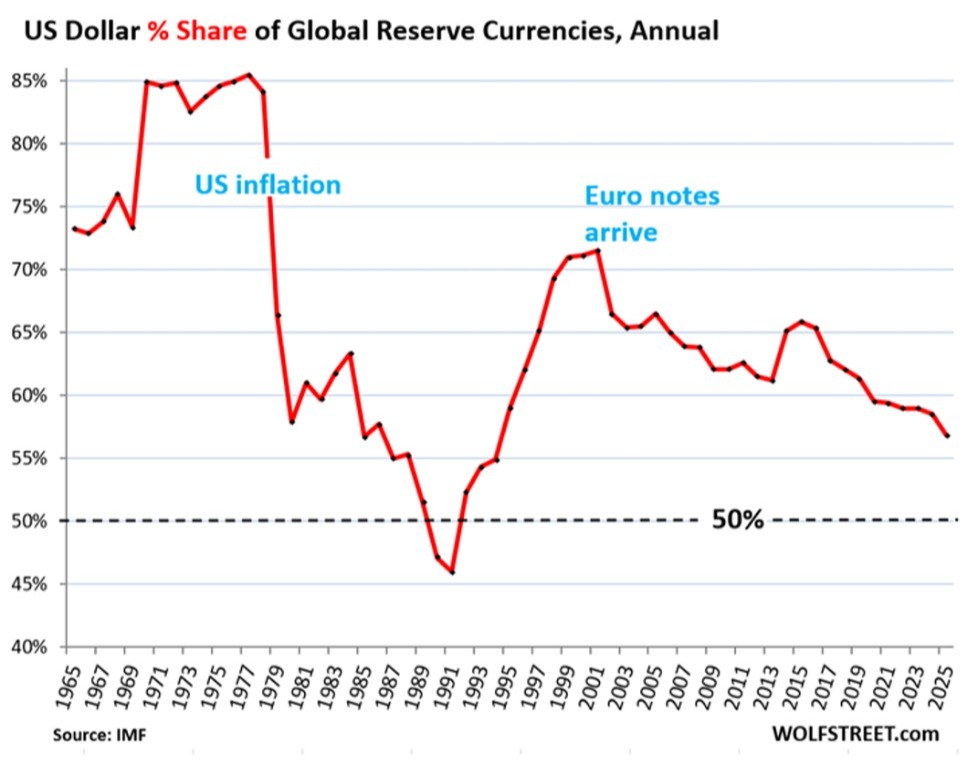
Although the dollar's share of global reserves has gradually declined, it still accounts for well over half of central bank foreign currency reserves worldwide, as shown in our final chart below.
Those are not simply statistics. They represent decades of trust, infrastructure, and network effects that cannot be recreated overnight.
Perhaps the biggest advantage is one we rarely think about because we've become accustomed to it.
Everyone already uses dollars.
International trade is largely priced in dollars. Commodities such as oil are generally bought and sold in dollars. Global banks conduct an enormous volume of transactions in dollars every single day. Once the world's financial plumbing has been built around a common standard, replacing that standard becomes extraordinarily difficult.
History teaches us that reserve currencies rarely disappear overnight. They evolve over decades, not months. Their influence can gradually diminish while remaining dominant.
Please remember that over the last 500 years, countries such as Spain, Portugal, France, and England have all held the world's reserve currency at one point. It is also important to remember that after they no longer carried that mantle, they did not drop off the economic face of the earth or suddenly become insignificant economies.
They were eventually replaced by currencies backed by larger economies, deeper financial markets, and greater global trust. That distinction is important because it helps explain much of what we're seeing today.
After the 2008 Global Financial Crisis, legendary bond manager Bill Gross described U.S. Treasury securities as "the cleanest dirty shirt in the hamper."
It wasn't intended as a compliment. It was a reminder. Ironically, while the fiscal and financial outlook in the United States has continued to worsen, along with our growing national debt, other developed economies around the globe have declined at a faster pace.
Our shirt is still dirty. It's just that other shirts have gotten dirtier.
Financial markets rarely choose perfection. They choose the best available alternative.
Today, the United States faces serious fiscal challenges that deserve attention. Pretending those challenges don't exist would be a mistake.
Policymakers should work toward putting our nation's finances on a more sustainable path. Ignoring those issues would be irresponsible.
At the same time, predicting the imminent collapse of the dollar ignores an equally important reality: no credible replacement currently exists. As I stated earlier, you can't replace something with nothing.
Reserve currencies aren't chosen in an election. They evolve through millions of financial decisions made over decades. They are built on trust, liquidity, legal protection, and habit. Losing that position is possible, but history suggests it happens gradually, not overnight.
The dollar doesn't have to be flawless to remain the world's reserve currency. It simply has to remain more useful, more liquid, and more trusted than every realistic alternative.
At least for now, the answer is still yes. That doesn't mean the story ends here.
In fact, while the dollar remains firmly on top of the financial world, an important shift has quietly begun beneath the surface. Following recent geopolitical events, many countries have begun diversifying portions of their reserves into smaller currencies and gold.
That isn't the same thing as replacing the dollar. But it is worth understanding.
Next week, we'll examine why, and what we need to keep watching as we continue Moving Life Forward.
© 2026 Jesse Hurst
Senior Wealth Manager
The views stated are not necessarily the opinion of Cetera and should not be construed directly or indirectly as an offer to buy or sell any securities mentioned herein. Due to volatility within the markets mentioned, opinions are subject to change without notice. Information is based on sources believed to be reliable; however, their accuracy or completeness cannot be guaranteed. Past performance does not guarantee future results.
Investors cannot directly invest in indices.
Featured Blog Image Source: iStock.com/de-nue-pic