


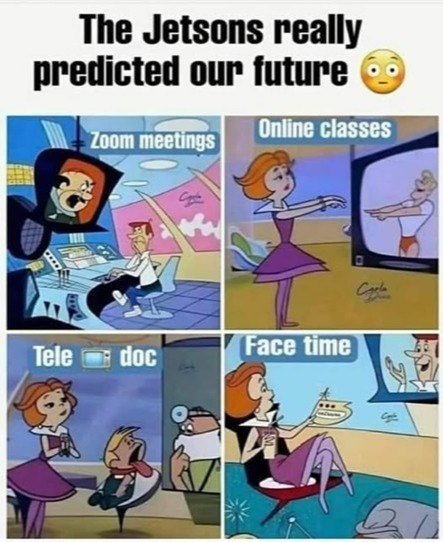
When The Jetsons first aired in 1962, it was meant to be a whimsical form of escapism. Flying cars. Robot maids. Video phones. A world so automated that work took an hour a day and technology quietly handled the rest. At the time, it all felt absurd.
Source: Facebook
More than sixty years later, it feels less like science fiction and more like a rough draft of modern life. We may not be commuting to cities in the clouds, but many of the Jetsons’ “impossible” inventions have quietly become part of our daily routines. What once looked cartoonish turned out to be early-stage reality, as you can see in the YouTube video below.
Top 10 Times The Jetsons Predicted the Future
Top 10 Times The Jetsons Predicted the Future
The Jetsons didn’t just predict gadgets, they predicteddirection. A steady march toward automation, convenience, and productivity, often met with skepticism along the way.
Consider a few examples:
- Video communication: George Jetson took calls on what looked suspiciously like a smartwatch. Today, FaceTime, Zoom, and Apple Watch are unremarkable parts of life.
- Smart homes: Rosie the Robot may have been sentient and sarcastic, but her functional descendants — robot vacuums, voice assistants, automated lighting, and climate control — are everywhere.
- Healthcare innovation: Pill cameras, once played for laughs, now perform real, non-invasive diagnostics.
- Digital media: Flat screens and digital news replaced paper faster than most expected.
Each innovation followed the same pattern: disbelief, resistance, early adoption, then inevitability. And that’s an important reminder as we think about another major technological shift now moving from novelty to inevitability: self-driving vehicles and autonomous transportation. Autonomous cars are following that same arc — just on a much larger economic scale.
Transportation is on the cusp of what can reasonably be called an extinction-level event. In 1908, Henry Ford’s Model T rolled off the assembly line. Within two decades, the horse-drawn carriage industry vanished. Entire professions disappeared. The shift was disruptive, painful — and ultimately transformative.
Today’s disruption is unfolding faster.
Autonomous ride-hailing services are projected to generate $378–$486 billion in annual revenue across North America and Europe by 2035. That’s measured in quarters and years, not generations. What changed? Two things: safety and economics.
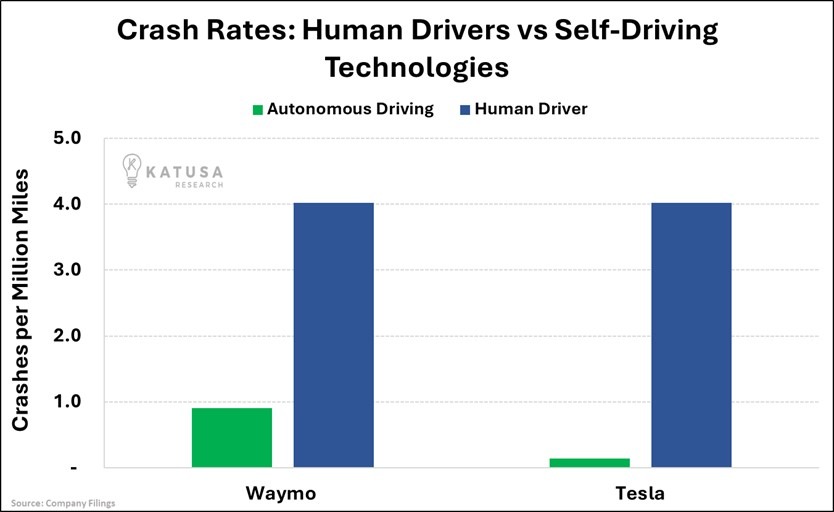
Data now shows autonomous systems achieving millions of miles per accident, far outperforming human drivers, as shown in our first chart below. Insurance models are being rewritten in real time.
Source: Katusa Research
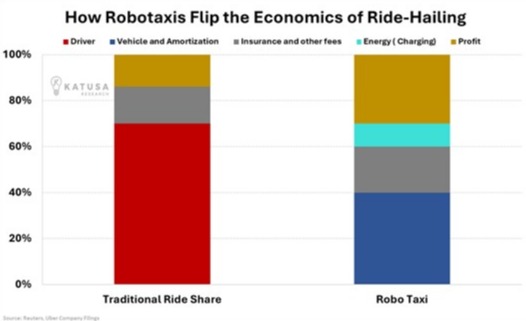
But even more compelling is the math: remove the driver, who takes 60–80% of every fare, and the entire cost structure changes, as you can see in our next chart below. This also leads to profit margins more than doubling in the process.
Source: Katusa Research
This isn’t theoretical anymore. Waymo is already completing hundreds of thousands of fully autonomous rides every week in U.S. cities. In China, robotaxi fleets are matching, and in some cases exceeding, traditional taxi volumes. The Jetsons’ moving walkways were just an early metaphor for frictionless transit. This is the modern version.
Self-driving cars generate strong opinions. Many people instinctively trust human judgment more than software, even when the data says otherwise. But we’ve seen this movie before. People once feared elevators without operators. They distrusted autopilot systems on airplanes. They resisted online banking, remote work, and digital signatures. Over time, familiarity replaced fear.
Autonomous vehicles offer profound secondary benefits that rarely make headlines: fewer accidents, lower emergency response costs, reduced congestion, and reclaimed time. Commutes become productive or restorative instead of stressful. Real estate dynamics shift as distance matters less. Driving, after all, is not most people’s passion. It’s cortisol and concentration. A computer doesn’t get distracted, tired, or emotional — and it has far better reflexes than any of us.
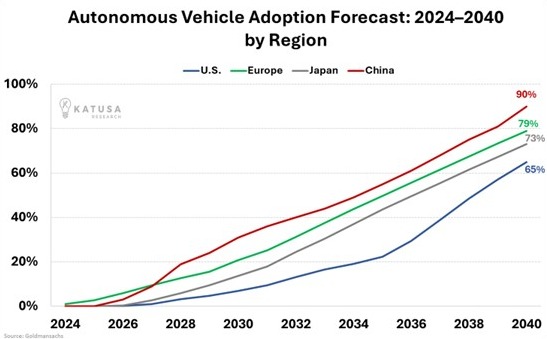
From an investment perspective, this is not about betting on a single company or technology. It’s about understanding where value accrues in large transitions. History suggests that not every innovator survives. Some early leaders fall behind. Capital is misallocated. Regulation intervenes. Volatility is unavoidable. But platforms, manufacturing scale, and distribution matter. Projections show that this future is coming our way faster than many may expect. As our last chart shows, China, Europe, Japan, and the U.S. are all on track to see major growth by 2040, just fifteen years from now.
Source: Katusa Research
The lesson from The Jetsons isn’t that every prediction comes true exactly as imagined — it’s that direction matters more than precision. The future often arrives unevenly, rather than all at once.
For decades, The Jetsons felt charmingly unrealistic. In hindsight, it was simply early. Self-driving cars, like video calls and smart homes before them, are moving from skepticism to scale. The question isn’t whether they reshape transportation, it’s how quickly adoption accelerates and which models endure. As investors, we don’t need to chase every shiny object or fear every headline. We need to recognize long-term shifts, remain disciplined through volatility, and separate discomfort from risk.
The future has a way of arriving whether we’re ready for it or not. At Impel Wealth, our role is to help you navigate those transitions thoughtfully…grounded in data, history, and perspective, as technology continues doing what it has always done: quietly turning yesterday’s cartoons into tomorrow’s reality. We will do our best to keep you informed and to guide you as we continue “Moving Life Forward.”
© 2025 Jesse Hurst
Senior Wealth Manager
Related Content
- Building Your Financial Future on a Strong Foundation
- Securing Your Family's Future: The Importance of Estate Planning for Young Families
The views stated are not necessarily the opinion of Cetera and should not be construed directly or indirectly as an offer to buy or sell any securities mentioned herein. Due to volatility within the markets mentioned, opinions are subject to change without notice. Information is based on sources believed to be reliable; however, their accuracy or completeness cannot be guaranteed. Past performance does not guarantee future results.
Neither Cetera Advisors LLC nor any of its representatives may give legal or tax advice. This information is not intended as tax or legal advice. Please consult legal or tax professionals for specific information regarding your individual situation.
Investors cannot directly invest in indices.
Featured Blog Image Source: iStock.com/marrishuanna