


Every August, central bankers, finance ministers, academics, and financial market participants from around the world attend the Kansas City Fed’s Jackson Hole Symposium to discuss economic issues related to the current state of the global economy, interest rates, and central bank policies. The symposium has historically been the place where the Federal Reserve Bank Chairman announces major policy shifts or new initiatives.
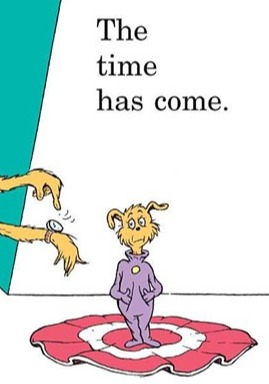
The 2024 Jackson Hole Symposium proved to be no exception. On Friday, August 23rd, current Fed Chair Jay Powell stepped to the podium and, in a highly anticipated speech, announced, “The time has come.” He was referring to the fact that the Fed would very likely be lowering interest rates at its September meeting.
You may remember that from March 2022 to July 2023, the Fed raised interest rates 11 times by a total of 5.25%. After watching most of its peer central banks around the globe already begin cutting interest rates, The Fed, to the surprise of many, has left interest rates unchanged for eight consecutive meetings. This is despite growing evidence of a slowing economy and rising unemployment.
Source: Pinterest.com
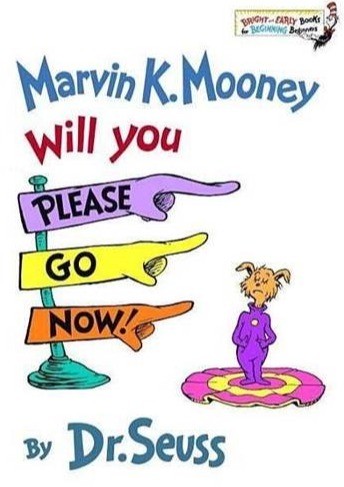
So, what does this have to do with Dr. Seuss? I am glad you asked. In 1972, Marvin K. Mooney's Will You Please Go Now! was published by Random House as part of their early beginning readers. It is suitable for children who cannot yet read at the level of more advanced beginning books such as The Cat in the Hat. The book presents Dr. Seuss's nonsensical words, rhymes, and illustrations in a short and funny fashion.
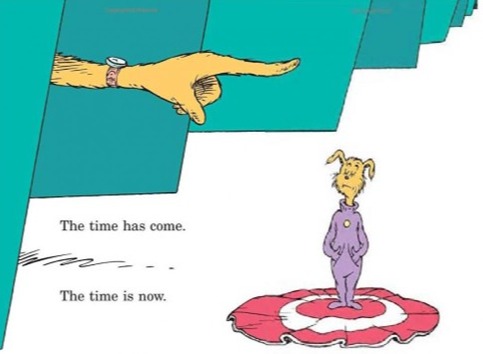
It was one of my son Zach's favorite books, and we read it often during his preschool years. Marvin K. Mooney, a young dog boy wearing purple pajamas standing in the middle of a rug, is asked to "go" by an unseen individual because "the time has come." A popular interpretation of the story, given that Marvin is wearing purple pajamas, is that he is being told to go to bed by his parent. However, the story was designed to be ambiguous. The story begins with a simple command that bears a striking resemblance to our Fed Chair.
Source: Amazon.com
The big question will ultimately be did the Fed start cutting interest rates quickly enough, given the slowing pace of economic growth and growing cracks in the employment market. We will explore just a few of these factors below.
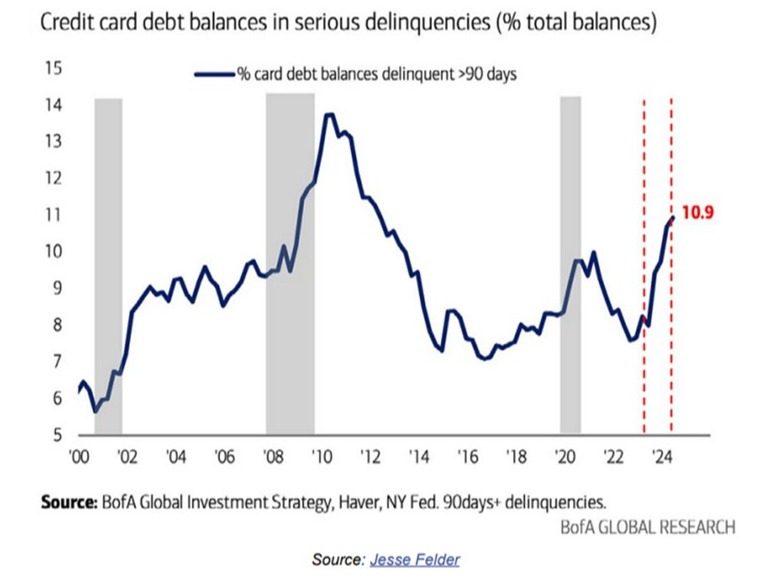
We will begin with household credit card debt, which has risen to a record high of $1.14 trillion. As COVID stimulus money has been spent, consumers have relied heavily on credit to maintain their spending habits in the face of high inflation and wages not keeping pace with higher prices. This is leading to rising credit card and auto loan delinquency rates, as you can see in our first chart below. Credit card delinquencies rising at this pace have previously been seen as the economy enters recession, represented by the gray bars below.
A second area of concern is the jobs market. The unemployment rate has risen from its recent low of 3.4% in April 2023 to 4.3% in July 2024. All eyes will be on the August report of the Bureau of Labor Statistics, which will be released on Friday, September 6th, to see if there is further deterioration. This would potentially indicate that the Fed is behind the curve in managing its second mandate, maintaining full employment for the US economy.
The Bureau of Labor Statistics also recently released its annual benchmark revisions to the number of jobs created over the last year. This report showed that the number of jobs created was 818,000 fewer than the number originally reported by the Bureau. We have also seen the unemployment rate rise above its 36-month moving average, as shown in our following chart. This has historically been a strong indicator of future recession, also shown by the gray bars in the chart.
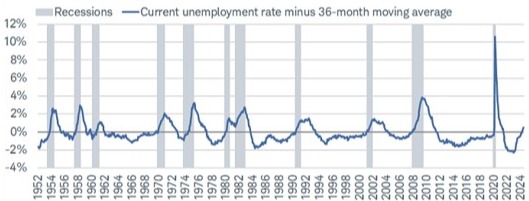
Source: Charles Schwab, Bloomberg, Bureau of Labor Statistics, as of 7/31/2024
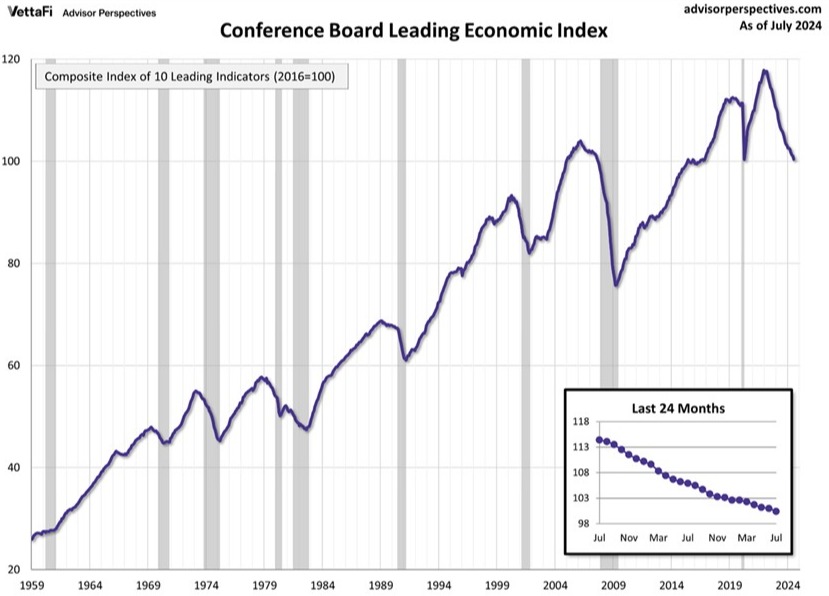
Finally, we have the Conference Board’s Index of Leading Economic Indicators, which is now more than 14% below its previous high. The index has dropped for 30 of the previous 31 months. We have never seen a drop of this magnitude without seeing a recession follow closely behind.
The Fed has told us “the time has come.” Many of the economic indicators above tell us that the Fed is behind the curve, and if it doesn't move soon or quickly enough, it could risk causing more damage to the economy. We all remember them telling us that inflation was “transitory” and that they waited too long to take action against rising prices. Many economists now fear that they have waited too long to take action as unemployment and other indicators have been showing cracks in the economic armor.
Source: YouTube
In its summary of economic projections (SEP), the Fed told us in December and March that they expected to cut interest rates three times this year. As we turn the calendar to September, the Fed, like our friend Marvin K Mooney, has yet to act. We believe “the time has come,” and based on his Jackson Hole speech, Jay Powell on the Fed appears to believe “the time is now.”
I hope you found this a fun way to convey what is happening to the economy, interest rates, and the Fed. As we continue to muddle our way through these unusual economic times, the CFPs of Impel Wealth Management will continue to do our best to keep you in the loop. Our mission is to provide some clarity to the narrative as we continue “Moving Life Forward.”
© 2024 Jesse Hurst
Senior Wealth Manager
The views stated are not necessarily the opinion of Cetera and should not be construed directly or indirectly as an offer to buy or sell any securities mentioned herein. Due to volatility within the markets mentioned, opinions are subject to change without notice. Information is based on sources believed to be reliable; however, their accuracy or completeness cannot be guaranteed. Past performance does not guarantee future results.
Neither Cetera Advisors LLC nor any of its representatives may give legal or tax advice. This information is not intended as tax or legal advice. Please consult legal or tax professionals for specific information regarding your individual situation.
Investors cannot directly invest in indices.
Featured Blog Image Source: iStock.com/Sporran