


"(I Can't Get No) Satisfaction" is a song by the Rolling Stones. It is a product of Mick Jagger and Keith Richards' songwriting partnership. Richards's guitar riff opens the song and is considered to be one of the greatest hooks of all time. The song's lyrics refer to frustration with commercialism and other issues...
I can't get no satisfaction
I can't get no satisfaction
'Cause I try and I try and I try and I try
I can't get no, I can't get no
When I'm watchin' my TV
And a man comes on and tells me
How white my shirts can be
But he can't be a man 'cause he doesn't smoke
The same cigarettes as me
I can't get no, oh no, no, no
Hey, hey, hey, that's what I say
Source: Wikipedia
Below is a YouTube link to the song for those of you who need a reminder or a pick-me-up this morning.
The Rolling Stones - (I Can't Get No) Satisfaction (Official Lyric Video)
The song was released as a single in the United States in June 1965 and was featured on the Rolling Stones' fourth studio album, Out of Our Heads, released that July. "Satisfaction" was a hit, giving the Stones their first number one in the US. It is one of the world's most popular songs and was No. 31 on Rolling Stone magazine's "The 500 Greatest Songs of All Time" list in 2021. It was inducted into the Grammy Hall of Fame in 1998. The song was added to the National Recording Registry of the Library of Congress in 2006.
Unfortunately, many US consumers are expressing the same frustrations and lack of satisfaction with their economic standing today. We seem to have this unique juxtaposition where a smaller percentage of Americans have the income and asset resources to be able to enjoy life and spend freely on vacations, restaurants, and events. At the same time, there is a larger percent of the population that is struggling to make ends meet. We can see this play out in a number of different economic sentiment surveys, as well as the spending habits of those on the lower half of the resource ladder.
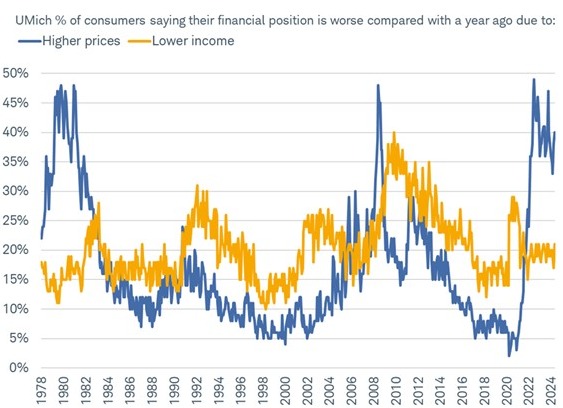
We will begin by looking at a chart from the University of Michigan Consumer Sentiment survey. This monthly survey recently showed that 40% of consumers say that higher prices are the primary reason that their financial position is worse off than it was a year ago. However, an additional 21% blame the fact that their income is not keeping up with expenses as the main culprit in their financial plight.
Source: Charles Schwab, Bloomberg, as of 5/10/2024
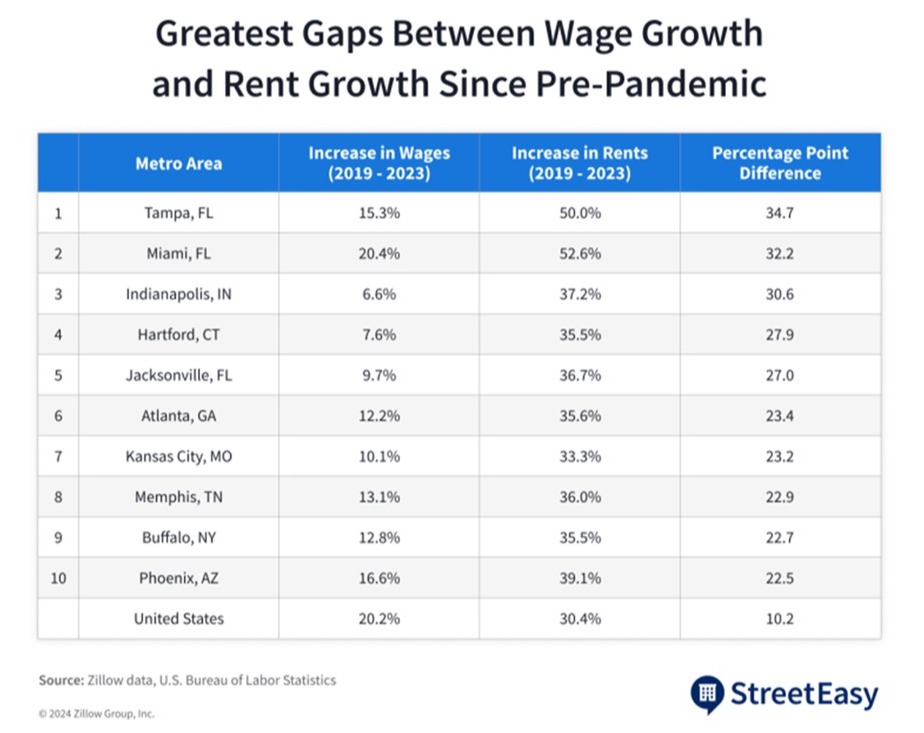
A second source of financial frustration is that over the last five years, rents have increased at a faster pace than wages across most of the US. Even though many politicians and more than a few economists have told us that wages have been growing at a faster level than they were before the pandemic, that does little to help consumers if prices rise even faster. Recent data from Zillow shows that rent growth has outpaced wage growth in 44 of the 50 largest US metro areas. This means that consumers are having to pay a higher percentage of their earned income for rent, leaving less money available for the rest of their budgetary needs. You can see the impact from the 10 largest examples of this in the chart below.
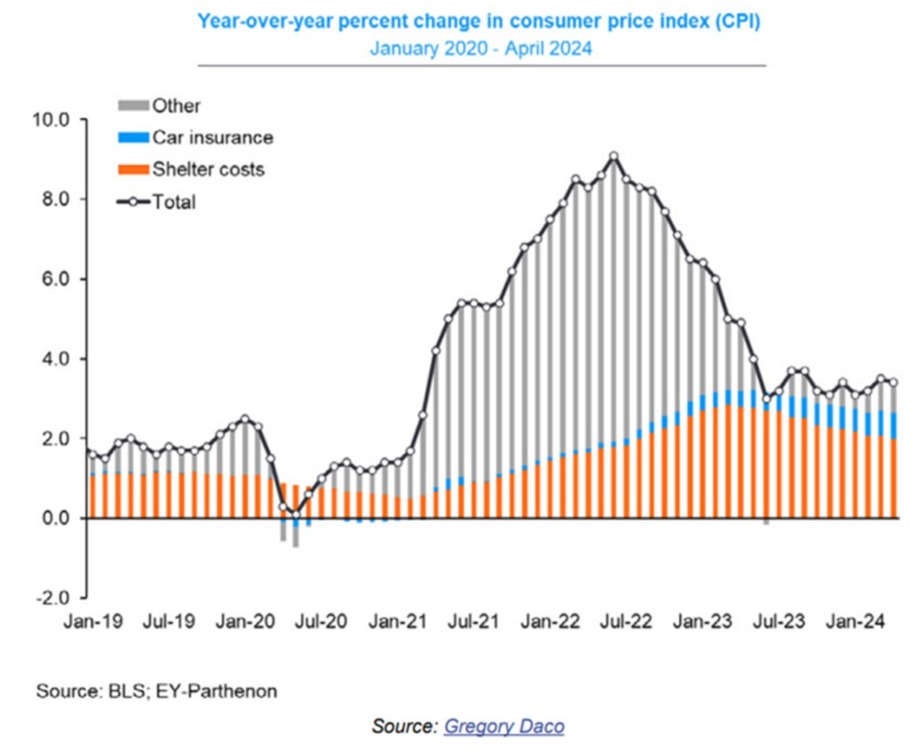
My next chart confirms that shelter costs nationally continue to make up a large part of the ongoing inflation pressures we all have been experiencing. They are the red bars in the chart below. You will also notice that the blue bars, which are auto insurance increases have been making up a larger and larger percentage of the bite inflation is taking out of most people's lifestyles. Finally, you will see that after inflation, as measured by CPI, peaked at 9.1% on June 22, it fell rather rapidly and bottomed at 3.0% on June 23. Unfortunately, since then, it has been drifting sideways to slightly higher, as we can all see and feel with each purchase that we make. This is also not allowing the Fed to cut interest rates at the pace they originally projected last December.
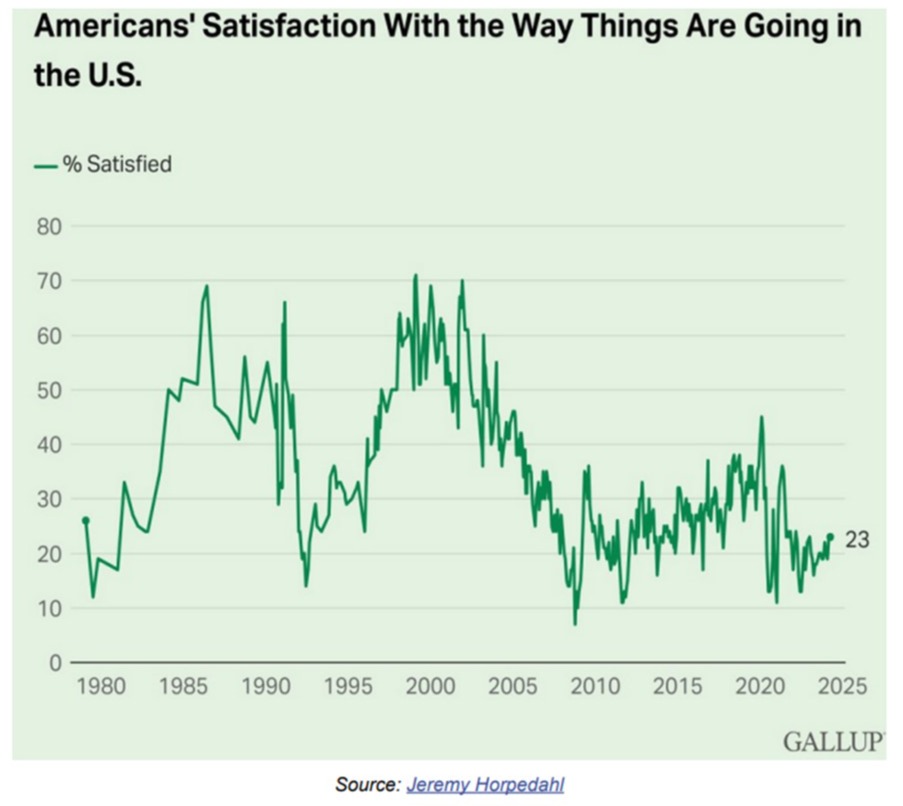
These factors, and many others, have compounded to bring American satisfaction, as measured by Gallup each year, to decline significantly from its most recent peak just before the COVID-19 coronavirus pandemic, as you will see in our final chart below. What is interesting to note is that Americans started growing more and more dissatisfied after the bursting of the dot.com bubble and 9/11 just after the turn of thecentury. Things deteriorated to an all-time low shortly after the subprime mortgage debacle led to the Great Financial Crisis. We have been bouncing along the bottom for most of the last 15 years. All the factors outlined above are not helping us with any higher in the near term.
I can't get no satisfaction
I can't get no satisfaction
'Cause I try and I try and I try and I try
I can't get no, I can't get no
Just as Mick and the boys sang nearly 60 years ago, many Americans feel that no matter how hard they try, and they try, they can't get no satisfaction either. This will be extremely important to watch both economically and politically. People tend to voice their dissatisfaction at the polls, which should make politicians on both sides of the aisle nervous.
It will also be important to see whether US consumers, who have largely defied expectations by spending and keeping the economy out of recession, can continue to do so despite their dwindling resources and the financial and economic pressures outlined above. This is something the CFPs of Impel Wealth Management will continue to watch closely and communicate with you as we continue “Moving Life Forward.”
© 2024 Jesse Hurst
The views stated are not necessarily the opinion of Cetera and should not be construed directly or indirectly as an offer to buy or sell any securities mentioned herein. Due to volatility within the markets mentioned, opinions are subject to change without notice. Information is based on sources believed to be reliable; however, their accuracy or completeness cannot be guaranteed. Past performance does not guarantee future results.
Neither Cetera Advisors LLC nor any of its representatives may give legal or tax advice. This information is not intended as tax or legal advice. Please consult legal or tax professionals for specific information regarding your individual situation.
Investors cannot directly invest in indices.
Featured Blog Image Source: iStock.com/Robtoz