


Why Midterm Election Years Have Historically Tested Investors
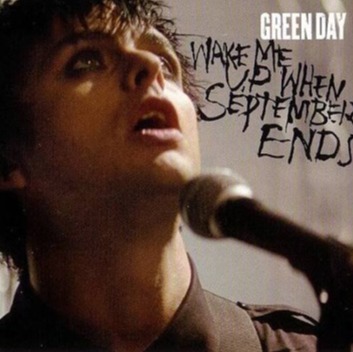
In 2004, Green Day released one of its most memorable songs, "Wake Me Up When September Ends," on the enormously successful album American Idiot.
Although it appeared on an album filled with political themes, the song itself was deeply personal. Lead singer Billie Joe Armstrong wrote it about the death of his father, who passed away from cancer in September 1982 when Armstrong was only 10 years old. According to the story Armstrong has told over the years, after his father's funeral he went home, locked himself in his bedroom, and told his mother, "Wake me up when September ends."
Source: Genius
If you are not familiar with the song or the iconic video that accompanied it, I've included a YouTube link below to set the mood and the stage for today's discussion.
Green Day - Wake Me Up When September Ends [Official Music Video] [4K Upgrade]
More than four decades later, investors might occasionally understand the sentiment, although for reasons nowhere near as profound.
September has historically been the most difficult month of the year for the stock market. And in midterm election years, the period surrounding September and October has often been particularly uncomfortable. That seems worth discussing now because summer is winding down, kids are heading back to school, and it seems awfully early to start worrying about midterms.
Unfortunately, I'm talking about elections, not exams.
As we move toward the November 2026 midterm elections, Americans will be increasingly inundated with political advertisements telling us why one candidate will save the country, while another will destroy it. Depending on which television channel you watch, website you visit, or social media feed you follow, you may come away with entirely different impressions of what the future holds.
Markets will be trying to sort through that uncertainty as well.
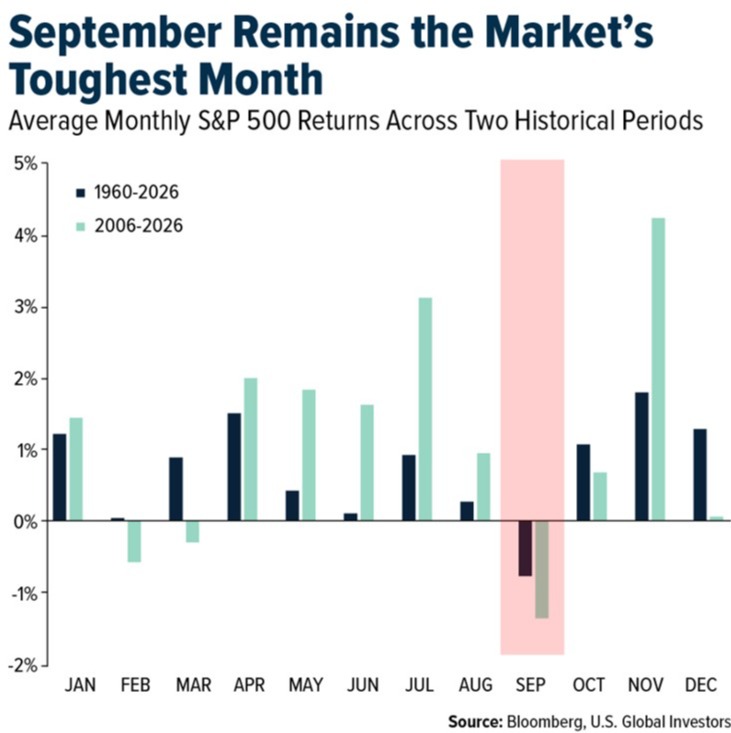
History tells us that September has generally been an unusually challenging month for stocks. According to Bloomberg and U.S. Global Investors, September is the only month that has produced negative average S&P 500 returns over both the longer period from 1960 through 2026 and the more recent period beginning in 2006.
Source: Bloomberg, U.S. Global Investors
But the story becomes even more interesting when September occurs during a midterm election year.
Research from Capital Group shows that the S&P 500 has historically experienced greater volatility during midterm election years than during other years, with that volatility becoming particularly pronounced during the two months immediately preceding Election Day. Since 1931, the S&P 500 has generated an average price return of 4.7% during midterm election years compared with 9.5% during all other years.
Perhaps even more interesting is the path the market has historically taken to get there.
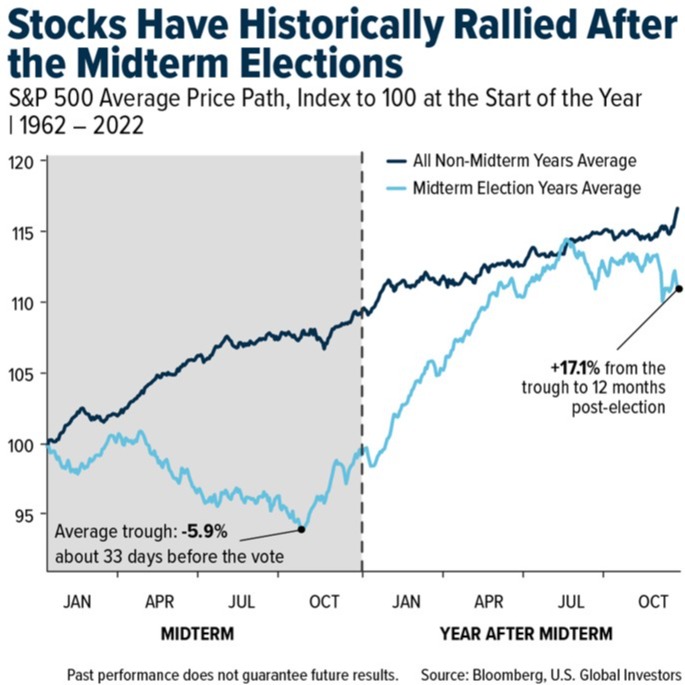
Research from U.S. Global Investors examining midterm elections since 1962 found that stocks declined between mid-August and Election Day during every midterm cycle. The average decline was approximately 8%, and the market's average trough occurred roughly 33 days before voters went to the polls, as shown in the chart below.
Source: Bloomberg, U.S. Global Investors
None of this means the stock market must decline this September or October. Historical averages are observations, not predictions, and markets have an irritating habit of refusing to follow scripts precisely when investors become convinced that they will. But if volatility does increase as Election Day approaches, it would hardly be unprecedented.
The more interesting question may be why this pattern has existed.
I think part of the answer is something investors sometimes forget about stock market indexes. The S&P 500 isn't really a business. It is an index representing 500 of America's largest publicly traded companies, each led by management teams making daily decisions about hiring, investment, expansion, borrowing, research, inventories, and how to deploy capital. Those executives don't have the luxury of putting their businesses on hold every four years while America figures out who will govern.
They need to make plans.
And businesses can generally adapt to many different political environments. They can operate with higher or lower tax rates. They can adjust to different regulatory priorities. They can respond to changes in government spending, trade policy, and countless other rules affecting their industries.
What is considerably harder to plan around is uncertainty.
Will tax policy change? Will regulations become tighter or looser? Which party will control the House and Senate? What legislation could realistically become law? Which proposals being discussed during campaign season will actually survive once governing begins? Until those questions become clearer, some businesses may postpone decisions, investors may become more cautious, and markets may demand a greater margin of safety for taking risk.
That helps explain why I think investors should be careful about interpreting election-year volatility through a partisan lens. Markets don't necessarily need Republicans to win. They don't necessarily need Democrats to win.
Markets need enough information to begin pricing what comes next.
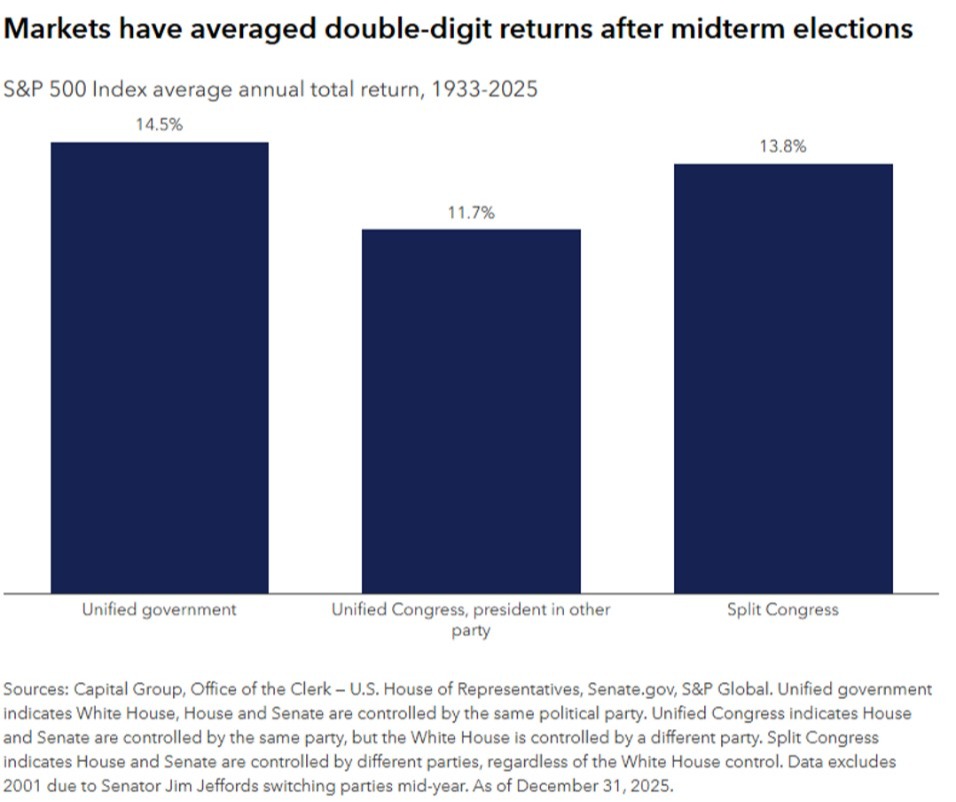
History supports that distinction. Capital Group's research shows that stocks have generated positive long-term average returns under unified Republican or Democratic government, divided government, and periods when Congress was controlled by one party while the White House was controlledby the other, as shown in our final chart below. Companies do what good companies have always done: They adjust, compete, innovate, and attempt to grow.
Source: Capital Group, Office of the Clerk — U.S. House of Representatives, Senate.gov, S&P Global
Of course, knowing this won't make the next several weeks any quieter… or the potential volatility easier to stomach.
The political advertisements will become more frequent, and likely more combative. Polls will move. Pundits will confidently explain what each development means.
Markets may rise or fall sharply on any given day, often driven by headlines that make investors nervous. This is sometimes called headline risk—the volatility that accompanies the day-to-day news and noise on cable television, social media, and the Internet. But it is also important to remember that by the time most of us see and react to the latest headline, millions of market participants have already seen it too, and much of that information may already be reflected in market prices. Reacting after the fact can often do more harm than good. That is precisely when perspective becomes most valuable.
If we experience another bout of volatility between now and Election Day, history suggests that investors should resist confusing political uncertainty with a failure of their long-term financial plan. Diversification is designed for periods when we don't know exactly what comes next. Staying disciplined with that diversification matters most when the urge to do something feels more comfortable than having the patience and the confidence to do nothing.
And one more piece of midterm election history is worth remembering.
What has historically happened after Election Day looks remarkably different from what has often happened before it. Perhaps investors shouldn't be asking someone to wake them up when September ends.
Maybe we should stay awake, remain disciplined, and see what history has to teach us next.
In Part Two, we'll look at what has historically happened after the votes were counted and the uncertainty surrounding midterm elections began to fade. I believe it offers an important lesson as we navigate the political noise of the months ahead while continuing to focus on what matters most: making thoughtful financial decisions that keep us Moving Life Forward.
©2026 Jesse Hurst
Senior Wealth Manager
The views stated are not necessarily the opinion of Cetera and should not be construed directly or indirectly as an offer to buy or sell any securities mentioned herein. Due to volatility within the markets mentioned, opinions are subject to change without notice. Information is based on sources believed to be reliable; however, their accuracy or completeness cannot be guaranteed. Past performance does not guarantee future results.
Investors cannot directly invest in indices.
Featured Blog Image Source: iStock.com/KateArtery19