


Why Doing Nothing May Be the Hardest—and Most Valuable—Decision an Investor Makes
Last week, we borrowed the title of Green Day's Wake Me Up When September Ends to explore something investors have experienced for generations: September and October have historically been two of the most difficult months of the year for the stock market, and midterm election years have often made that ride even more uncomfortable.
So perhaps the natural response is to close our eyes, pull up the covers, and ask someone to wake us when it's over.
The good news is that eventually it is. September ends. October ends. And, thankfully, so does election season.
What happens next may be one of the more important lessons history can teach long-term investors.
For all the anxiety surrounding midterm elections—the campaign advertisements, political arguments, predictions about what will happen if one party or the other gains control of Congress—markets eventually receive something they value enormously.
Clarity.
The election takes place. The votes are counted. Control of Congress becomes known. Businesses have a better idea of the political, tax, and regulatory environment in which they will be operating, and investors can begin focusing again on earnings, interest rates, economic growth, inflation, and all the other forces that ultimately matter far more to markets than campaign-season rhetoric.
And historically, something remarkable has happened after that uncertainty begins to fade.
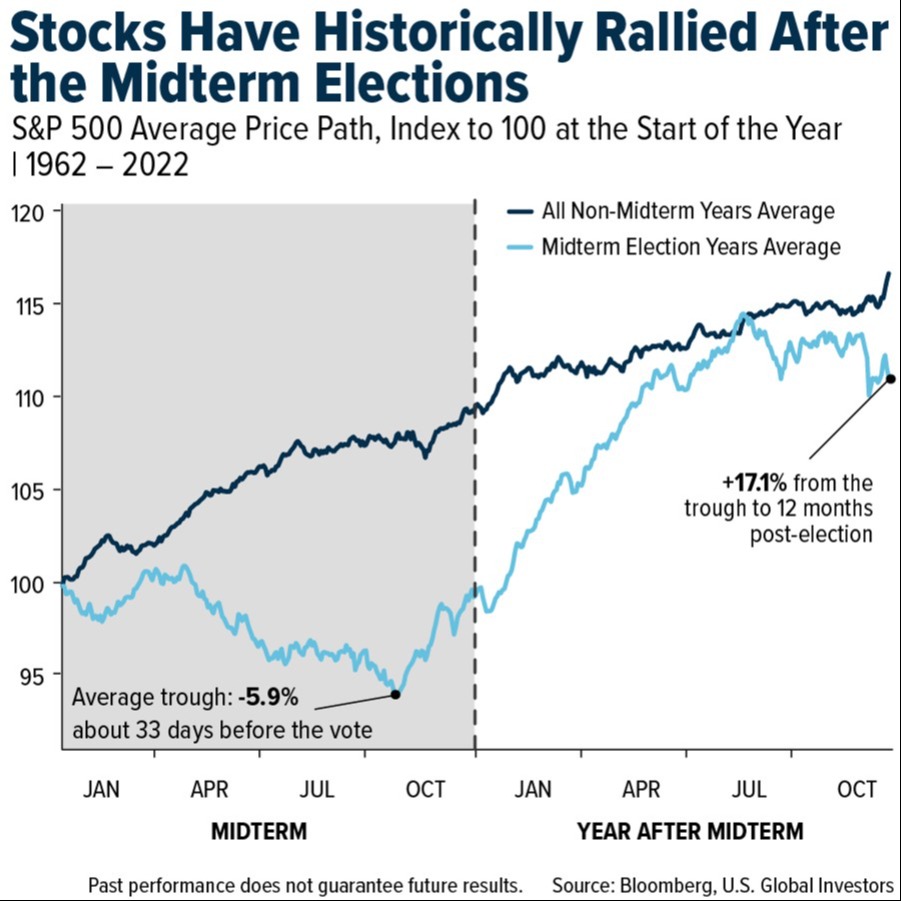
According to Capital Group, stocks rose during the 12 months following every midterm election from 1950 through 2022.
All 19 of them. The average gain was 15.4%, as shown in the following chart.
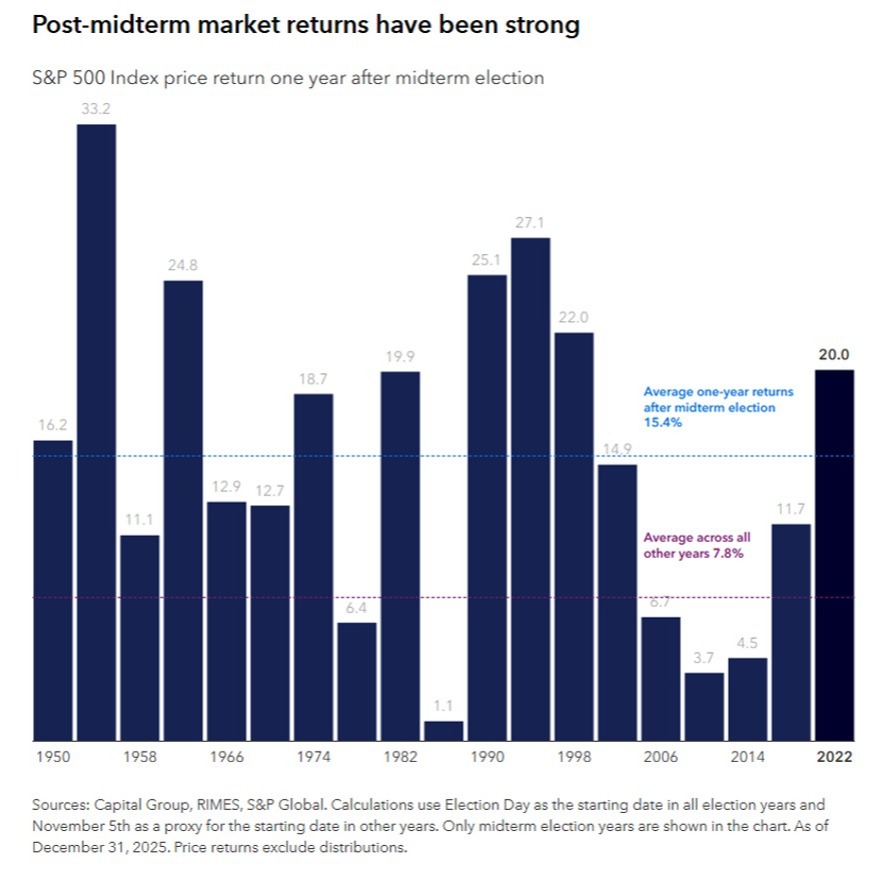
That is certainly an eye-catching statistic, particularly after the volatility that has historically preceded many midterm elections. But before anyone concludes that we have discovered an easy way to predict what stocks will do following the 2026 election, we haven't.
Past performance never guarantees future results, and there is nothing magical about Election Day that suddenly makes stocks go up. Over long periods, however, the stock market has tended to move higher.
That may actually be the more important lesson.
The argument isn't that investors should buy stocks because midterm elections are over. It is that they probably shouldn't abandon a sound long-term investment strategy simply because an election temporarily makes them uncomfortable.
There is an enormous difference between those two ideas.
Unfortunately, doing nothing can be extraordinarily difficult when everything around us seems to be screaming that we should do something. Financial television is filled with predictions. Social media algorithms feed us increasingly alarming stories. Political campaigns spend billions of dollars convincing us that catastrophe awaits if the other side wins.
And our brains are not particularly good at separating our political emotions from our investment decisions.
If we strongly dislike the party in power, we may become more pessimistic about the economy and markets. If our preferred party wins, we may suddenly become more optimistic. Yet the companies we own don't stop selling products, developing technologies, investing in new factories, hiring employees, or generating profits based on which political party controls Congress.
The American economy is much bigger than any election. So is the stock market.
Over nearly four decades of working with investors, I have lived through Republican presidents, Democratic presidents, divided governments, unified governments, contested elections, wars, recessions, financial crises, terrorist attacks, pandemics, inflation, deflation, bubbles, crashes, and more predictions of America's imminent decline than I could possibly count. There has always been a reason to worry.
There has also almost always been a reason to invest.
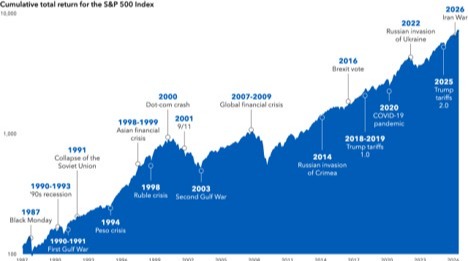
Sources: Capital Group, Standard & Poor's. As of December 31, 2025. Data is indexed to 100 as of January 1, 1987, based on cumulative total returns for the S&P 500 Index.
This chart may be the one I would most like investors to remember. Not because the journey was easy. It wasn't. The line moved up and to the right over decades because American businesses continued to adapt, innovate, earn profits, and create value despite everything happening around them.
I also love this chart because it starts in 1987, the year I became a financial advisor. It's a picture of my entire career.
Investors did not need to predict every election to correctly participate in that progress. They did not need to know which party would control Congress, where interest rates would be a year later, or what the next geopolitical crisis would be.
They needed something much harder.
They needed patience. They needed confidence. And they needed faith that American businesses would continue doing what they have done for generations: creating products and services people want and need, generating sales and profits, and creating value over time.
One of the great paradoxes of successful investing is that tremendous effort may go into constructing a financial plan and investment portfolio. Yet, sometimes the most valuable action we can take afterward is no action at all.
That doesn't mean ignoring changes in your life, blindly holding inappropriate investments, or never rebalancing a portfolio. Good financial planning requires ongoing adjustments as circumstances, goals, tax laws, markets, and financial needs evolve.
But changing a well-designed long-term strategy because we are frightened by an election is something entirely different.
That is an emotional decision masquerading as an investment decision. And those decisions can be expensive.
Think back to where we began this two-part series.
September and October have earned their reputations because markets have historically experienced more volatility during this part of the calendar. Midterm election years have often added another layer of uncertainty.
Knowing that history doesn't make the volatility disappear. But perhaps it helps us respond differently when it arrives.
Instead of asking, "What should I do because I'm worried about the election?" perhaps the better question is, "Has anything about my long-term financial plan actually changed?"
If the answer is no, doing nothing may not be passive at all. It may be an active decision to remain disciplined.
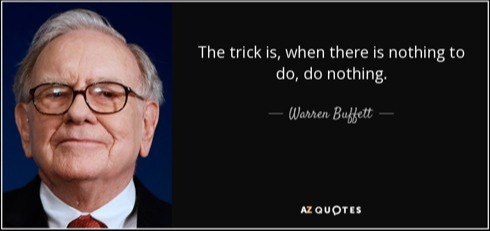
Perhaps Warren Buffett said it best:
Eventually September ends. Eventually the election ends. Eventually today's uncertainty will be replaced by tomorrow's uncertainty, because that is how investing has always worked.
We don't get to invest in a world without uncertainty. We only get to decide how we respond to it.
And if history has taught us anything, perhaps the investors who ultimately enjoy the greatest success aren't the ones who correctly predict every election, market decline, or economic turn.
They are the ones who build a thoughtful plan, understand why they own what they own, and have the patience to stick with it when the world gives them every reason not to.
Sometimes Moving Life Forward means knowing when to act. And sometimes it means having the discipline to do absolutely nothing.
©2026 Jesse Hurst
Senior Wealth Manager
The views stated are not necessarily the opinion of Cetera and should not be construed directly or indirectly as an offer to buy or sell any securities mentioned herein. Due to volatility within the markets mentioned, opinions are subject to change without notice. Information is based on sources believed to be reliable; however, their accuracy or completeness cannot be guaranteed. Past performance does not guarantee future results.
Investors cannot directly invest in indices.
Featured Blog Image Source: iStock.com/gguy44