


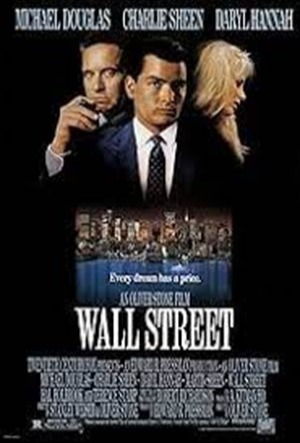
Michael Douglas won the Academy Award for Best Actor for his portrayal of corporate raider Gordon Gecko in the 1987 movie Wall Street. Oliver Stone directed and wrote the movie. It also starred Charlie Sheen, who played the son of his real-life father, Martin Sheen.
Source: IMDb
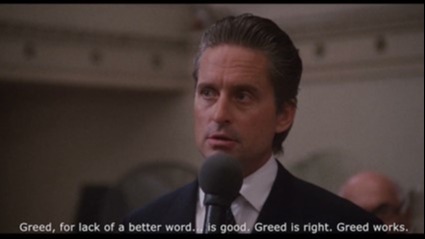
In one of the more memorable scenes from the movie, Gordon gives a speech in which he states, “ Greed, for lack of a better word, is good.” He goes on to state that greed isn’t necessarily a bad thing. He shares that "A longing for progress, or greed, is actually what made America great." This leads many people to believe that corporate America is only concerned about greed and profits.
Source: LinkedIn
We have seen this theme playing out in campaign speeches by politicians on both sides of the aisle recently. Many claim that the run-up in inflation is largely coming from corporate greed, not from the policies enacted on Capitol Hill or by the Federal Reserve Bank. We expect this to continue throughout the presidential and congressional elections.
The purpose of today’s blog post is to examine this premise in a nonpartisan way and determine whether greed is causing the inflation that has hurt so many Americans over the last few years.
Let’s begin by hearing some words of wisdom from Nobel Prize-winning economist Milton Friedman. People are often quick to point to his famous statement, "Inflation is always a monetary phenomenon.” Friedman expanded on this thought process further, sharing that corporations don’t cause inflation. It is the result of governments printing too much money. “It is always and everywhere a result of too much money, of a more rapid increase of money than of output. The important next step is to recognize that day the government controls the quantity of money so that, as a result, inflation in the United States is made in Washington DC and nowhere else.”
He concludes by stating that only Washington has a printing press, so only Washington DC can produce inflation. This is contrary to the messages we are getting from multiple political campaigns this year. Let’s examine their claims further.
If we think back to the dozen years that followed the Great Financial Crisis in 2008–2009, inflation was not a problem; quite the contrary. Despite the government bailout of the banking system and massive amounts of quantitative easing, in which the Federal Reserve Bank injected money into the banking system by buying government bonds and mortgages, the Fed worried for years about deflation rather than inflation, as they could not sustainably get inflation to their 2% target rate.
If greedy corporations produce inflation, as politicians tell us, why was this not an issue during those years? Are we to conclude that corporate America was feeling much more generous and not nearly as greedy during those 12 years? Did CEOs and corporate boards of directors not have a fiduciary duty to act in a way that benefited their shareholders by driving profits and stock prices higher?
Do we really believe that corporate leadership suddenly became greedy and drove up prices in the post-COVID world? If they are to benefit their shareholders, the owners of the business, they first have to stay in business. This means that if the cost of doing business, such as wages, raw material prices, utilities, and so on, rises dramatically, this must be accounted for in the price of the products they produce.
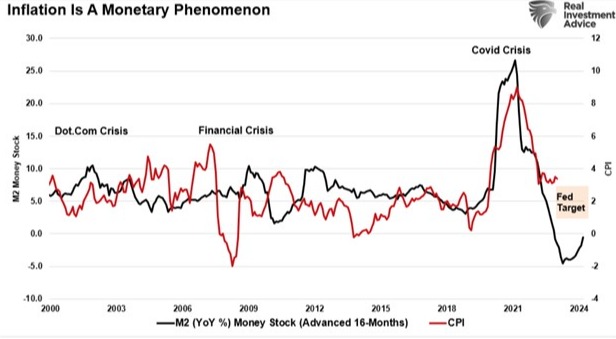
It is important to remember that shortly after the COVID-19 government shutdowns, the federal government gave money directly to consumers by mailing them stimulus checks instead of buying government bonds as they did after the previous crisis. This led to consumers having massive amounts of liquidity at a time when companies had a hard time meeting demand. This caused prices to rise dramatically. The chart below shows the increase in the money supply and the corresponding rise in inflation. It seems that everybody was happy getting checks and free money until they saw the resulting rise in prices.
However, consumers in a free-market economy can also choose not to purchase goods of a higher price. They can choose lower-cost alternatives if and when those are available. As consumers began running through their pandemic-related largess, and production picked up to meet the lower demand, the rate of inflation did indeed start to come back down. It is extremely important to remember that this does not mean that prices fell; they are just not rising as quickly as they previously did.
To conclude, I will share several poignant questions that Lance Roberts, the chief portfolio strategist/economist for RIA Advisors, posed in a recent article. I think they drive home the points I tried to make above:
- Who had the power to shut down the economy and force everyone into their homes during the pandemic? Was it corporations or the government?
- Who supplied trillions of dollars in stimulus checks directly to households when no supply could be produced? Corporations or the government?
- Who issued trillions of dollars of debt to fund stimulus checks and keep interest rates artificially low? The Federal Reserve Bank or corporations?
- Who put a moratorium on student loans, rent, and mortgage payments, giving people additional money to spend? Corporations or the government?
The answer to each of the questions above rests squarely on the federal government or the Federal Reserve Bank. Let me be clear: I am not stating that corporate America has no incentive to sell more of its products or create higher profits and stock prices for its shareholders over time. They absolutely do. As an investor and a shareholder, you and your 401K have likely benefited from this. However, those actions and incentives are not the main drivers of inflation, no matter what politicians tell you.
Whether greed is good or not, I hope you better understand that it is not primarily driven by Wall Street and corporate America. I always take a risk by sharing messages with any political connotation during election season. However, I want you, the trusted friends and clients of Impel Wealth Management, to be better informed and more discerning during this seemingly never-ending political season. I think it's important to help you be informed as we continue "Moving Life Forward."
© 2024 Jesse Hurst
The views stated are not necessarily the opinion of Cetera and should not be construed directly or indirectly as an offer to buy or sell any securities mentioned herein. Due to volatility within the markets mentioned, opinions are subject to change without notice. Information is based on sources believed to be reliable; however, their accuracy or completeness cannot be guaranteed. Past performance does not guarantee future results.
Investors cannot directly invest in indices.
Featured blog image source: iStock.com/Teamjackson