


"Who Says You Can't Go Home" was written by Jon Bon Jovi and Richie Sambora for Bon Jovi's ninth album, Have a Nice Day, released in 2005. A duet version of the song featuring vocals from Jennifer Nettles of the duo Sugarland was also shipped to country music radio. Uniquely, both versions of the song can be found on the album. The New Jersey native seems to be a favorite with the Impel Wealth team, with several team members noting that he has “aged very well.”

Source: YouTube
I have absolutely no opinion about how well Jon Bon Jovi has aged. However, if you would like a fun and upbeat way to start your day, a YouTube link to the duet version of the song is included below. By the way, the music video featured Habitat for Humanity volunteers building homes for low-income families and was used to promote the organization.
Bon Jovi, Jennifer Nettles - Who Says You Can't Go Home
Do you know who else is saying it's hard to go home? Fannie Mae. According to their recent Economic & Strategic Group, despite a significant drop in mortgage rates and an increase in active listings and inventory, many buyers are having a hard time making the decision to purchase a home. They have not seen evidence of a corresponding increase in new mortgage applications, nor has there been an improvement in home buyer sentiment. This is likely driven by housing affordability being at the lowest level we have seen in more than 30 years, as you can see in our first chart below from the National Association of Realtors.
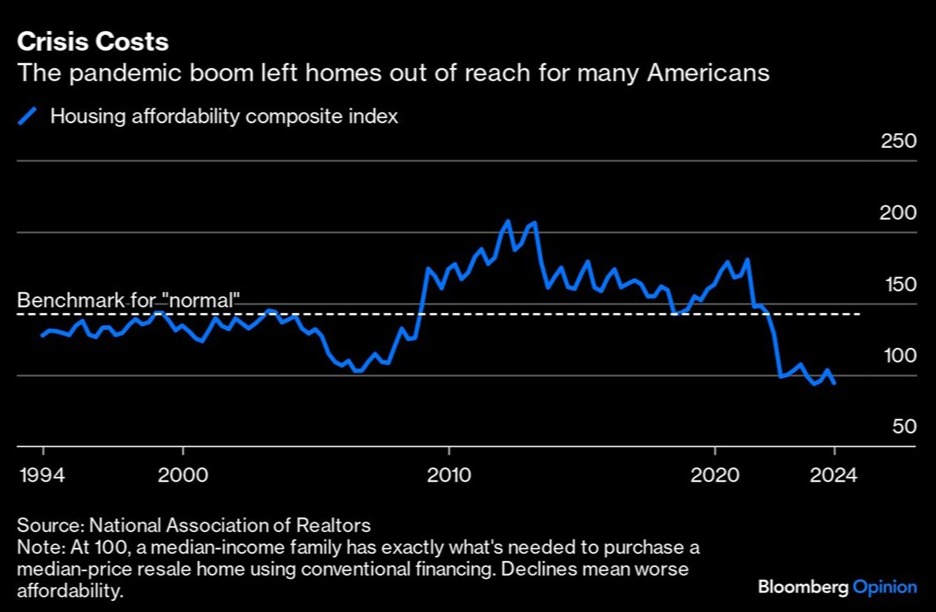
The main culprit seems to be a significant rise in housing prices over the last five years. This has made qualifying for a mortgage and the ability to make higher mortgage payments much more difficult for the average American. Fannie Mae believes that many aspiring homeowners are likely waiting for affordability to improve or their incomes to increase to allow them to buy more confidently. This has led to both mortgage applications and existing home sales dropping to historically low levels, as you can see in the charts below.
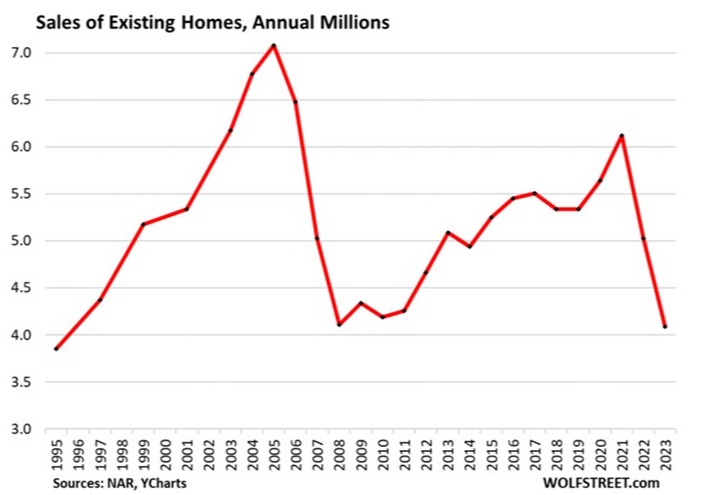
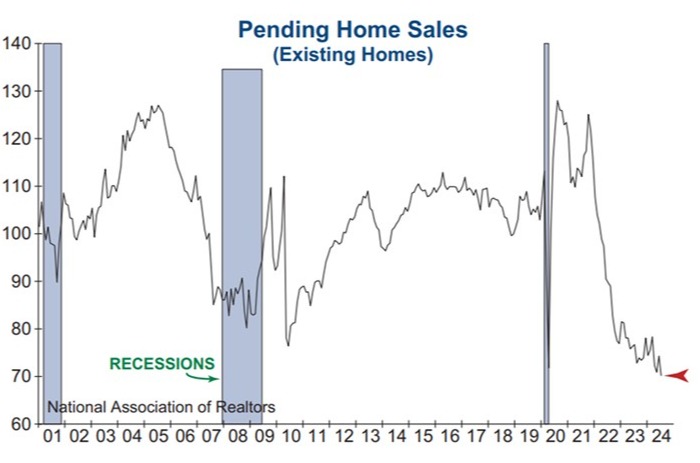
So, what would it take for Americans to feel more confident about buying their first or next home? The first answer would be even more inventory. More importantly, it would be inventory priced at a level more people can afford. It seems that home builders are listening. There is a recent trend toward building smaller homes, instead of the McMansions we have seen go up in many neighborhoods over the last several decades.
Even lower mortgage interest rates would also help people feel more confident about purchasing a home. Mortgage interest rates most recently peaked at approximately 8% for a 30-year mortgage around this time last year. They have since fallen to below 6 1/2 percent. Please remember that mortgage rates are not directly influenced by the Federal Reserve Bank raising or lowering their overnight Fed Funds rate. They are more closely tied to 10-year treasury bond rates, which the bond market determines. These rates have fallen significantly over the last several months in anticipation of the Fed eventually cutting interest rates, which it did in September.
History shows that over the last 30 years, mortgage rates have typically been 1.5% to 1.75% higher than the 10-year treasury. Our final chart below shows this.
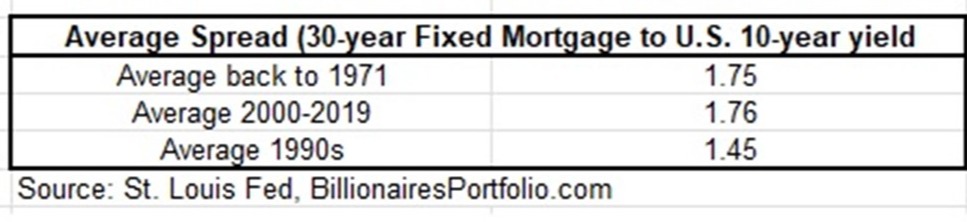
As I write this in late September, 10-year treasury bonds are trading at approximately 3.75%. This means that based on the chart above, 30-year mortgages should be somewhere between 5.25% and 5.5%. They are currently nearly 1% higher than this. A drop towards historical norms in this relationship would make housing more affordable and would likely move the needle with many aspiring home buyers.
Despite what Jon Bon Jovi and Jennifer Nettles tell us, it has not been easy for many Americans to “go home” over the last several years. Higher incomes, more affordable inventory, and lower interest rates might help those looking to make the move. However, until some combination of those factors is achieved, home sales and mortgage applications will likely remain below historical norms.
As many Americans accumulate most of their wealth in two places: their 401K plans and the equity in their homes, it is essential for housing to become affordable so that more families can continue to build the wealth they will need to retire comfortably down the road. I thought this was an important story to tell. It is a complex issue, and I wanted to provide you with context as we continue “Moving Life Forward.”
© 2024 Jesse Hurst
Senior Wealth Manager
The views stated are not necessarily the opinion of Cetera and should not be construed directly or indirectly as an offer to buy or sell any securities mentioned herein. Due to volatility within the markets mentioned, opinions are subject to change without notice. Information is based on sources believed to be reliable; however, their accuracy or completeness cannot be guaranteed. Past performance does not guarantee future results.
Neither Cetera Advisors LLC nor any of its representatives may give legal or tax advice. This information is not intended as tax or legal advice. Please consult legal or tax professionals for specific information regarding your individual situation.
Investors cannot directly invest in indices.
The performance of any index is not indicative of the performance of any investment and does not take into account the effects of inflation and the fees and expenses associated with investing.
Featured Blog Image Source: iStock.com/Wirestock