


"The First Cut Is the Deepest" is a song written by British singer-songwriter Cat Stevens. Originally released by P. P. Arnold in April 1967, Stevens' version appeared on his album New Masters in December 1967. I was first introduced to the Rod Stewart single, which was included on his 1976 album, A Night on the Town. In addition to the artists listed above, the song also became a hit single for Keith Hampshire, Papa Dee, and Sheryl Crow.
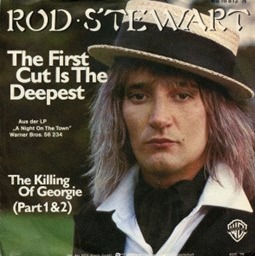
Source: Discogs
A YouTube link to the Rod Stewart version of the song, which was released in 1977 when I was 12 years old, is included below for your listening enjoyment:
Rod Stewart - The First Cut Is The Deepest (Official Video)
As I write this in early September, we are two weeks from the Federal Reserve Bank meeting on September 18th. After Fed Chair Jay Powell's speech at the annual Federal Reserve symposium at Jackson Hole, Wyoming, on August 23rd, it is now widely expected that the Fed will cut rates for the first time since the spring of 2020 when we were in the midst of the initial COVID lockdowns and recession.
After Chairman Powell's speech, the stock and bond markets responded positively. We should ask whether the markets are right that rate cuts always ushered in good economic times and higher stock market prices. Let's look at our first chart to begin answering this question.
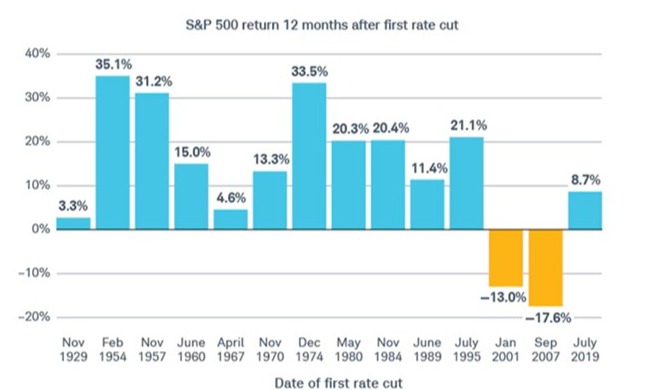

As you can see, markets have generally responded positively in the 12 months following the Fed's first rate cut. However, we can't discount the yellow bars on the right side of the chart showing significant downturns after the first Fed rate cut in 2001 and 2007. Why the different outcomes in those years?
Those years coincided with significant recessions and economic downturns. The 2001 period emanated from the bursting of the dot.com bubble and the events of 9/11. The 2007 downturn coincided with the beginning of the Great Financial Crisis, which ultimately led to the government takeover of Fannie Mae and Freddie Mac, the failure of AIG and Lehman Brothers, and the government bailouts that accompanied them.
We can begin to see that it is essential to know what is going on with the economy as the Fed starts cutting interest rates. If the Fed cuts interest rates because it has successfully lowered inflation without pushing the economy into a recession, the markets generally respond positively. However, if a significant geopolitical event or economic downturn accompanies the Fed rate cuts, the results have not been nearly as constructive going forward. We can see this in more detail in our second chart below.
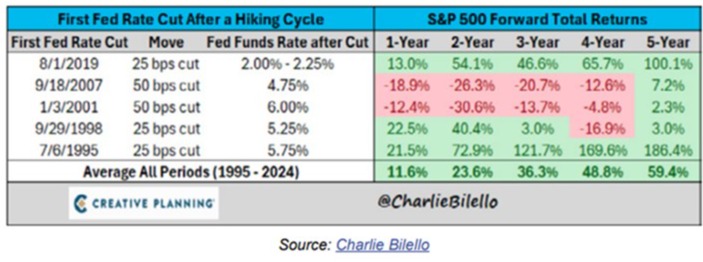
We can once again see that during the 2001 and 2007 interest rate-cutting cycles, the market did not respond favorably due to multi-year economic downturns and geopolitical events. This leads to our second big question, “Is a recession in our future?” I have shared with you previously that there is plenty of economic data that historically would have pointed toward a recession by now.
However, there is also a growing optimism among many economists and market strategists that the Fed will be able to stick the proverbial “soft landing,” raising interest rates enough to lower inflation pressures without slowing the economy so much that it causes a recession and a massive rise in unemployment.
Markets are pricing in that this cut will be the first of many. Fed futures are currently predicting that there will be as many as three rate cuts before the end of the year and four more in 2025. This would take the Fed's overnight lending rate from 5.25%—5.5% toward the 3.5% level. Whether this comes to fruition or not is yet to be seen. Please remember that these same Fed futures markets predicted as many as seven interest rate cuts in 2024 at the beginning of the year.
So, will the Fed’s version of “The First Cut Is the Deepest” become the seventh time it becomes a hit? We will be looking to answer that question over the coming months. In the meantime, we wanted to give you some context as the financial media and cable news networks will likely give the September 18th fed meeting more attention than usual. We always believe it is important to be informed as we continue “Moving Life Forward.”
© 2024 Jesse Hurst
Senior Wealth Manager
The views stated are not necessarily the opinion of Cetera and should not be construed directly or indirectly as an offer to buy or sell any securities mentioned herein. Due to volatility within the markets mentioned, opinions are subject to change without notice. Information is based on sources believed to be reliable; however, their accuracy or completeness cannot be guaranteed. Past performance does not guarantee future results.
Neither Cetera Advisors LLC nor any of its representatives may give legal or tax advice. This information is not intended as tax or legal advice. Please consult legal or tax professionals for specific information regarding your individual situation.
Investors cannot directly invest in indices.
Featured Blog Image Source: iStock.com/Nerthuz