September 2026 Investylitics
Horizon Advisor Network Investment Committee September 8, 2026
Executive Summary
- In August 2026, the S&P 500 delivered a solid turnaround, advancing 2.7% to bounce back from its July slump and reach new record highs. This upward momentum was driven largely by a strong rebound in information technology and continued robust earnings.
- Large-cap value stocks have significantly outperformed large-cap growth stocks in 2026, reversing a multi-year trend of growth dominance. Trends and reversals like this support the principle of maintaining a wisely diversified portfolio designed to meet your financial goals.
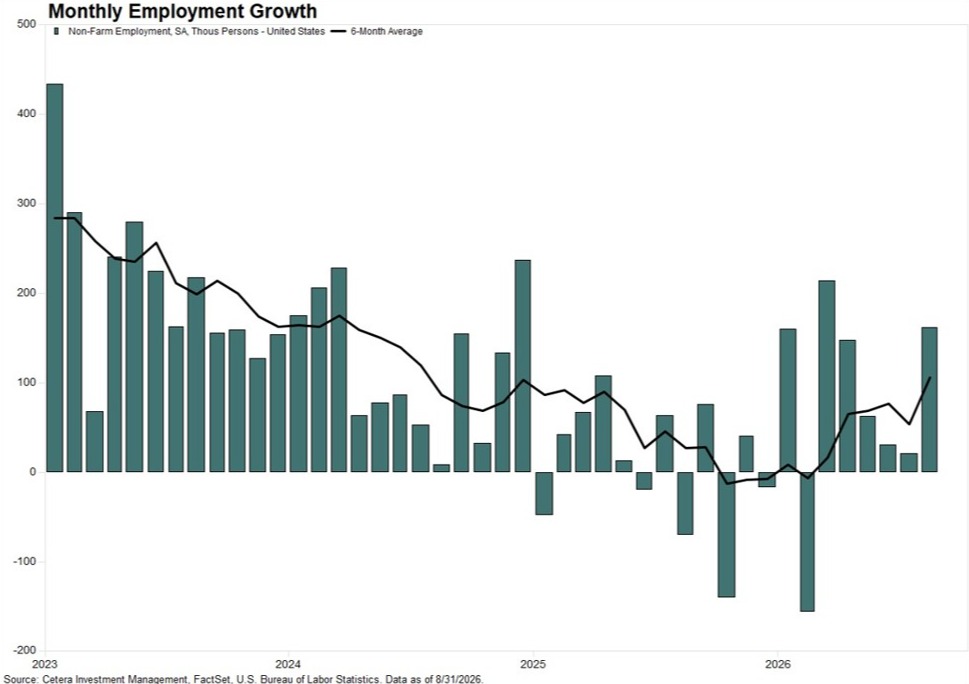
- The US labor market delivered an upside surprise as nonfarm payrolls surged by 162,000 in August 2026, while the unemployment rate held steady at 4.1% and weekly initial jobless claims remained muted at 206,000.
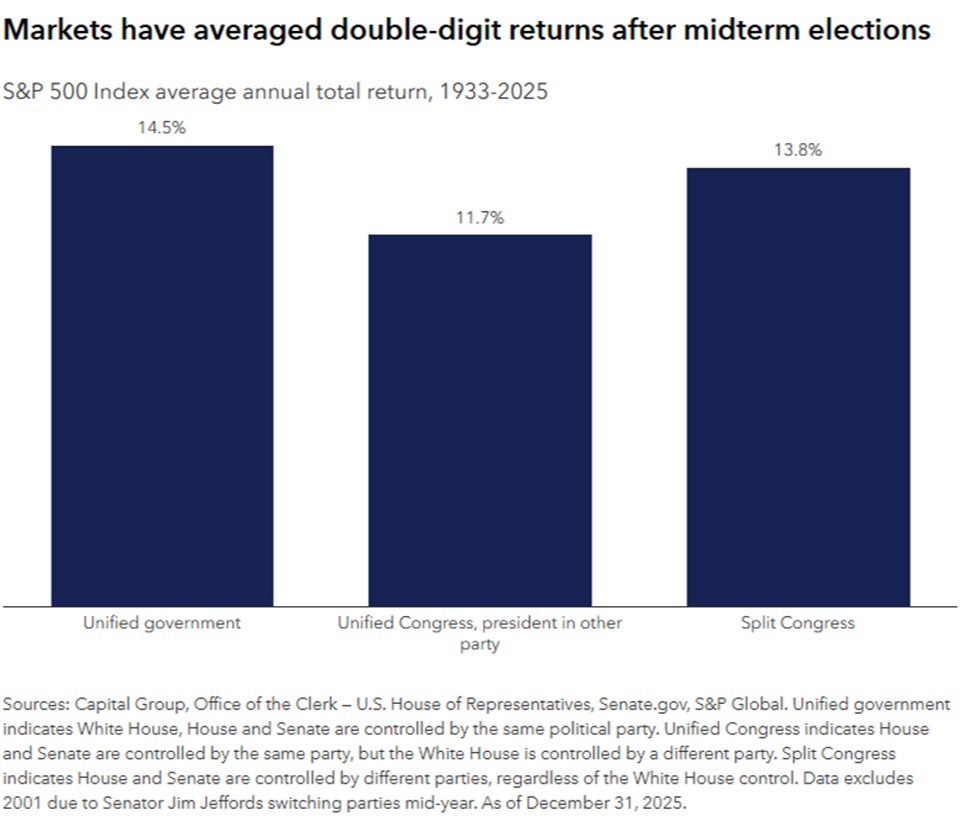
- Attention is continuing to focus on the upcoming midterm elections. While we know the months leading up to the election create short-term volatility, markets tend to rally once the outcome is determined. Historically, this has been true regardless of which party comes out on top and whether we have a unified or split government. Keep in mind that historical trends do not guarantee future market performance.
- The committee would like to take this moment to remind you that market pullbacks are completely normal. Historical data suggests that the market experiences an average annual decline of about 14%, and a drop twice that size roughly one year out of six. Much like a lifeboat drill, which is done before the boat sets sail, investors should prepare for the next downturn before it happens.
All members of the Horizon Advisor Network Investylitics Committee met Tuesday afternoon, September 8. While corporate earnings and many economic reports showed resilience and strength, we continue to face an uncertain geopolitical backdrop, rising energy prices, and the upcoming midterm elections, which may create bouts of volatility. We were pleased to review the portfolio recommendations and market outlooks from the economists and market strategists our committee follows.
In August 2026, the S&P 500 delivered a solid turnaround, advancing 2.7% to bounce back from its July slump and touch new record highs. This upward momentum was driven largely by a strong rebound in information technology, robust corporate earnings, and rising energy commodities, before pulling back slightly at month-end after unexpectedly hawkish Federal Reserve commentary at Jackson Hole.
Large-cap value stocks have significantly outperformed large-cap growth stocks in 2026, reversing a multi-year trend of growth dominance. Trends and reversals like this support the principle of maintaining a wisely diversified portfolio designed to meet your financial goals.
Against this backdrop, fixed-income assets struggled in August, with 10-year Treasury yields pushing toward 4.75%, while gold surged 9.9% to close near $4,500. Interest rates for longer-term government bonds, such as 10-, 20-, and 30-year maturities, have risen recently.
Dr. Ed Yardeni of Yardeni Research notes, "If the bond market continues to push interest rates higher on its own, it could accomplish the Fed's job of tightening for them." He argues that if the Fed announced a rate cut, it could have increased market volatility. However, because yields have been rising on their own due to market forces, we haven't seen much media coverage, which may help avoid market shocks. We will be watching next week's Fed meeting to see whether this plays into their policy decision.
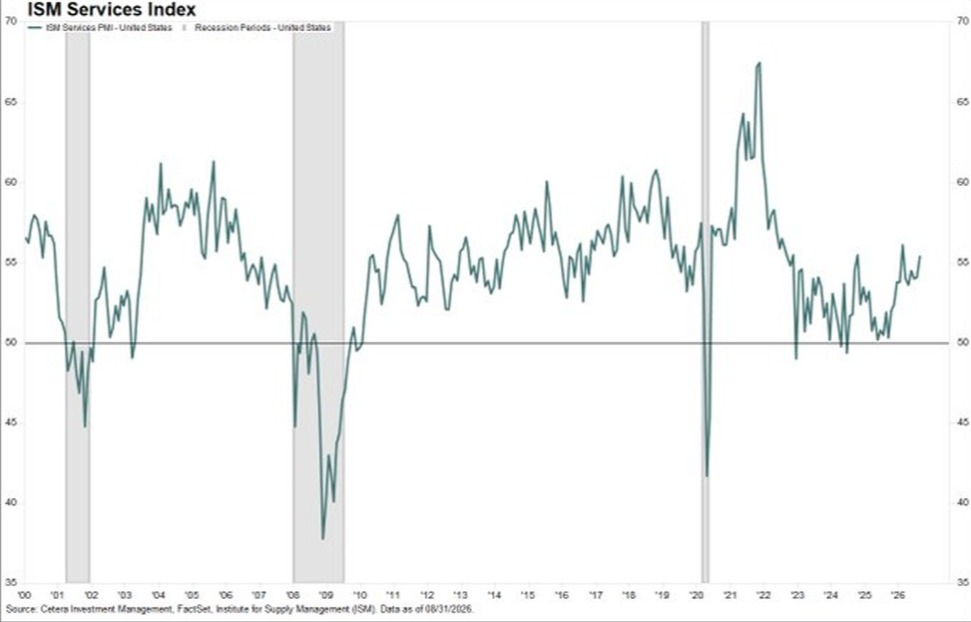
We believe many economic reports continue to surprise to the upside. The ISM Services Index increased to a 6-month high of 55.4 last month, driven by stronger business activity and new orders.
At the same time, the US Economic Surprise Index is down from its June peak but remains firmly in positive territory and above its 5-year average. The index has been positive throughout 2026, indicating that economic data has consistently exceeded expectations.
The US labor market delivered an upside surprise as nonfarm payrolls surged by 162,000 in August 2026. Revisions added 55K jobs to the prior two months. The unemployment rate held steady at 4.1% and weekly initial jobless claims remained muted at 206,000. As the chart below shows, the six-month average of employment growth steadily moved upward this year, surprising many economists.

The sudden acceleration in hiring shifts the Federal Reserve's primary focus back to upcoming consumer price data. While the robust payroll numbers reinforce the case for maintaining higher interest rates, central bank officials will likely wait for Friday's CPI report to make a definitive policy decision.
Attention is continuing to focus on the upcoming midterm elections. While we know the months leading up to the election create short-term volatility, markets tend to rally once the outcome is determined. Historically, this has been true regardless of which party comes out on top and whether we have a unified or split government, as shown in our final chart below.

The committee would like to take this moment to remind you that market pullbacks are completely normal. Historical data suggests the market averages about a 14% annual decline, with a drop twice that size roughly once every six years.
Much like a lifeboat drill, which is done before the boat sets sail, investors should prepare for the next downturn before it happens. We must remember that historically, market declines have been temporary. The watchword of the drill is always, "This too shall pass," to counteract the dangerous psychological trap, largely perpetrated by the media and social media, of trying to make you believe "This time is different."
Remember that since 2020, the stock market, as represented by the S&P 500 index, has experienced four significant downturns over the past six-plus years. These bouts of volatility accompanied the COVID-19 outbreak, Russia's invasion of Ukraine and the inflation and interest-rate shock that followed, the trade tariff war, and the war with Iran.
However, amid the economic and geopolitical dislocation and volatility we've seen since January 2020, the S&P 500 Index has more than doubled, rising from roughly 3,200 at the beginning of 2020 to around 7,660 today... "This too shall pass." However, keep in mind market downturns can be prolonged and investors should consider their objectives, risk tolerance, and time horizon.
The committee appreciates your continued trust and support. If you have questions about your unique situation or would like your advisor to walk you through your own personalized lifeboat drill, please reach out; we are here for you. Make it a great day!
The views stated in this piece are not necessarily the opinion of Cetera Advisors LLC and should not be construed directly or indirectly as an offer to buy or sell any securities. Due to volatility within the markets, opinions are subject to change without notice. Information is based on sources believed to be reliable; however, their accuracy or completeness cannot be guaranteed. Past performance does not guarantee future results.
Investors cannot invest directly in indexes. The performance of any index is not indicative of the performance of any investment and does not take into account the effects of inflation and the fees and expenses associated with investing.
A diversified portfolio does not assure a profit or protect against loss in a declining market.
INVESTYLITICS TEAM OF HORIZON ADVISOR NETWORK
Jesse Hurst - Senior Wealth Manager - Chair, Impel Wealth Management
Nathan Ollish - Senior Financial Advisor - Impel Wealth Management
Clint Gautreau, Financial Advisor - Horizon Financial Group
Kevin Myers, Financial Advisor - ATL Global
Grace Hayden MacNaught, Financial Advisor - The Planning Studio
Dusty Green, Financial Advisor - Spencer Financial Inc.
Sincerely,
Jesse W. Hurst, CFP®, AIF®
Senior Financial Planner and CEO

*Award Recipient Jesse Hurst
Forbes: Best-in-State Wealth Advisors Award received by Jesse Hurst, Senior Wealth Advisor, (2018-2025). The Forbes ranking of Best-In-State Wealth Advisors, developed by SHOOK Research, is based on an algorithm of qualitative data, rating thousands of wealth advisors with a minimum of seven years’ experience and weighing factors like revenue trends, assets under management, compliance records, industry experience, and best practices learned through telephone and in-person interviews. Portfolio performance is not a criteria due to varying client objectives and lack of audited data. Neither Forbes nor SHOOK receive a fee in exchange for rankings. Research summary as of April 2025: - 48,944 nominations received, based on thresholds - 27,586 invited to complete online survey - 23,303 telephone interviews - 6,004 in-person interviews at Advisor's location - 1,545 virtual interviews. Listing in this publication and/or award is not a guarantee of future investment success. This recognition should not be construed as an endorsement of the advisor by any client. No compensation was provided directly or indirectly by the recipient for participation or in connection with obtaining or using the third-party rating or award.
1 This recognition and the due–diligence process conducted are not indicative of the advisor's future performance. Your experience may vary. Winners are organized and ranked by state. Some states may have more advisors than others. You are encouraged to conduct your own research to determine if the advisor is right for you.
2 Portfolio performance is not a criterion due to varying client objectives and lack of audited data. SHOOK does not receive a fee in exchange for rankings.