


During the 1970s, several notable rock bands, including The Rolling Stones, Bad Company, and Led Zeppelin, moved from their home countries, often the UK, to avoid high taxes. Bad Company moved to California, and Led Zeppelin spent 1975 touring abroad, largely to avoid paying what they owed in UK taxes. The Rolling Stones had had enough and went to France to record Exile on Main Street. “[I]n those days, in England, the high tax rate was 90 percent,” Mick Jagger explained: You made 100 pounds, they took 90. So it was very difficult to pay any debts back.”
Rod Stewart was furious. He shared, “The Government thinks it’ll tax us bastards right up to the hilt because we won’t leave, but that’s wrong because I will if I want to…with a 90 percent tax ceiling, it’s just not worth living in England anymore.”
In 1973, Pink Floyd released The Dark Side of the Moon, which included the single ‘Money,’ on which Roger Waters grumbled:
Money
Get back
I’m alright, Jack, keep your hands off of my stack
Source: Wikipedia
For those of you who would like a reminder of this classic rock anthem from one of the best-selling albums of all time, I am including a YouTube link to the 50th anniversary remaster of the album. It includes the iconic double guitar solo, which lasts from approximately 3:05 to 5:05 on the video.
Pink Floyd - Money (2023 Remaster)
Britain’s top income tax rate hovered around 90% through the 1950s and 60s. These rates were a bane of Britain’s entertainment industry. One of the most famous and public examples of tax revolt came from George Harrison's song ‘Taxman,’ released on the album Revolver. The Beatles sang:
Let me tell you how it will be
There’s one for you, nineteen for me
‘Cause I’m the taxman
Yeah, I’m the taxman
“Taxman” was when I first realized that even though we had started earning money, we were actually giving most of it away in taxes,” George Harrison wrote in 1980. “It was and is still typical.” The Beatles began recording "Taxman" in April 1966, a month after Harold Wilson's landslide win in the 1966 UK general election. Coinciding with the song's creation, Harrison learned that the band members' tax obligations were likely to lead to their bankruptcy, and he was outspoken in his opposition to the government using their income to help fund the manufacture of military weapons.

Source: YouTube
Once again, I have included a link to the YouTube video of the song below for your listening pleasure. Before his tragic passing, Stevie Ray Vaughan also did an awesome cover version of this song. I encourage you to play that version as well if you have time.
Stevie Ray Vaughan & Double Trouble - Taxman
Why all this focus on taxes? Great question. You see, the Tax Cuts and Jobs Act, which was passed in late 2017 during President Trump's first administration, did not get 60 votes in the Senate and will expire at the end of this year. If it is not extended, this would mean a massive tax increase for almost all taxpayers. After focusing much of his first 100 days on border security and trying to reorder global trade through the implementation of tariffs to encourage new trade deals, it appears that much of the next 100 days will be focused on passing legislation designed to address the expiring tax law and add some additional tax cuts and incentives for both individuals and businesses.
There will be much discussion about what tax rates should be, who should pay the most in tax, and what constitutes a fair rate of income tax. To help give us all some background and understanding about what current tax rates are and how much tax people are paying based on their income, I wanted to provide you with a synopsis created by the Tax Foundation which gives us summary data for tax year 2022, the most recent year for which information is available. This information is meant to provide you with the education needed to understand better what you will be hearing from lawmakers on both sides of the aisle on Capitol Hill over the coming weeks and months.
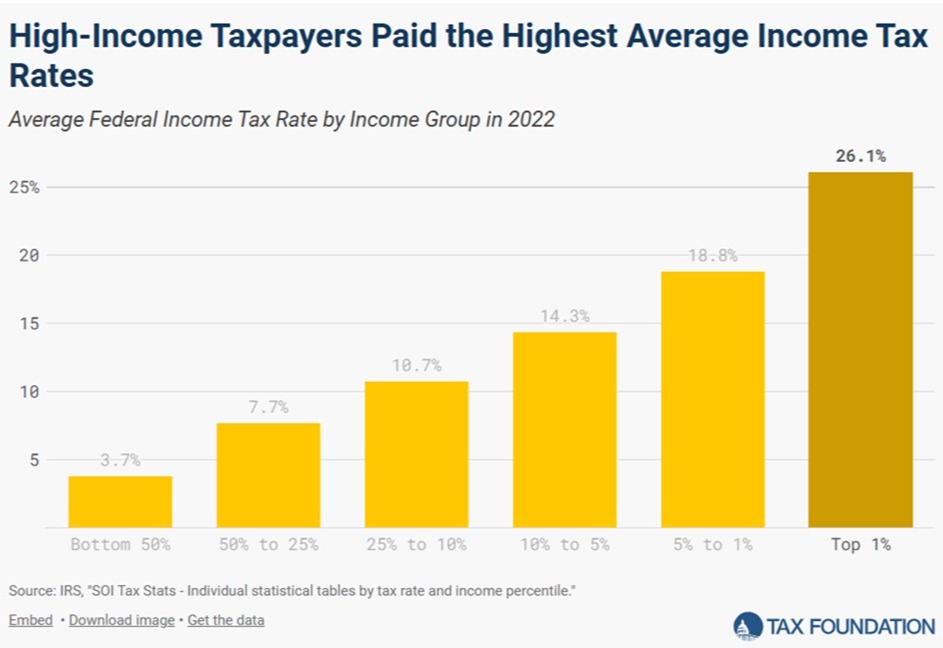
New Internal Revenue Service data for tax year 2022 shows the US federal income tax system continues to be progressive, as high-income taxpayers pay the highest average income tax rates. Average tax rates for all income groups remained lower in 2022, five years after the Tax Cuts and Jobs Act (TCJA), than in 2017 before the reform. In 2022, taxpayers filed 153.8 million tax returns, reported nearly $14.8 trillion in adjusted gross income(AGI) earnings, and paid $2.1 trillion in individual income taxes.
High-Income Taxpayers Paid the Highest Average Income Tax Rates
The bottom half of taxpayers, or taxpayers making under $50,399, faced an average income tax rate of 3.7 percent. As household income increases, average income tax rates rise. For example, taxpayers with AGI between the 10th and 5th percentiles ($178,611 and $261,591) paid an average income tax rate of 14.3 percent—almost five times the rate paid by taxpayers in the bottom half.
The top 1 percent of taxpayers (AGI of $663,164 and above) paid the highest average income tax rate of 26.1 percent—seven times the rate faced by the bottom half of taxpayers, as you can see in our first chart below.
High-Income Taxpayers Paid the Majority of Federal Income Taxes
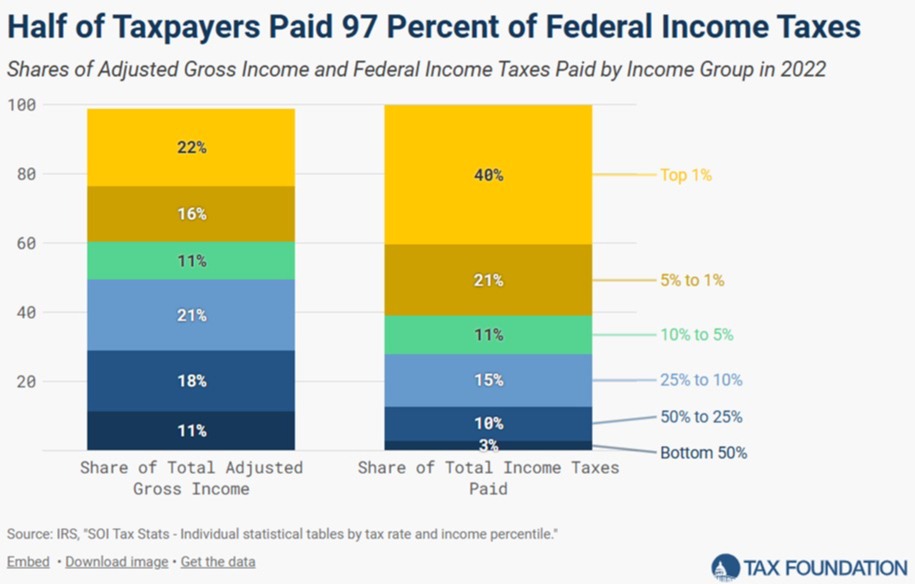
In 2022, the bottom half of taxpayers earned 11.5 percent of total AGI and paid 3 percent of all federal individual income taxes. The top 1 percent earned 22.4 percent of total AGI and paid 40.4 percent of all federal income taxes. In total, the top 1 percent of taxpayers paid more income taxes than the bottom 90 percent combined. The top 1 percent paid $864 billion in income taxes, while the bottom 90 percent paid $599 billion, as shown in our second chart below.
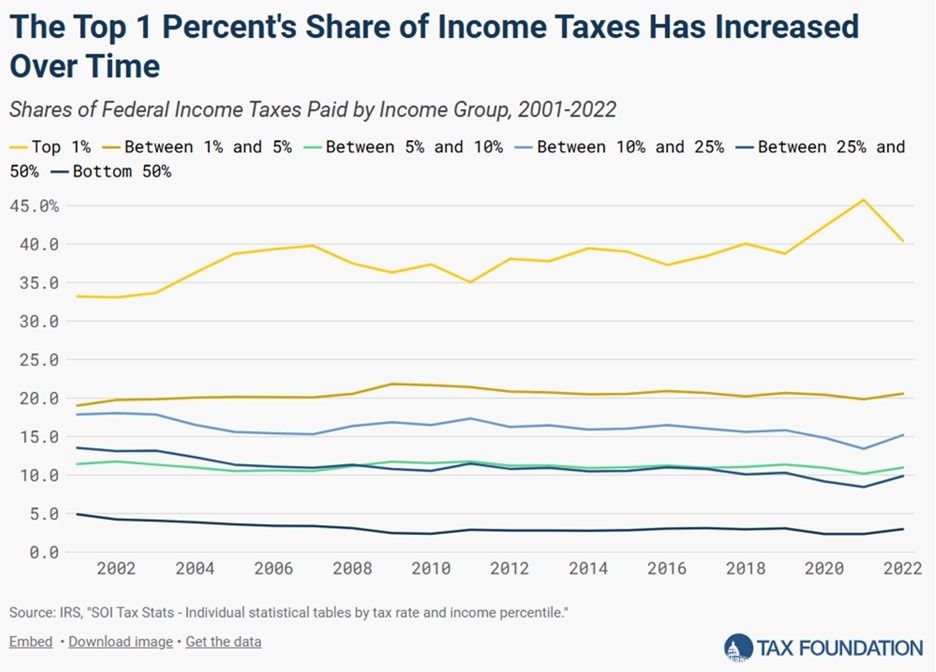
The share of income taxes paid by the top 1 percent increased from 33.2 percent in 2001 to 40.4 percent in 2022. While the share has generally been rising over the period, 2020 and 2021 are outlier years primarily because of significant changes in income and tax policy during the coronavirus pandemic. Over the same period, the share of income taxes paid by the bottom 50 percent of taxpayers fell from 4.9 percent in 2001 to 3 percent in 2022, as shown in our final chart below.
Once again, the information in the charts above comes from IRS records and is not meant to be commentary on what tax policy and rates should be, or what is fair. It is intended to provide you with the information to interpret the substantial amount of cable news and social media headlines likely to be generated around this topic in the next few months.
While it may have been relatively easy for rock bands of the 1960s and 1970s to move to a different country to avoid paying what they considered ridiculous income tax rates, it is not a practical solution for most of our clients. As the focus on Capitol Hill shifts to the “Taxman” and what future tax law will be drafted and agreed to by those in Congress, we wanted to keep you informed. It is part of our mission as we continue “Moving Life Forward.”
© 2025 Jesse Hurst
Senior Wealth Manager
Related Content
The views stated are not necessarily the opinion of Cetera and should not be construed directly or indirectly as an offer to buy or sell any securities mentioned herein. Due to volatility within the markets mentioned, opinions are subject to change without notice. Information is based on sources believed to be reliable; however, their accuracy or completeness cannot be guaranteed. Past performance does not guarantee future results.
Neither Cetera Advisors LLC nor any of its representatives may give legal or tax advice. This information is not intended as tax or legal advice. Please consult legal or tax professionals for specific information regarding your individual situation.
Featured Blog Image Source: iStock.com/HitToon