


“Treat Me Nice” was recorded by Elvis Presley in 1957 and featured in Jailhouse Rock. In the film, Elvis plays Vince Everett, a man trying to reinvent himself, make something of his future, and, in the process, lays out a pretty simple message: treat me right… or I’m gone. It’s a catchy lyric. It’s also a pretty good economic principle. Because money—capital, income, wealth—has a funny way of behaving like Elvis. If it isn’t treated well, it doesn’t argue. It doesn’t protest. It just leaves.

Source: Wikipedia
If you are unfamiliar with the B side of the movie’s title song, or you simply want a fun, upbeat song to get you in a good mood today, I have included a YouTube link to the movie's video below.
Elvis Presley - Treat Me Nice / Original Soundtrack / ReScan 8K
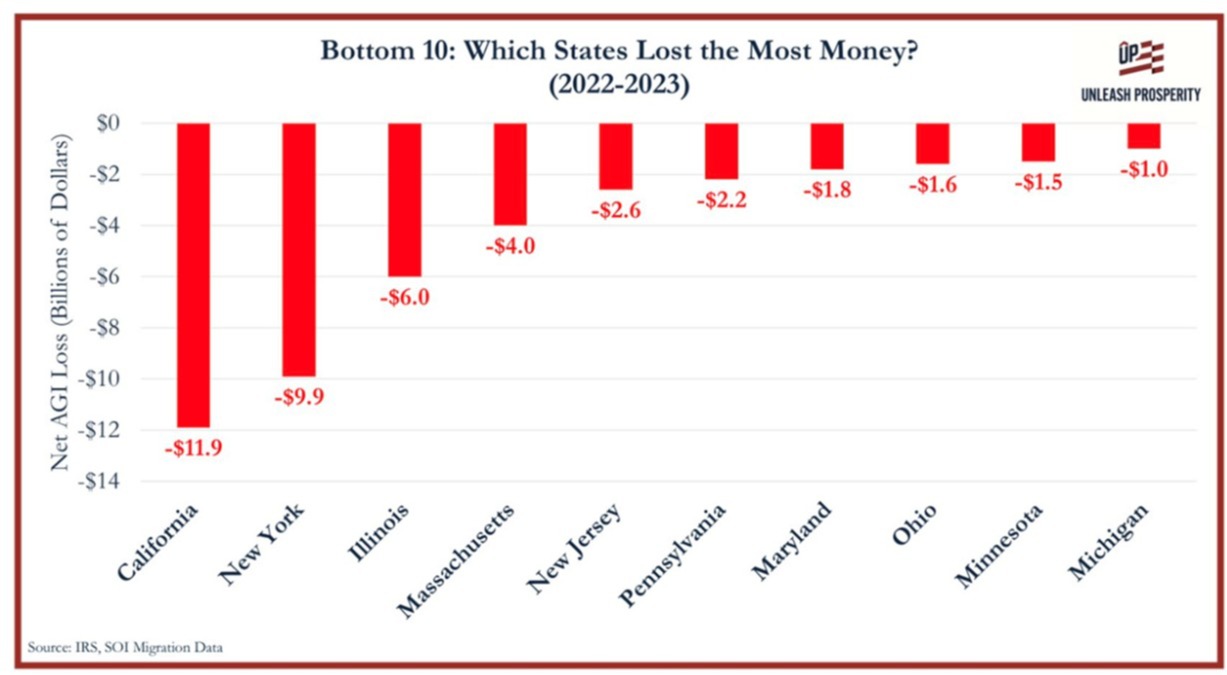
Over the last few years, we’ve had a real-time case study in how this plays out across the United States. The IRS tracks migration data not just by people, but by adjusted gross income (AGI)—where the money is going. And the numbers tell a clear story. As shown in our first chart below, from 2022 to 2023, California saw roughly $11.9 billion in net income leave, New York lost about $9.9 billion, Illinois lost $6.0 billion, and Massachusetts lost $4.0 billion. That’s not just population movement—that’s capital walking out the front door.
Source: IRS, SOI Migration Data
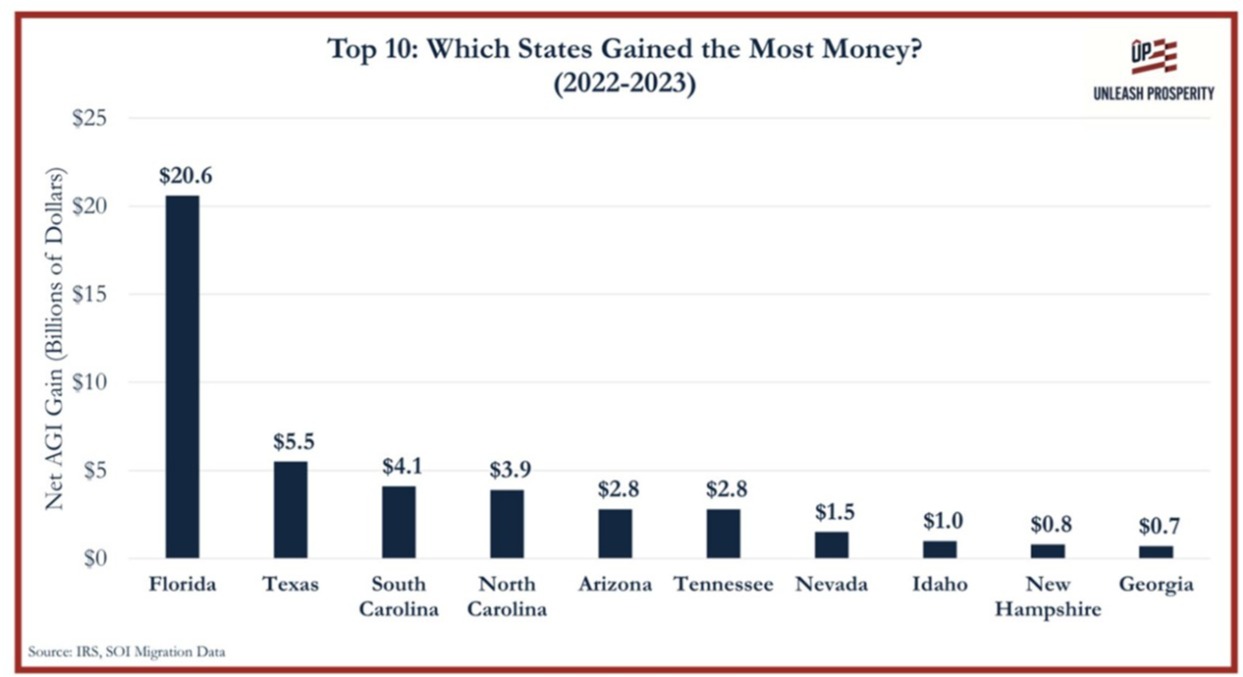
On the other side of the ledger, Florida gained about $20.6 billion, Texas $5.5 billion, South Carolina $4.1 billion, and North Carolina $3.9 billion. That’s a lopsided scoreboard, as you will see in our second chart below.
Source: IRS, SOI Migration Data
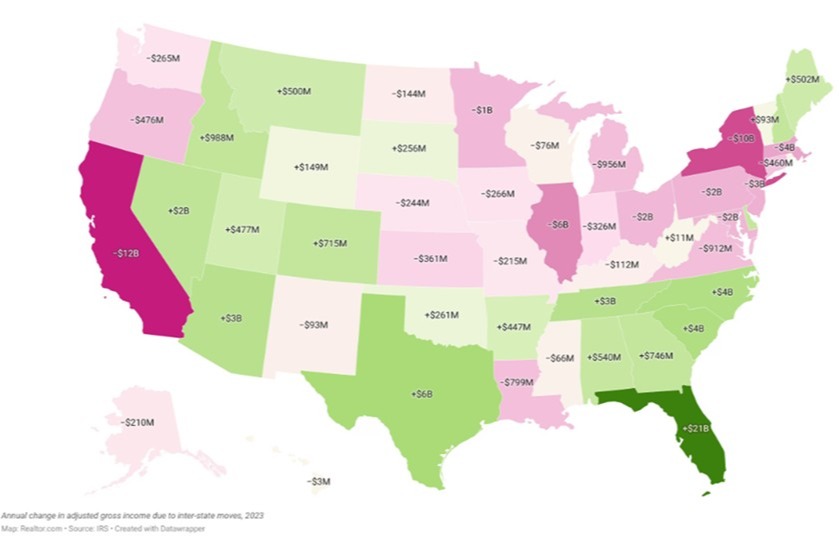
And if you zoom out to the national map, the pattern sharpens: green across much of the Southeast, Southwest, and Mountain West… pink across much of the Northeast and West Coast.
Source: Realtor.com
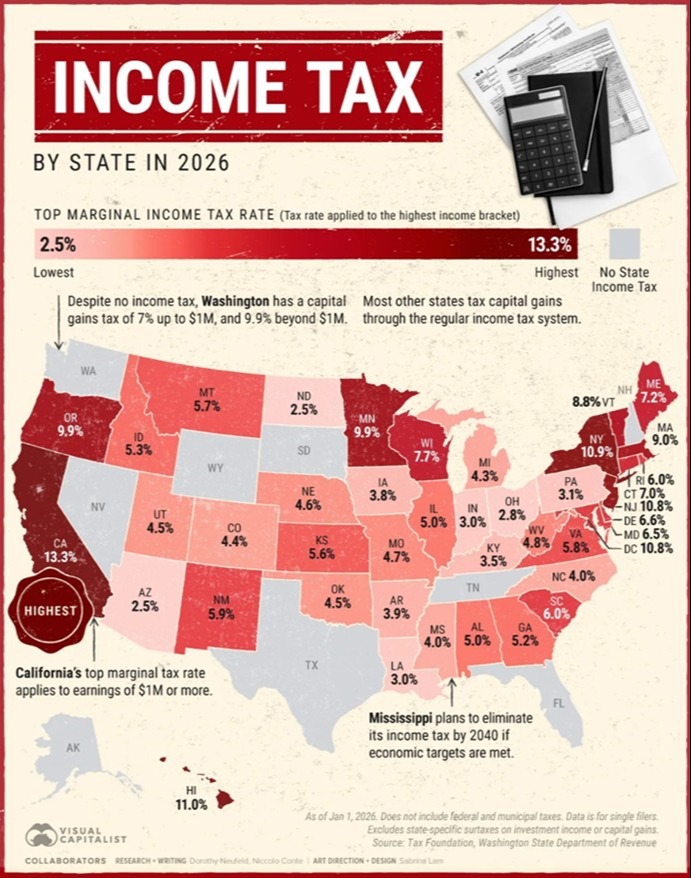
Now, correlation isn’t causation. People move for many reasons…jobs, weather, housing, family. But it’s hard to ignore one variable that lines up almost too neatly: tax policy. As shown in our last chart below for 2026, states like California top out around 13.3%, New York pushes above 10%, while Florida, Texas, and Tennessee sit at 0% state income tax. That’s not a small difference—it’s structural. If you’re a high earner, the math isn’t subtle. On $1 million of income, a 13% tax rate is $130,000, while a 0% rate is $0.
Source: Visual Capitalist
That’s not a rounding error.
That’s a house.
A business investment.
A retirement cushion—that can allow you to build a wider moat around your retirement castle…every single year.
But here’s where it gets interesting. While recent headlines focus on CEOs leaving states like California and New York and moving to Texas and Florida, this isn’t just about the ultra-wealthy packing up yachts and heading south. The IRS data captures aggregate income, including that of small business owners, retirees, and professionals…people making real-life decisions about where their dollars go further. And those decisions add up.
I see this firsthand. Every year, I have clients who choose to relocate to states like Texas, Tennessee, or Florida, not for politics, but for math. Every dollar not paid in taxes is a dollar that can fund retirement, support family, or go toward causes that matter.
When billions of dollars leave a state, it doesn’t just impact tax revenue. It affects local investment, housing demand, small business formation, and long-term economic growth. Conversely, when billions flow into a state, those same forces begin compounding in the opposite direction. Money doesn’t just move. It builds.
So, what are we really seeing? Not a political statement. Not a cultural shift. Just behavior. People, and their capital, respond to incentives. Always have. Always will. Elvis didn’t overcomplicate it: treat me nice… or I’ll be gone. The IRS data suggests capital feels the same way. And in today’s increasingly mobile world, where remote work is viable, businesses are portable, and relocation is easier than ever—that reality is only becoming more pronounced.
For investors, this matters. Because capital flows tend to lead economic momentum rather than follow it. The states gaining income today are likely to see stronger population growth, increased demand for infrastructure and housing, and expanding tax bases—even at lower rates. While the states losing capital may face tougher trade-offs ahead.
None of this is about right or wrong. It’s about math. And the math is pretty straightforward: when you treat money well, it tends to stick around. When you don’t, it finds somewhere else to go. Just ask Elvis. You’re going to hear a lot about these issues in the months ahead. My goal is simple: make sure you’re looking at the data—not just hearing the noise. Because at the end of the day, good decisions start with good information. And that’s how we keep “Moving Life Forward.”
© 2026 Jesse Hurst
Senior Wealth Manager
Related Content
The views stated are not necessarily the opinion of Cetera and should not be construed directly or indirectly as an offer to buy or sell any securities mentioned herein. Due to volatility within the markets mentioned, opinions are subject to change without notice. Information is based on sources believed to be reliable; however, their accuracy or completeness cannot be guaranteed. Past performance does not guarantee future results.
Neither Cetera Advisors LLC nor any of its representatives may give legal or tax advice. This information is not intended as tax or legal advice. Please consult legal or tax professionals for specific information regarding your individual situation.
Investors cannot directly invest in indices.
Featured Blog Image Source: iStock.com/simplehappyart