


The Three Mile Island accident, which occurred on March 28, 1979, was a partial nuclear meltdown in Reactor Unit 2 of the Three Mile Island Nuclear Generating Station located near Harrisburg, Pennsylvania. It was the most serious accident in the history of U.S. commercial nuclear power plants. A series of equipment failures, including a stuck-open relief valve in the primary system, allowed a large amount of water to escape the reactor's coolant system. This prevented proper heat removal from the core, leading to overheating.
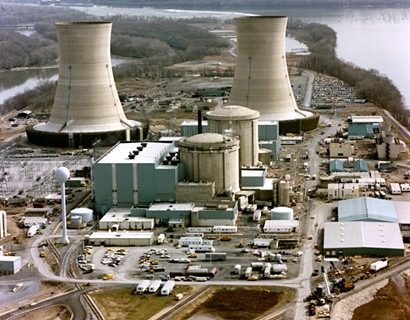
Source: Wikipedia
Inadequate or misleading instrumentation, such as a faulty indicator for the relief valve's position, contributed to the confusion and delayed response by operators. Operators initially misdiagnosed the situation and took actions that made the problem worse, such as shutting down emergency cooling pumps, due to bad and inadequate training for such a complex emergency scenario. The incident caused widespread public fear and concern about the safety of nuclear power, leading to large-scale protests and fueling anti-nuclear movements.
This led to the formation of Musicians United for Safe Energy (MUSE). They held the “No Nukes” concerts over five nights, from September 19th to September 23rd, 1979, at Madison Square Garden in New York City to raise awareness and funds for the anti-nuclear movement. The concerts were a direct response to the Three Mile Island nuclear accident in March 1979 and were meant to bring awareness to the public's fears about the safety of nuclear power. The concerts featured a star-studded lineup including Bruce Springsteen & The E Street Band, Crosby, Stills & Nash, The Doobie Brothers, James Taylor, Carly Simon, Tom Petty & The Heartbreakers, and others.
No Nukes: The Muse Concerts for a Non-Nuclear Future was a 1979 triple live album that contained selections from the September 1979 Madison Square Garden concerts by the Musicians United for Safe Energy collective. Jackson Browne, Graham Nash, Bonnie Raitt, and John Hall were the key organizers of the event and guiding forces behind the album. This was the first official appearance of Bruce Springsteen and the E Street Band's live act on record, and their "Detroit Medley" achieved considerable album-oriented rock airplay.
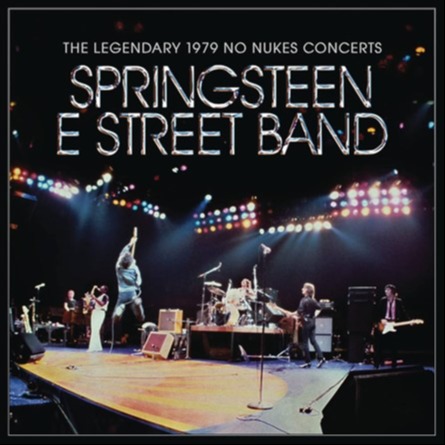
Source: Amazon.com
In 2021, Springsteen officially released a compilation of songs he performed in his sets from the shows as the live album The Legendary 1979 No Nukes Concerts. A YouTube link to the concert video is included below and clocks in at 1:45. Bruce was paying homage to his hero, Elvis Presley, who had recently passed away.
Bruce Springsteen and The E Street Band - The Legendary 1979 No Nukes Concert Trailer
For those of you who have six minutes to spare and could use an extraordinarily fun and energetic pick me up, a YouTube link to the band's closing song, Quarter to Three, a relatively obscure cover of Gary U.S. Bonds' 1961 hit, is included for you below. I highly recommend taking the time to watch. The concert occurred when Bruce was just 30 years old. It will give you some idea of what it is really like to attend a Springsteen concert, something I have done more than a dozen times.
No Nukes Encore - Quarter to Three, excellent performance!
Politicians listened to the musicians' efforts and the fears of the American people. Since the 1970s, building a new reactor has effectively been illegal in America. It required $30 billion and 15+ years in regulatory purgatory to get a new nuclear facility across the finish line. In 1974, a bureaucratic monster called the Nuclear Regulatory Commission (NRC) was born. How many new reactor designs have been approved since the bureaucracy was created? Zero! Only two reactors have started commercial operation on the NRC’s watch, compared to 133 before it. Government work at its finest…
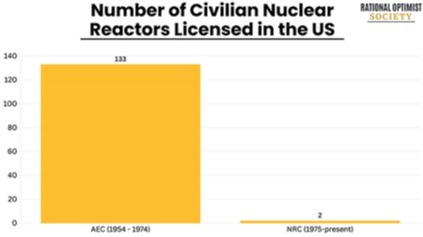
Source: Rational Optimist Society
This is nothing new for the US government. Nearly 50 years ago, supersonic flight made a trip from New York to London possible in approximately three hours instead of eight. The problem was that every time these planes took off, they created a Sonic boom, which caused issues for people on the ground below them. In its infinite wisdom, instead of banning Sonic booms, all supersonic flights were made illegal for the next five decades. That is, until recently. Despite the tremendous advances in engineering and technology that have been brought to our world, we are still flying at the same speeds we were when I was a child. All of that is going to change in the next 5 to 10 years.
Back to solving the world's evolving electrical generation needs without creating carbon emissions and greenhouse gases. A single uranium pellet the size of a gummy bear contains as much energy as 140 barrels of oil. It’s the cleanest, safest energy source known to man. So why don’t we have nuclear-powered everything?
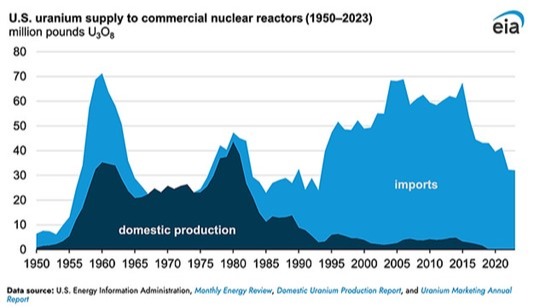
One of the problems we have here in America is getting the fuel for the next generation of nuclear reactors. Unfortunately, many of today's innovators lack the fuel they would need to get their new machines up and running. How is that possible? Because America regulated its domestic nuclear fuel industry to death, handing control of the supply chain to Canada, Kazakhstan, Australia, Namibia, Niger, and Russia. Over 85% of the world’s uranium comes from these six countries. America has plenty of uranium in the ground. But thanks to overregulation, it has minimal capacity to process it. As of 2023, 99% of the fuel used in US reactors was imported – much of it from Russia, as you can see in the chart below.
President Trump has signed four executive orders to turbocharge nuclear. These orders will bring about a number of changes to the future of nuclear energy in the United States. They set a goal of quadrupling the size of America’s nuclear fleet by 2050. They also speed up the development of “advanced nuclear” through pilot programs and streamlined environmental reviews. They order the NRC to license new reactors within 18 months. They ordered the Department of Energy (DoE) to approve at least three reactors by mid-2026, so that they will be up and running for America’s 250th birthday.
Small Modular Reactors (SMRs) typically have a power output of up to 300 Megawatt electric per module, which is significantly smaller than traditional large-scale nuclear reactors. While they are not "small enough to fit in a backyard," they are considerably smaller than conventional plants, potentially requiring only a fraction of the space. Many people ask me whether these small nuclear reactors have been tested and are trustworthy. I remind them that we have a whole fleet of nuclear submarines and nuclear aircraft carriers that have been running on similar technology for decades. My younger brother Craig was a naval officer and served on both of these nuclear port vessels.
As technology such as electric vehicles and AI data centers continues to boost demand for electricity significantly, there is a need to find safe, reliable, and clean sources for these ongoing needs. U.S. electricity demand is projected to increase considerably in just the next few years. A new report from ICF International suggests that demand will grow by 25% between 2023 and 2030. This growth is primarily attributed to the increasing use of data centers and manufacturing facilities. Further projections out to 2050 show an even more dramatic increase of 78%.
America’s bright future requires a lot more energy, not less. Remember: There is no such thing as a rich, low-energy country, as you will see in our final chart below.
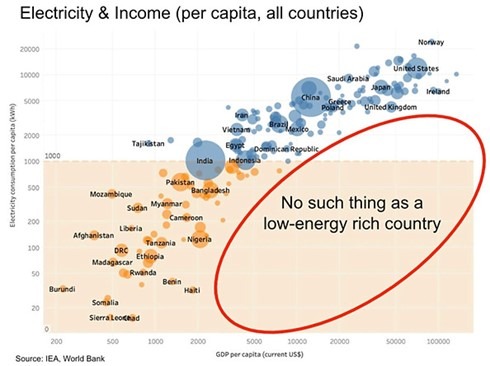
With 1,000 microreactors dotted across the US we could desalinate seawater and turn barren deserts green. After hurricanes, portable reactors could roll in to power hospitals and water systems within hours. Despite musicians, including some of my favorites, telling the world that we should say “No Nukes” in 1979, building an abundant, independent, prosperous, and low-carbon future comes down to towns and cities across America saying “Yes Nukes”.
If you want to learn more about nuclear and other technologies that can positively shape our future world and give us a much brighter tomorrow than many believe is possible, I strongly suggest that you search for and subscribe to the Rational Optimist newsletter. The weekly publication hits my inbox every Sunday morning, and I always feel better about the future after reading it. I thought this was an important message and history lesson to share with you as we continue “Moving Life Forward.”
© 2025 Jesse Hurst
Senior Wealth Manager
Related Content
The views stated are not necessarily the opinion of Cetera and should not be construed directly or indirectly as an offer to buy or sell any securities mentioned herein. Due to volatility within the markets mentioned, opinions are subject to change without notice. Information is based on sources believed to be reliable; however, their accuracy or completeness cannot be guaranteed. Past performance does not guarantee future results.
Additional risks are associated with international investing, such as currency fluctuations, political and economic stability, and differences in accounting standards.
Neither Cetera Advisors LLC nor any of its representatives may give legal or tax advice. This information is not intended as tax or legal advice. Please consult legal or tax professionals for specific information regarding your individual situation.
Featured Blog Image Source: iStock.com/Pi-Lens