


Every sports fan knows the rule, even if they won’t admit they believe it.
If you make the cover of Madden NFL, something bad is probably coming. Same thing with the cover of Sports Illustrated. Injury. Unexpected losses. A season that never quite gets off the ground. The list of athletes who looked invincible on a cover only to stumble shortly thereafter is long enough that it’s become part superstition, part pattern recognition. Tremendous talent didn’t protect them. Timing never does.
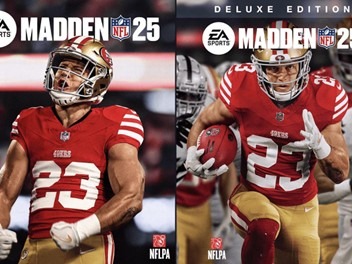
The Madden NFL Cover Curse suggests that the NFL player featured on the annual video game's cover will have a disastrous season the following year. The jinx is often traced back to Garrison Hearst (Madden 99), who suffered a career-altering ankle injury shortly after his cover appearance. Notable Victims include Michael Vick (2004): Fractured his fibula in a preseason game just days after the game’s release. Shaun Alexander (2007): Suffered a foot fracture and never rushed for 1,000 yards again. Peyton Hillis (2012): Missed multiple games due to injury and saw a massive drop in production. Christian McCaffrey (2025): Missed most of the 2024 season with calf, Achilles, and PCL injuries, appearing in only four games.
Source: reddit
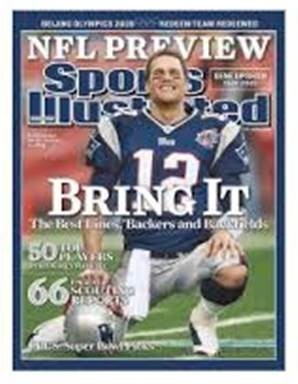
The Sports Illustrated Cover Jinx is a much older urban legend that claims that appearing on the magazine's cover leads to immediate misfortune. Its Origins: The first person on the cover, Eddie Mathews (1954), broke his hand shortly after his issue hit newsstands. High-Profile Instances include 1957 Oklahoma Sooners: Featured with the headline "Why Oklahoma Is Unbeatable," they immediately lost their 47-game winning streak. 2008 Tom Brady: Suffered a season-ending ACL tear the same week his "NFL Preview" cover was released. 2024 Athing Mu: Tripped during the 800-meter final and missed the Paris Olympics shortly after appearing on an Olympic-themed SI cover.
Source: Instagram
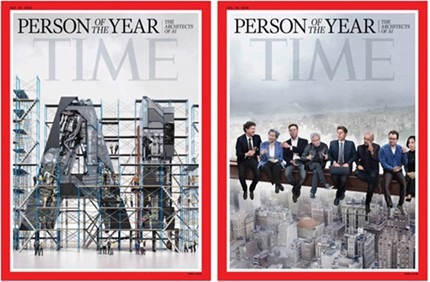
So, when Time Magazine named the “Architects of AI” its People of the Year, my first reaction wasn’t amazement. It was the same uneasy feeling you get when your favorite running back shows up on the cover in August. Uh oh.
Source: Time
Because this phenomenon isn’t limited to sports, financial history has its own version of the cover curse. There are many examples of this, as I shared with you in my July 2023 blog post, Financial Journalism is Wrong...AGAIN.
https://www.impelwealth.com/blog/financial-journalism-is-wrong-again
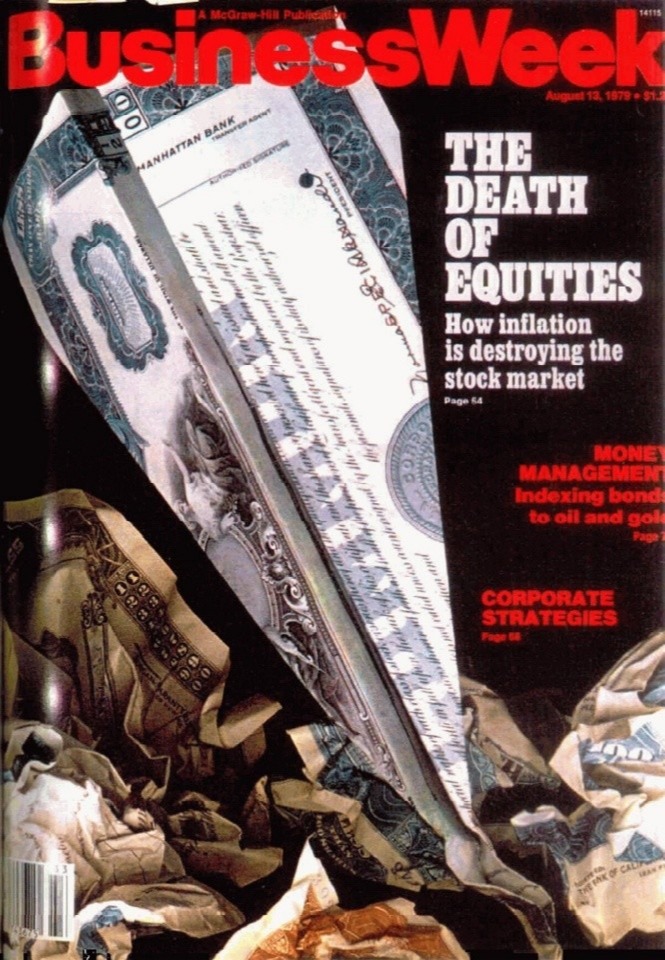
In 1979, BusinessWeek famously declared “The Death of Equities.” Stocks were unloved, inflation was rampant, confidence was gone — and the cover captured exactly how investors felt. What followed wasn’t the end of equities, of course, but one of the greatest bull markets in modern history.
Source: Real Investment Advice
More recently, in April 2019, we were told inflation was dead. Permanently. Structural forces, technology, demographics…take your pick. That declaration didn’t age particularly well once the COVID-19 stimulus met supply constraints and prices began rising at the fastest pace in four decades.
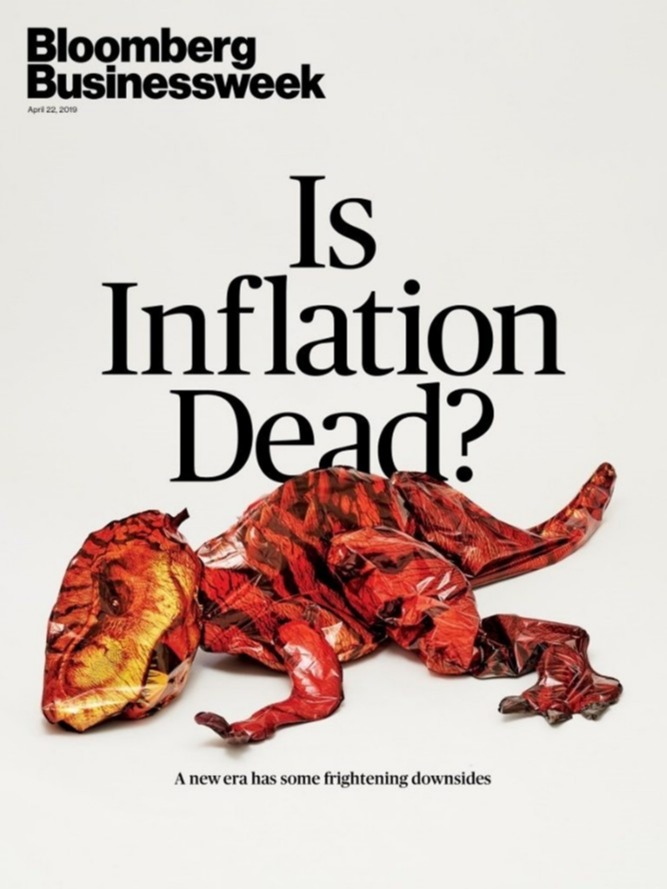
Source: Real Investment Advice
These covers weren’t wrong because journalists are careless or incompetent. They were wrong because the media is, by design, reactive. Covers don’t predict turning points. They commemorate narratives that already feel settled. By the time something earns a crown, it’s usually no longer early; it’s obvious.
That’s what makes the AI cover so interesting. When searching all the Time Magazine Person of the Year covers for any corporate head, CEO, or industry as the winner. Nine that fit the bill. The List includes such venerable leaders as Owen Young, the CEO of RCA in 1929, Harlow Curtis, CEO of General Motors in 1955, and Ted Turner come on the CEO of TBS in 1991. In looking through the data, it is also interesting to note that making the cover of Time magazine coincided with their companies’ stocks underperforming over the next year or two. We will have to wait and see whether this pattern repeats itself with the “Architects of AI.”
To be clear, AI is real. This isn’t pets dot-com. The productivity gains, the genuine innovation, the way it’s already changing workflows and business models — none of that is in dispute. But AI didn’t land on the cover of Time because it’s just getting started. It landed there because it has already captured the imagination, dominated headlines, driven market leadership, and convinced an enormous number of people that the future has arrived.
Financial author Jared Dillian recently ran a chart under the blunt title “AI Is Probably Doomed.” Not doomed in the sense that the technology disappears or stops mattering, but doomed in the way most consensus trades eventually are. When everyone agrees, when positioning becomes crowded, when belief hardens into certainty, the margin for disappointment narrows dramatically.
Anyone who lived through the late 1990s remembers how this played out. The Nasdaq didn’t simply roll over and die at the top. It became volatile, emotional, and exhausting. Big rallies. Sharp drops. False starts in both directions. Even investors who were ultimately right found it incredibly difficult to hold positions through the noise, as it took years and an enormous amount of patience and conviction to hold on to their positions and eventually profit from them.
That’s how major trends tend to end — not with a single crash, but with frustration. And it raises an uncomfortable question that investors rarely want to ask in the moment: if everyone already knows AI is the future, who’s left to buy?
This is where financial journalism tends to struggle the most. Its role should be to provide context, skepticism, and balance. Instead, at extremes, it often reinforces what people already believe. At market tops and bottoms alike, the media doesn’t push back against the crowd — it amplifies it. That’s why the most confident covers often mark inflection points rather than beginnings.
So, is this the Madden/Sports Illustrated cover moment for AI? Maybe. Maybe not. AI isn’t a running back with a fragile knee. It’s a powerful, durable technological shift. But markets don’t reward brilliance alone. They reward surprises, and surprises are hard to come by when expectations are sky-high. You can believe sincerely in AI and still believe that volatility is coming, leadership will shift, and the biggest winners of the last cycle may not lead the next one. That isn’t bearish. It’s realistic.
The real takeaway here isn’t to short AI, bet against technology, or assume the end is imminent. It’s something far simpler and far more helpful. When something makes the cover, your job as an investor isn’t to cheer. It’s time to think. It’s time to ask questions. It’s probably NOT the time to blindly follow the herd. I thought this was an important message and reminder as we continue “Moving Life Forward.”
© 2026 Jesse Hurst
Senior Wealth Manager
Related Content
The views stated are not necessarily the opinion of Cetera and should not be construed directly or indirectly as an offer to buy or sell any securities mentioned herein. Due to volatility within the markets mentioned, opinions are subject to change without notice. Information is based on sources believed to be reliable; however, their accuracy or completeness cannot be guaranteed. Past performance does not guarantee future results.
Neither Cetera Advisors LLC nor any of its representatives may give legal or tax advice. This information is not intended as tax or legal advice. Please consult legal or tax professionals for specific information regarding your individual situation.
Investors cannot directly invest in indices.
Featured Blog Image Source: iStock.com/Estherrr