


“I pulled into Nazareth, was feelin’ about half past dead…”
That opening line from The Band’s 1968 classic “The Weight” has always sounded like the beginning of an old American fable. A tired traveler arrives in town looking for rest, maybe even a little help, but instead finds himself collecting one burden after another. Every person he meets seems to need something from him. A favor. A message. A promise. A little more weight added to the bag.
Source: Wikipedia
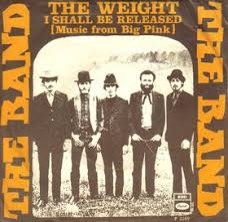
The collaboration between The Band and The Staple Singers on "The Weight" is widely considered one of the most powerful and culturally significant musical pairings in rock history, and their defining joint performance with The Band was captured for Martin Scorsese's legendary 1978 concert film, The Last Waltz. I strongly encourage you to take five minutes and watch their joint performance on the YouTube link below. It will set the stage for the rest of today's story.
The Band - The Last Waltz - The Weight feat. the staples singers
By the time the chorus arrives, the meaning is clear, even if the story remains wonderfully strange: burdens do not disappear. They get shifted.
“Take a load off, Fanny. Take a load for free. Take a load off, Fanny, and you put the load right on me.”
That may also be the best way to understand where we are today with Social Security. For nearly ninety years, Social Security has been one of the central promises in American life. Workers pay in during their careers, and retirees receive income later in life. It has never been a perfect system, but it has been a foundational one. For millions of households, it is the difference between financial dignity and financial hardship.
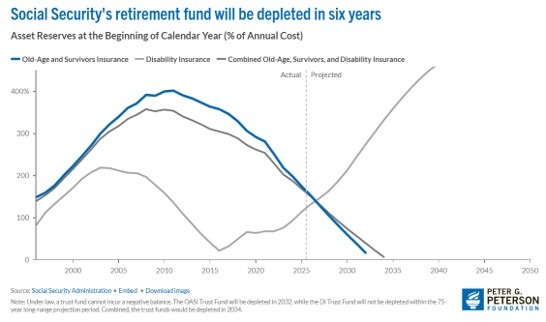
But the latest Social Security Trustees Report, released on June 9th, delivered another reminder that the system is carrying more weight than it can support indefinitely. The Old-Age and Survivors Insurance Trust Fund, which pays retirement and survivor benefits, is now projected to deplete its surplus reserves in 2032, as shown in our first chart below.
Source: Social Security Administration and The Peter G. Peterson Foundation
If Congress does nothing before then, the program will not disappear, and checks will not go to zero. That is an important distinction. But incoming payroll taxes would only cover about 78% of scheduled retirement benefits at that point.
In plain English, retirees could face an automatic benefit cut of roughly 22%.
The combined Social Security trust funds, which include disability insurance, are projected to last until 2034, at which point continuing revenues would cover about 83% of scheduled benefits. That is likely where many people have seen the “83%” figure. Either way, the message is the same: Social Security is not bankrupt in the way a company might be bankrupt, but it is underfunded relative to the promises it has made.
And if nothing changes, the load gets transferred… to current and future retirees.
That is the heart of the issue. Social Security’s problem is not that the burden vanishes in 2032 or 2034. It is that someone else is forced to carry it. Retirees may carry it through lower benefits. Workers may carry it through higher payroll taxes. Higher earners may carry it through changes to the taxable wage base. Younger generations may carry it through delayed reform and reduced flexibility. Or all of us may carry some portion of it through a combination of changes.
But the weight does not go away.
For decades, since the last major overhaul of the program, Social Security has run surpluses. More money came in through payroll taxes than went out in benefits. Those annual surpluses were credited to the trust funds and invested in special-issue Treasury securities. This was intentionally done to help fund the Baby Boom generation's retirement as they approached retirement age. That structure gave the program a cushion. It also gave policymakers time.
But time is not the same thing as a solution.
Politicians have proven this point over and over since we entered the 21st century. I have long thought that fixing Social Security was a second-term presidential issue. Because it is a politically charged third rail policy issue, most Presidents would not want to address it during their first term for fear of not getting reelected.
The last serious attempt at reform came after President George W. Bush's reelection in 2004. At the time, the trust fund was projected to remain solvent until 2042, making the problem seem distant and manageable. Bush proposed allowing workers to divert a portion of their payroll taxes into private investment accounts, but the proposal met resistance from both parties and quickly stalled. Since then, despite repeated warnings from trustees and economists, no administration or Congress has mounted a serious effort to address the long-term funding gap.
Times of financial crisis also changed the calculus of how long our Social Security trust fund would last. Remember the Great Financial Crisis of 2008 or the COVID-19 pandemic of 2020? Each time we faced a major recession and job loss, workers aged 62 to 67, who thought they would continue working for several more years, lost their jobs and ended up retiring and drawing Social Security benefits earlier than expected. This meant that not only were they not paying FICA taxes into the system, but they were also drawing retirement benefits from it. Each time this occurred, the depletion date for the surplus drew nearer.
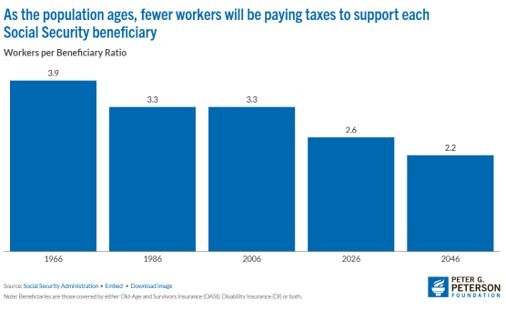
Today, the math has changed. America has more retirees, longer life expectancies, and fewer workers supporting each beneficiary than in previous generations, as you can see in our next chart.
Source: Social Security Administration and The Peter G. Peterson Foundation
The Baby Boom generation has moved from paying into the system to drawing from it. Birth rates have declined. Workforce growth has slowed. The result is a program that is paying out more than it takes in from dedicated tax revenue, with trust fund reserves making up the difference.
That reserve cushion is now being drawn down.
As a financial advisor, I've been discussing Social Security's future with clients for nearly four decades. The projected depletion date has moved around over the years, but the underlying issue has never changed. Every Trustees' Report eventually arrives at the same conclusion: the longer we wait to make adjustments, the larger those adjustments ultimately become.
This is where the language around Social Security can get confusing. When people hear that the trust fund is “running out,” they often assume the program itself is running out of money entirely. That is not accurate. As long as workers are paying FICA taxes, Social Security will have revenue. But without trust fund reserves, the program would only be able to pay benefits from incoming payroll taxes and other dedicated income. That is why the Trustees estimate benefits would be reduced rather than eliminated.
Still, for retirees living on a fixed income, a reduced benefit is not a minor accounting adjustment. It is real money. A retiree receiving $2,000 per month would see a 22% cut, reducing that benefit by about $440 per month. That is more than $5,000 per year. For a couple, the impact could be significantly larger. For households that depend heavily on Social Security, such a reduction would not feel like a policy change. It would feel like a pay cut.
And it would come at exactly the wrong time.
Retirement already requires households to carry more of the load than they did in previous generations. Traditional pensions have become less common. Health care costs remain a major concern. A longer life expectancy means retirement savings may need to last 30 years or more. Inflation, even when it cools, leaves a lasting mark on household budgets. Many Americans already enter retirement with insufficient savings, and Social Security remains the floor beneath them.
If that floor weakens, the entire retirement structure becomes less stable.
That is why this issue matters beyond Washington budget debates. It is not simply a line item. It is not just another partisan argument. It is a household balance sheet issue. It is a retirement planning issue. It is a generational fairness issue. It is also a trust issue, because millions of Americans have spent their working lives paying into a program they were told would be there when they needed it.
The hard part is that none of this is new. Social Security’s long-term financing challenge has been visible for decades. The last major reform was passed in 1983, and those changes brought the system roughly half a century of breathing room. Since then, the warnings have grown louder, the projections have become more urgent, and the political will to act early has remained limited.
That may be the most frustrating part of the story. This is not a sudden crisis. It is a slow-moving one. We have been watching the weight accumulate year after year, report after report, election after election.
In the song “The Weight,” the traveler keeps trying to do the right thing. He keeps accepting one more task, one more obligation, one more strange request from someone else. There is something noble in that. But there is also exhaustion. Eventually, even the willing traveler feels the bag sinking low.
Social Security is reaching that point. The system has carried The Weight for generations. It has reduced poverty among older Americans, supported widows and widowers, helped disabled workers and their families, and provided dependable income to tens of millions of retirees. It remains one of the most important and successful social insurance programs in American history.
But success does not make it immune to math.
The problem we face today is not whether Social Security should matter. It clearly does. The problem is whether we are willing to adjust the program before automatic cuts force adjustments on retirees. Reform delayed does not mean reform avoided. It usually means reform becomes more painful.
There is still time to fix this. That is the good news. The 2032 depletion date is not tomorrow. Congress has options. None will be painless, and most will be politically difficult, but the earlier changes are made, the more gradually the burden can be shared.
I often remind my clients that having a good financial plan is like having a pilot with a good flight plan. If you were flying from Cleveland to Los Angeles, it is easier to make a minor mid-course adjustment over Chicago than to wait until you're out over the Rockies and find yourself hundreds of miles off course. It's too bad for all Americans that the political class on Capitol Hill, on both sides of the aisle, has waited so long to make the adjustments needed to make the program solvent for the long haul.
The bad news is that the delay has already made the load heavier.
And that brings us back to the chorus. “Take a load off, Fanny. Take a load for free. Take a load off, Fanny, and you put the load right on me.”
The question facing Social Security is the same question posed by The Band nearly sixty years ago.
The weight isn't disappearing. It is simply looking for a new set of shoulders. The only question left is who will carry it.
In Part 2, we will look at how we got here—not through one bad decision or one political party, but through decades of demographic change, delayed action, and promises that became harder to fund over time. Because before we can talk honestly about how to fix Social Security, we first must understand how “The Weight” got so heavy in the first place.
Finally, in Part 3, we will explore some of the many options we have to fix the Social Security system. None of them will be painless or make everybody happy, but it will be for the ultimate good of our American Society.
The load of that weight may make it harder for all of us to continue “Moving Life Forward.”
© 2026 Jesse Hurst
Senior Wealth Manager
Related Content
- Carry That Weight: Why Social Security's Burden Was Decades in the Making
- The Load-Out: How We Keep Social Security Here to Stay
The views stated are not necessarily the opinion of Cetera and should not be construed directly or indirectly as an offer to buy or sell any securities mentioned herein. Due to volatility within the markets mentioned, opinions are subject to change without notice. Information is based on sources believed to be reliable; however, their accuracy or completeness cannot be guaranteed. Past performance does not guarantee future results.
Investors cannot directly invest in indices.
Featured Blog Image Source: iStock.com/Olga Kurbatova