


In 1977, Jackson Browne released one of the more unique songs in rock history. Actually, it was two songs seamlessly joined together: The Load-Out and Stay.

Sources: YouTube & Wikipedia
Most people remember Stay. It's upbeat and joyful, and it ends the concert on a high note. But The Load-Out is the song that has always fascinated me.
If you are unfamiliar with this two-part song from nearly 50 years ago, I have included a YouTube link to the live performance from New York City below to set the stage for today's discussion.
Jackson Browne: The Load Out & Stay - 1977 (Live) (My "Stereo Sound" Re-Edit)
Instead of singing about the excitement of performing on stage, Browne pays tribute to the people most fans never see. After the applause fades and the arena empties, the road crew goes to work. They roll up cables, pack away instruments, load trucks, and prepare everything for the next city. The glamorous part of the evening is over. Now comes the hard work that makes tomorrow's performance possible.
As we conclude this three-part series on Social Security, that feels like an appropriate metaphor.
In Part 1, we discussed the growing financial strain facing Social Security and the reality that, absent congressional action, the trust funds are projected to be depleted within the next several years, triggering automatic benefit reductions. In Part 2, we explored how decades of demographic change, longer life expectancies, lower birth rates, and repeated political delays gradually brought us to this point.
That naturally leaves one question. How do we get Social Security to Stay for future generations?
Fortunately, despite what many headlines suggest, Social Security's financial challenges are not unsolvable. They are simply uncomfortable.
One of the biggest misconceptions surrounding Social Security is that there must be one grand solution waiting to be discovered. There isn't.
There is no hidden switch in Washington. No magic button that instantly restores long-term solvency.
There are only a handful of policy levers, and every serious proposal simply pulls them in different combinations.
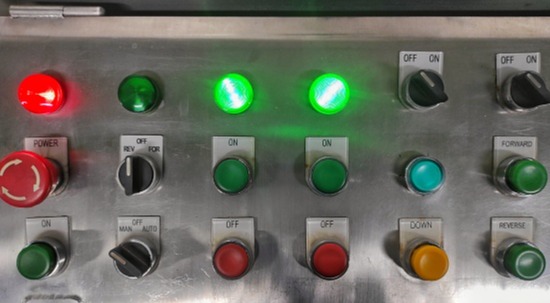
Think of it as standing in front of a control panel. Every serious proposal discussed in Washington is simply a different combination of those same controls.
Source: iStock.com/Rifky Rachman Safri
Each lever affects the system differently. Pull one too hard, and someone bears more of the burden. Pull several gradually, and the weight can be shared more evenly across generations. The debate isn't whether these levers exist. The debate is which combination Americans are willing to accept.
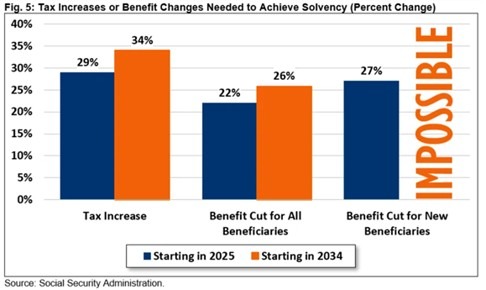
We know that doing nothing is not a tenable solution. The longer we wait, the greater the pain will be for everyone, as shown in the chart below from the Social Security Administration.
The first lever is the age at which workers receive full retirement benefits.
In 1935, when the Social Security Act was signed, the average U.S. life expectancy at birth was about 60 years for men and 64 years for women. Because the full retirement age was set at 65, many people joked that the U.S. Government was selling ice cubes to Eskimos, and that they would never live long enough to collect these future benefits.
However, that metric was heavily skewed by high infant and childhood mortality rates at the time. Americans who reached age 65 could expect to live roughly 12 to 13 additional years. While life expectancy gains have not been equal across all occupations or income levels, the reality is that millions of Americans now spend decades collecting benefits.
Gradually increasing the Full Retirement Age from today's 67 to 69 or even 70 over many years would reduce long-term costs while giving younger workers plenty of time to prepare. This is similar to what was passed in 1983, when the full retirement age for Social Security benefits was gradually increased from 65 to 67.
While people initially resisted that change, very few clients question it today when it comes up in conversation. It is not an easy conversation, particularly for those in physically demanding jobs, but it is one of the most frequently discussed options.
A second lever involves payroll taxes.
Today, workers and employers each contribute 6.2% of wages toward Social Security. Even a relatively modest increase, phased in slowly over many years, could close a meaningful portion of the long-term funding gap. The tradeoff, of course, is that workers take home slightly less pay during their careers in exchange for strengthening the program for future retirees.
We saw a similar solution when Ohio faced funding shortfalls in its State Teachers’ Retirement System (STRS) several years ago. Increasing the amounts both teachers and school systems paid into the system, along with other adjustments, made the system solvent and sustainable for future generations. No one enjoyed paying more, but those changes ultimately helped preserve the system for both current AND future retirees.
Another frequently discussed option is raising the amount of earnings subject to Social Security payroll taxes.
Currently, wages above the annual taxable maximum are generally exempt from the Social Security payroll tax. As higher-income workers account for a growing share of total earnings, a smaller percentage of all wages is actually subject to the tax than in previous decades.
In 2026, the maximum amount of earnings subject to the 6.2% Social Security tax is $184,500. Any earnings you make above this threshold are exempt from the Social Security portion of FICA taxes. It is also important to remember that earnings above that level do not accrue additional Social Security retirement benefits.
Some proposals would raise that ceiling, while others would eliminate it entirely. Supporters argue this would improve fairness and strengthen the program's finances. Critics worry about higher tax burdens and unintended economic consequences. Like every lever, it comes with tradeoffs.
Benefit adjustments represent another set of tools.
These proposals include modifying the formula used to calculate annual cost-of-living adjustments, changing how benefits are taxed, adjusting benefit formulas for higher-income retirees, or introducing some form of means testing. None of these ideas is politically easy, but each can help improve Social Security's long-term financial outlook.
There is another lever that receives less attention than it deserves. A stronger economy helps Social Security.
Higher wages generate more payroll tax revenue. More people working means more workers contributing to the system. Greater productivity, technological innovation, thoughtful immigration policy, and economic growth all strengthen the financial foundation supporting Social Security. Economic growth alone won't solve the problem, but it can certainly make the challenge more manageable.
Finally, there is one proposal that I believe deserves thoughtful discussion, even if opinions differ.
Unlike virtually every major public pension fund, university endowment, or charitable foundation, the Social Security trust funds have historically been invested almost entirely in special-issue U.S. Treasury securities. That approach has emphasized safety and liquidity while avoiding concerns that the federal government would become a significant owner of private companies.
However, it also meant that the trust funds largely missed out on decades of higher long-term returns generated by diversified investments in stocks and bonds.
Had a portion of those surplus assets been invested in a diversified portfolio many years ago, the trust funds likely would have accumulated substantially greater assets than they hold today. Of course, those higher expected returns would have come with greater short-term market volatility.
However, pension funds and college endowments face the same issues and have managed to balance both volatility and liquidity within their portfolios.
Safety has a cost, just as taking investment risk has a cost. There are no cost-free options. The question is which tradeoff best serves future generations. Whether such an approach should be considered going forward is certainly open for debate, but I believe it is a debate worth having.
Notice something about all six of these levers.
None of them completely solves the problem by itself.
More importantly, none of them has to.
The most realistic path forward will almost certainly involve several modest adjustments working together rather than one dramatic change. A gradual increase in retirement age. A modest increase in payroll taxes. Some adjustment to taxable wages. Thoughtful benefit reforms. Continued economic growth. Perhaps even a broader conversation about how trust fund assets are invested.
Individually, each proposal has shortcomings.
Collectively, they could preserve Social Security for generations. No one gets everything they want, but everyone gets something even more important: a stronger Social Security system for future generations.
That, ultimately, is the choice before us.
The chart below illustrates the choice before Congress. The orange line represents the benefits Americans have been promised. The blue line represents the revenues currently projected to be available. Unless those lines are brought closer together, the gap eventually closes itself through automatic benefit reductions.
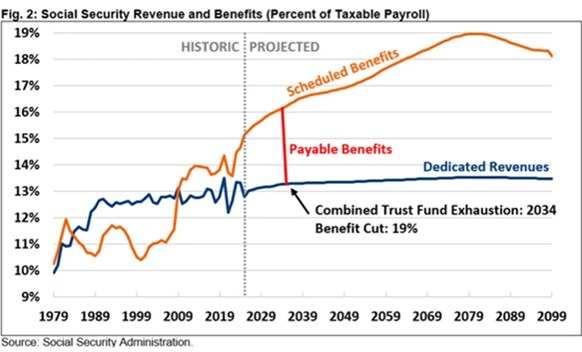
Congress does not get to choose between making changes and making no changes. It gets to choose between making thoughtful, gradual adjustments today or allowing much larger automatic benefit reductions tomorrow.
History suggests that Congress often waits until deadlines become unavoidable before acting. That is frustrating, but it is not new. We saw it in 1983, when elected officials from both parties finally came together to reform Social Security before the system reached a breaking point.
I also believe there is a practical political reason to remain optimistic.
Whether Democrat or Republican, elected officials understand that Social Security touches tens of millions of households, and the people who rely on those benefits tend to vote in large numbers. Allowing automatic benefit reductions to occur would not only harm retirees; based on conversations I have had with many concerned clients, it would likely create enormous political consequences for anyone viewed as responsible.
That is why I remain optimistic.
Americans have solved difficult financial challenges before. We did it with the bipartisan Social Security reforms of 1983. We have adjusted tax laws, Medicare, and countless other public programs over the decades as circumstances changed. There is every reason to believe we can do so again, provided we are willing to have honest conversations rather than pretend the problem will somehow solve itself.
Jackson Browne understood something that every touring musician eventually learns.
The concert doesn't continue because of the encore.
It continues because someone stays behind to do the load-out.
If we want Social Security to stay—not just for today's retirees, but for our children, grandchildren, and future generations—the same principle applies. The work may not be glamorous. The decisions may not be politically popular. But they are necessary.
The music isn't over. The encore is still ahead.
We simply have to do the load-out first as we continue Moving Life Forward.
© 2026 Jesse Hurst
Senior Wealth Manager
Related Content
- Take a Load Off, Fanny: The Weight Social Security Can No Longer Carry
- Carry That Weight: Why Social Security's Burden Was Decades in the Making
The views stated are not necessarily the opinion of Cetera and should not be construed directly or indirectly as an offer to buy or sell any securities mentioned herein. Due to volatility within the markets mentioned, opinions are subject to change without notice. Information is based on sources believed to be reliable; however, their accuracy or completeness cannot be guaranteed. Past performance does not guarantee future results.
Investors cannot directly invest in indices.
Featured Blog Image Source: iStock.com/ipopba