


"One Step Ahead" is a song by the New Zealand art rock group Split Enz. It came out in November 1980 as the lead single from their sixth album, Waiata. In a Radio New Zealand documentary, Neil Finn said he was surprised by the song's success, noting that it "hasn't got a proper chorus." The music video was also among the first ever shown on MTV.

Source: Wikipedia.com
As a matter of fact, if you happened to be watching on August 1st, 1981, the day MTV launched, you would have heard three different songs from Split Enz, including ”History Never Repeats” and “I Got You.” However, if you were not watching, I have included a link to the YouTube video below for your listening and viewing pleasure.
Split Enz - One Step Ahead (Official Video)
Like Split Enz, a group that doesn’t get much attention these days, the US budget deficit for 2025 quietly came in lower than expected. You might not have heard about it since the news didn’t get much coverage. Even though the deficit took “One Step Ahead” in the right direction, most major news outlets overlooked it. To understand why this matters, let’s look back at recent trends in the annual budget deficit and federal debt.
For years, America’s finances have been marked by growing debt. The federal government’s total debt is now close to $38 trillion. This is mostly because spending has steadily increased as a share of the economy, while tax revenues have stayed about the same. In 2000, federal spending was 17.7% of GDP. By 2025, it had risen to 23.2%. The main issue isn’t revenue, but ongoing increases in spending.
That’s the downside. But there’s also good news: in 2025, the deficit actually improved a bit. In a time when deficits usually get bigger, even small progress is something to celebrate.
The Congressional Budget Office estimated the 2025 deficit at $1.780 trillion, slightly lower than the $1.817 trillion in 2024, as shown in the first chart below. That’s a $41 billion improvement. But if you look more closely, things look even better.
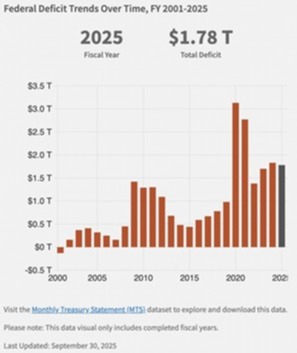
Source: Treasury.gov
First, the economy grew. Nominal GDP went up by 4.8% in 2025. This means the deficit decreased relative to the size of the economy, dropping from 6.3% of GDP in 2024 to 6.0% in 2025. It might seem like a small change, but it’s the first time in years the deficit has improved. Treasury Secretary Scott Bessant has said that higher GDP growth, fewer regulations, and lower oil and gas prices are essential for bringing the deficit back to its usual 3% range. You can read more about his goals in my January 20, 2025, blog post below.Fea
Will Three Be a Magic Number for Our New Treasury Secretary?
https://www.impelwealth.com/blog/will-three-be-a-magic-number-for-our-new-treasury-secretary
Second, some calendar quirks and tax deadlines affected last year’s numbers. In 2023, $72 billion in federal payments were moved to that year because October 1 fell on a Sunday, which made FY 2024 spending look lower. Disaster-related tax delays also increased FY 2024 revenues by about $70 billion. If you adjust for these timing issues, the real drop in the 2025 deficit was closer to $150 billion. That’s a real improvement.
Overall, spending rose by $228 billion after adjusting for timing, but most of that was due to factors policymakers couldn’t control. Social Security, Medicare, and Medicaid together added $245 billion in costs. Interest payments on the national debt rose by $80 billion. There was also a one-time $20 billion EPA payment from the previous administration. But outside of these areas, spending actually fell by $117 billion. That’s a rare and positive sign of restraint.
Source: Treasury.gov
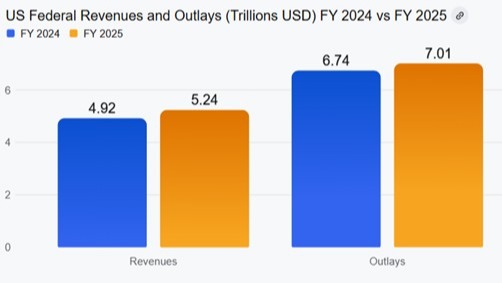
As shown in the chart above, federal receipts went up 6% from last year. Without disaster-related delays, the increase would have been about 8%. Tariff collections also jumped, adding billions to the Treasury. These gains helped balance out the rise in mandatory spending.
This doesn’t mean the deficit problem is fixed. A deficit equal to 6% of GDP is still not sustainable over the long term. There are still risks. The Supreme Court might overturn recent tariffs, which could lower revenue. Political fights over Medicaid and possible government shutdowns could undo progress. Interest costs will also keep rising as debt grows.
But progress is important. For years, government spending has only gone up with each crisis, like in 2008 and during COVID-19, each time setting a new, higher level. Seeing the deficit steady, even a little, shows that improvement can happen. It reminds us that fiscal policy isn’t only about big changes. Sometimes, small steps in spending control, revenue growth, and economic growth can lead to real progress.
So, even though the debt is still huge, 2025 brought a small but important win. The deficit shrank relative to the economy, revenues increased, and discretionary spending decreased. That’s something to celebrate. Let’s hope this “One Step Ahead” is the start of a longer trend toward fiscal responsibility. I thought this was an important and underreported story you needed to hear as we continue “Moving Life Forward.”
© 2025 Jesse Hurst
Senior Wealth Manager
Related Content
The views stated are not necessarily the opinion of Cetera and should not be construed directly or indirectly as an offer to buy or sell any securities mentioned herein. Due to volatility within the markets mentioned, opinions are subject to change without notice. Information is based on sources believed to be reliable; however, their accuracy or completeness cannot be guaranteed. Past performance does not guarantee future results.
Neither Cetera Advisors LLC nor any of its representatives may give legal or tax advice. This information is not intended as tax or legal advice. Please consult legal or tax professionals for specific information regarding your individual situation.
Investors cannot directly invest in indices.
Featured Blog Image Source: iStock.com/SPmemory