


Elton John released his first greatest hits compilation in November 1974. After hearing my older and very cool cousin, Brenda Jo, play the album when visiting, I decided I needed to get my own copy. The following year, I saved up money from raking leaves and shoveling snow and was finally able to purchase it in the summer of 1975 as I was turning 10 years old.This was the very first album I bought. Over the coming years, I purchased hundreds, which are now displayed in our music room and played on our Bluetooth turntable.

Source: Amazon.com
"I'm Still Standing" is a song written by English musician Elton John and his songwriter partner Bernie Taupin from John's 1983 studio album Too Low for Zero. It was the lead single from the album in North America and became a big hit for John on both sides of the Atlantic, peaking at No. 12 on the US Billboard Hot 100. Most people see it as an anthem based on Elton's strong sense of survival in the face of adversity.

Source: YouTube
The music video was shot in Cannes and Nice on the Côte d'Azur in France. Below is a YouTube link to the video for those who would like a reminder of this fun and upbeat tune.
Elton John - I'm Still Standing
Similar to the sentiment of Elton John's song, the US dollar is “Still Standing” in the face of geopolitical adversity despite growing government debt. Over the years, there have been many predictions that the US dollar is on the verge of a significant decline and might even lose its status as the world's primary reserve currency. Recent trade conflicts and tariff threats have reignited this speculation. Countries facing economic pressure from tariffs or the threat of tariffs are discussing moving away from the dollar as the primary currency for trade.
"De-dollarization," or the shift away from using the U.S. dollar as the primary currency of exchange in global trade and investment, has once again become a hot topic in financial markets and numerous client conversations here at the offices of Impel Wealth Management. I have long held the position that a trend toward diversification of global currencies is likely developing.
This means we would gradually move to a global economy with a less dominant dollar over time. However, I don't see the dollar losing its reserve currency status anytime soon. As I have written previously, for the U.S. dollar to lose its unique standing, there would have to be a bigger, stronger, and more liquid currency to replace it. Nothing like this exists today. If you would like to read more about the history of how reserve currencies have evolved over the centuries, please click the link below to read my blog post, Will the US Dollar Retain Its Title?, which was published in April 2023.
https://www.impelwealth.com/blog/will-the-us-dollar-retain-its-title
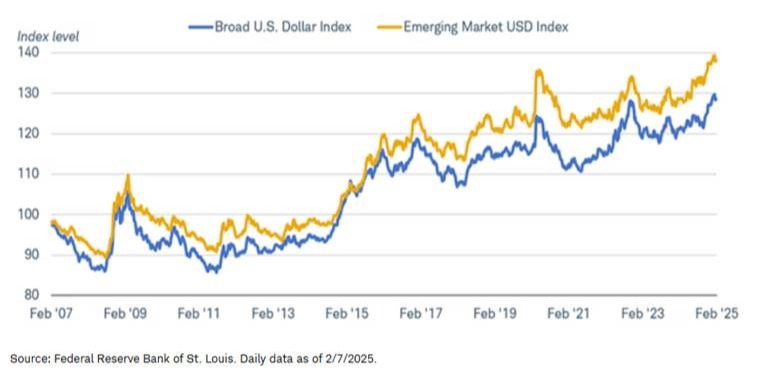
The dollar remains close to a 15-year high versus the currencies of countries with which the U.S. trades. It remains the primary currency used for trade and financial transactions in the global economy. Over the past decade, the dollar has been propelled higher by relatively high U.S. interest rates, strong capital inflows, and its status as a perceived safe haven in times of turmoil. The dollar's gains have been broad-based, with similar appreciation versus emerging markets and significant developed market currencies, as shown in the chart below.
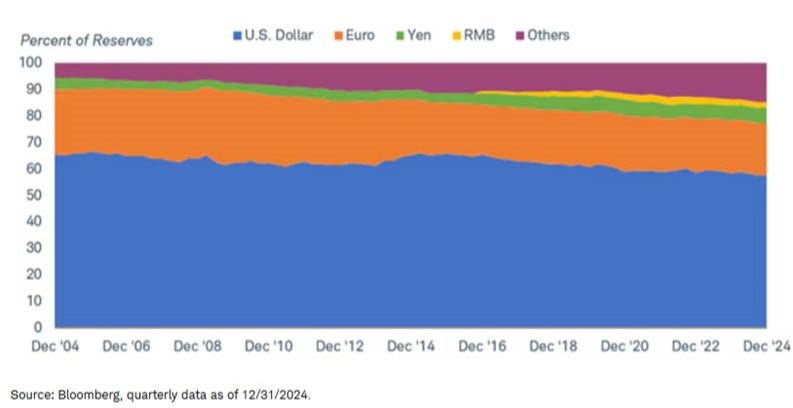
Some clients have expressed concern about the dollar's position as the world's primary reserve currency, even though it hasn't changed much in decades. The dollar's share of global reserves has declined gradually over the past 20 years as central banks have diversified their holdings. However, as you will see in our final chart below, the dollar still represents about 60% of global reserves…a modest decline from 67% 20 years ago.
To be considered a safe haven for foreign central banks, a reserve currency must be freely convertible and have deep and liquid bond markets. Central banks need to know that their money is easily and readily available when needed, particularly in times of stress. The U.S., with a large, open, and liquid market for treasury securities, fits that role. U.S. economic growth continues to outpace the growth rate in other major countries, and broad interest rate differentials favor the dollar.
As I have stated previously, you can't replace something with nothing. The chart above shows that no other currency can come close to filling the void that would be left if the US dollar were abandoned as the reserve currency. The United States economy is not without its problems, including our rapidly increasing federal debt. However, compared to other major global economies, we currently appear to be the “cleanest dirty shirt in the hamper.”
The US dollar is “Still Standing”…for now. However, foreign governments may continue diversifying their reserves over the coming years into other asset classes, including gold and cryptocurrencies. The CFPs of Impel Wealth Management will continue to watch this closely. However, it will likely be an evolution, not an event. We will keep you informed as this story progresses and we continue “Moving Life Forward.”
© 2025 Jesse Hurst
Senior Wealth Manager
Related Content
The views stated are not necessarily the opinion of Cetera and should not be construed directly or indirectly as an offer to buy or sell any securities mentioned herein. Due to volatility within the markets mentioned, opinions are subject to change without notice. Information is based on sources believed to be reliable; however, their accuracy or completeness cannot be guaranteed. Past performance does not guarantee future results.
Neither Cetera Advisors LLC nor any of its representatives may give legal or tax advice. This information is not intended as tax or legal advice. Please consult legal or tax professionals for specific information regarding your individual situation.
Investors cannot directly invest in indices.
Featured Blog Image Source: iStock.com/claudiodivizia