


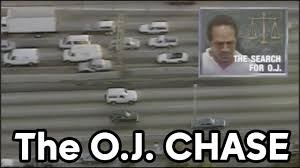
In June 1994, Los Angeles police gave O.J. Simpson a day and a time to turn himself in to face allegations he had killed ex-wife Nicole Brown Simpson and her friend Ron Goldman. It was a courtesy, said then-prosecutor Marcia Clark, often extended to celebrities or those with no criminal record. Instead, Simpson jumped in an SUV, apparently with a loaded gun and ready to commit suicide, and led police and media helicopters on a dramatic, televised chase.
Source: YouTube
On June 17th, a white Ford Bronco used by O.J. Simpson and Al Cowlings became the focus of viewers around the globe during a slow-speed police chase. The chase was televised and widely watched, with estimates from CBS Sports reporting around 95 million viewers. The Bronco was ultimately driven to Simpson's home in Brentwood, California, where he surrendered. A link to one of the many YouTube videos from that day is included below. This one shows Larry King's interview being interrupted by the breaking news.
https://www.youtube.com/watch?v=0WF_NeBgm-o
It was the first time I could remember the world being so singularly focused on a breaking news event. There were far fewer 24-hour cable news outlets at that time than there are today. However, the ones that did exist, along with their local news and newspaper brethren, had many hours and pages to fill. Therefore, their coverage became nonstop, overlapping, and redundant.
This pattern has existed since the events of June 1994. The only thing that stops the media from focusing so obsessively on the current crisis de jour is “the next white Bronco.” This means that when another news story comes along that surpasses the current one in sensationalism, or simply by being a new story to chase, the media moves “en masse” from the last obsession to the new obsession. There are so many examples that I could give you throughout my more than 35 years of being a financial advisor. Allow me to share some examples with you. As the world is replete with media obsessions on both sides of the political aisle, I am going to keep my examples in the economic and financial realm.
In 2014, a nurse in Dallas, Texas, who had been caring for a patient with Ebola, flew from Cleveland, Ohio, to Dallas on October 13th before being diagnosed with the virus. She was part of the medical team at Texas Health Presbyterian Hospital that treated the first person diagnosed with Ebola in the US, who died on October 8th. Before returning to Dallas, the nurse had visited family and a bridal shop in Tallmadge, Ohio.
The CDC initially indicated that her flight was not an immediate cause for concern, but later contacted passengers on flight 1143 and requested that they self-monitor for Ebola symptoms. Public health officials in Ohio traced her steps while in the state, including her visits to a bridal shop in Akron. As this became more widely known, it sparked intense media attention. A few headlines and links to the articles related to this incident are listed below.
· ABC News, Dallas Nurse With Ebola Visited Bridal Shop in Ohio
· Reuters, U.S. health official allowed new Ebola patient on plane with slight fever
· The New York Times, Ebola-Infected Health Worker in Dallas Took a Flight on Monday
https://www.nytimes.com/2014/10/16/us/ebola-infected-dallas-health-worker-was-on-flight.html#
The initial concern was stoked by the media's focus, and it quickly morphed into more of a panic. In the following days, this became the lead story for the next week on USA TODAY, the Wall Street Journal, the New York Times, and the Today show. Experts were brought on who told us this would become a significant health threat and a possible pandemic. At the time, my office was located at Canal Place in Akron, the original headquarters building of BF Goodrich Tire and Rubber. That Sunday night, the building manager called my cell phone at approximately 8:00 PM to let me know that a cousin of the nurse who flew from Cleveland to Dallas with Ebola worked in the next building over from us. She had not seen or interacted with her cousin during her visit to Ohio. However, they were going to have her quarantine for three weeks and wanted to notify everyone in the building in case we wanted to take extra precautions. To this day, I have no idea what they were asking us to take precautions against.
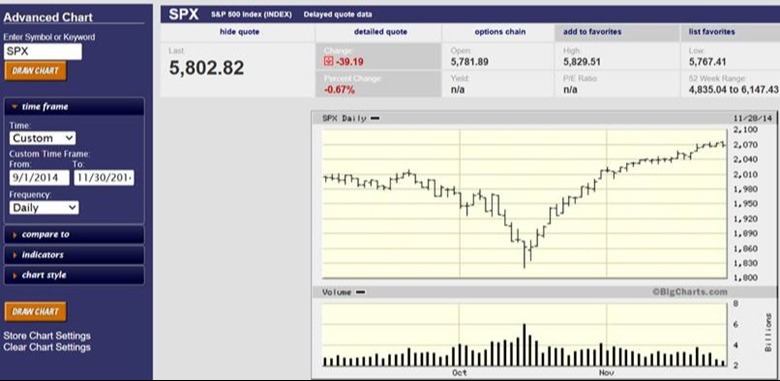
This could overwhelm the hospital system and cause massive loss of life both in the United States and abroad. Furthermore, it would likely cripple the travel industry as people would be too afraid to fly. The subsequent panic and potential economic impacts caused the stock market to drop approximately 10% over the next few weeks, as shown in the chart below.
Source: BigCharts.com
You will also notice that less than two months later, the market had rebounded to new highs. Once the Ebola narrative did not materialize the way the media screamed it would, eventually a “new white Bronco” came down the road and caught everybody's attention. Over the next few years, I never heard anybody mention the virus again, and I never heard anybody say they were afraid to get on an airplane because of it.
Several years later, I would pull up a five-year stock market chart and ask clients, “What happened in October of 2014 that caused the stock market to briefly drop 10%?” They would usually suggest something like the Federal Reserve Bank moving interest rates, or fears about recession. However, when I reminded them that that drop happened when a young lady who was wedding dress shopping in Tallmadge, Ohio, got on a plane in Cleveland and flew to Dallas, they would typically remark something like, “Oh yeah, I forgot all about that.” The “next white Bronco” must have caught their attention.
It seems that there is a typical Life Cycle to these media-induced crisis events:
· Stage 1: A news story becomes the focus of investor/market attention.
· Stage 2: The media greatly overestimates the long-term importance of this current event.
· Stage 3: Consumers see headlines, tweets, and posts on social media that lead them to believe they have expertise on the subject.
· Stage 4: Most investors inaccurately predict how financial markets will respond to the latest event.
· Stage 5: Many panic and make poor or ill-informed decisions that could affect their long-term wealth.
· Stage 6: A “new white Bronco” comes driving down the road that catches our attention
· Stage 7: Investors entirely forget what they said and did in Stages 1-5 of the previous event.
· Stage 8: This cycle is doomed to repeat itself over and over during an investor's lifetime.
I have experienced more “white Bronco” events during my career than I would like to count or remember. The failure of Long-Term Capital Management, the bursting of the dot.com bubble, the events of 9/11, the failure of AIG and Lehman Brothers, the fiscal Cliff, the COVID-19 pandemic, and inflation soaring to 40-year highs. Looking at the stock market over the last 30 years, it becomes evident that the best thing for an average investor to do is ignore the screaming media and not interrupt the compounding of their hard-earned investment assets.
However, we know this is easier said than done. It is hard to ignore something everyone else is screaming about on the cable news networks and social media platforms. It is harder yet not to react incorrectly when you see everyone else panicking. We are human, and it is tough to fight against human nature. However, if we can only remember one thing from this blog, I hope it is this:
· If accumulating wealth were easy, most people would do so. However, since most people are not wealthy, I do not want to do what most people do. I must be strong enough to trust my financial plan and the companies I have invested in in a capitalistic, free market economy.
There are more 24-hour cable news and social media platforms today than ever. Each must fill its time with content designed to draw viewers and clicks. They are always looking for the “next white Bronco” to draw people in. This does not mean you need to participate in this process. Doing so will certainly not help your psyche and may be dangerous to your wealth. I thought this was an important reminder for you, our trusted friends and clients, as we continue “Moving Life Forward.”
© 2025 Jesse Hurst
Senior Wealth Manager
Related Content
The views stated are not necessarily the opinion of Cetera and should not be construed directly or indirectly as an offer to buy or sell any securities mentioned herein. Due to volatility within the markets mentioned, opinions are subject to change without notice. Information is based on sources believed to be reliable; however, their accuracy or completeness cannot be guaranteed. Past performance does not guarantee future results.
Neither Cetera Advisors LLC nor any of its representatives may give legal or tax advice. This information is not intended as tax or legal advice. Please consult legal or tax professionals for specific information regarding your individual situation.
Investors cannot directly invest in indices.
Featured Blog Image Source: iStock.com/LagartoFilm