


The Jeffersons evolved from a spin-off of All in the Family into a groundbreaking sitcom that portrayed a prosperous Black family, a rarity on television at the time. The Jefferson family, including father George Jefferson (Sherman Hemsley), mother Louise "Weezy" Jefferson (Isabel Sanford), and son Lionel Jefferson (Mike Evans), was introduced on All in the Family in 1971 as the neighbors of Archie and Edith Bunker in working-class Queens. The spin-off launched on CBS in January 1975, when the Jeffersons "moved on up" from Queens to a luxury high-rise apartment on Manhattan's Upper East Side. This move was made possible by George's flourishing dry-cleaning chain.

Source: YouTube
Its theme song, "Movin' On Up," perfectly captured the show's premise of upward mobility. It is one of the most recognizable in television history and is a gospel-infused song of success and aspiration. The lyrics directly reference the show's plot, with the Jeffersons leaving their old life behind to move into a "deluxe apartment in the sky" and get "a piece of the pie". The song became an anthem representing the achievement of the American Dream and "moving from the margins of society to the center."
For those who would like to reminisce with some American culture from the 1970s, I invite you to listen to this short song, which introduced the show to us every week on CBS, via the YouTube link below.
The Jeffersons Intro Theme Song (Movin on Up)
Just as The Jeffersons were moving on up in financial and social class due to the success of George's business, the US stock market continues to defy most prognosticators and has continually “Moved On Up” to new highs multiple times this year. Investing when stocks are at all-time high prices naturally makes people somewhat nervous and hesitant to allocate additional resources. Today, we will review whether their nervousness is justified and should influence their actions.
The S&P 500 has achieved 25 new all-time highs as of September 15, 2025. This follows a strong performance in 2024, during which the index closed at a record level 57 times. After April's sharp drop, it rebounded more quickly and more sharply than most would have expected or believed. During this period, markets have experienced only brief and shallow pullbacks, as shown in our first chart below. This leaves many investors wondering: Is now really the right time to invest?
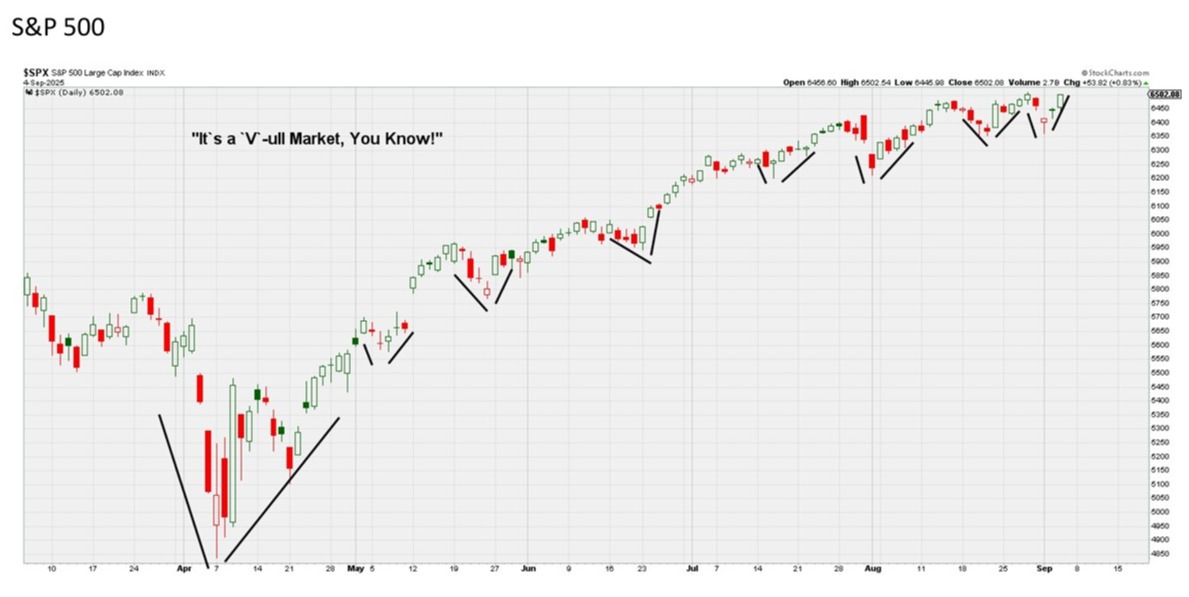
Source: Saut Strategy LLC. Past performance is not indicative of future results.
It's a fair question. Watching markets climb can create anxiety. What if you invest now and the market declines the day after tomorrow? What if you're entering right before a downturn? But here’s the truth: history says you shouldn’t be overly concerned about the level at which you invest your hard-earned resources, as time in the market is far more important than your initial purchase price.
Many investors are sitting on cash, lured by high interest rates and fearful of buying into a “top.” It feels safer to wait. But that instinct, while understandable, can be costly. Market highs can seem risky, but they actually happen often. Since 1926, the U.S. stock market has reached an all-time high in 31% of all months. That means almost one out of every three months.
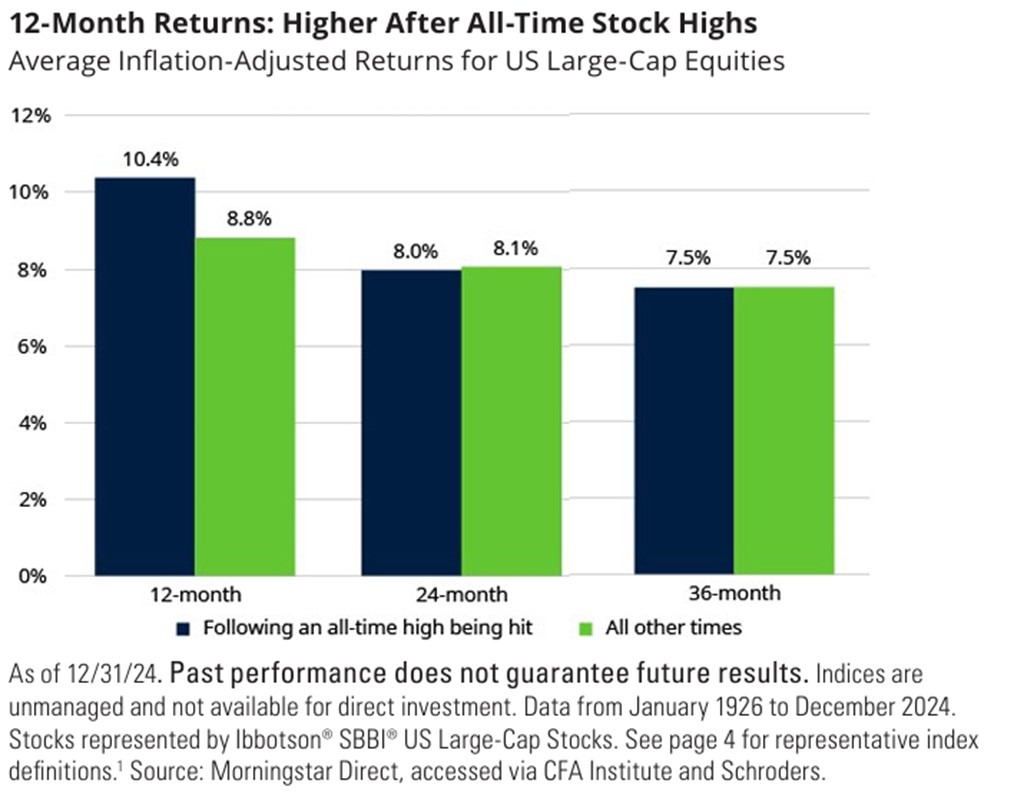
As you can see in the chart below, much to the surprise of most, on average, 12-month returns following an all-time high have been better than at other times: 10.4% compared with 8.8% when the market wasn’t at a high. Returns on a two- or three-year horizon have been similar, regardless of whether the market was at an all-time high or not.
Let’s also look at the longer-term impact of investing when markets are near all-time highs.
- A $100 investment in the U.S. stock market in 1926 would be worth $103,294 today (inflation-adjusted).
- A strategy of exiting the market every time it hits a high? That same $100 would be worth just $9,922. That’s a 90% difference. Why? Because compounding works best when you don’t stop its progress. As Warren Buffett's longtime business partner, Charlie Munger, was known to say regularly, “Never stop the compounding.” Trying to sidestep highs means missing out on growth, as you can see in our final chart below.
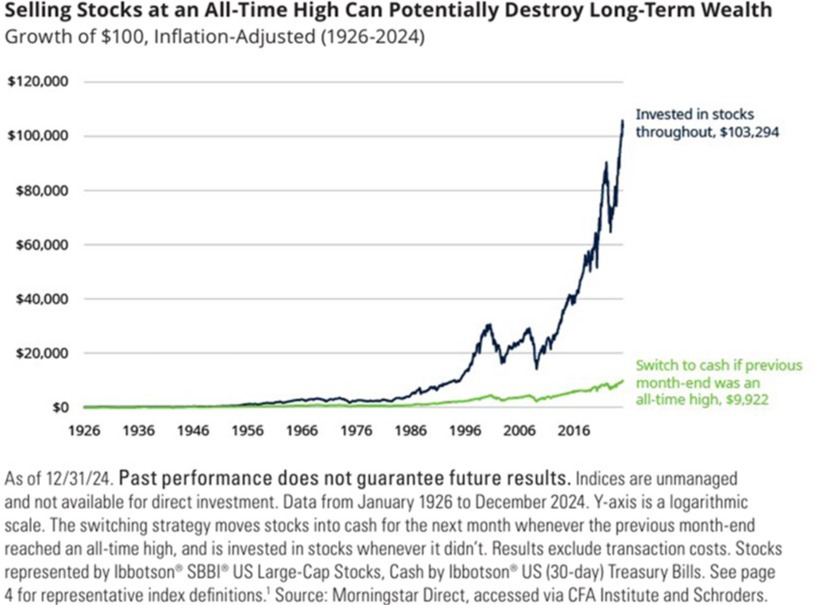
If you feel nervous about investing when the market is high, you are not alone. The main point is clear: history shows that staying invested, especially for the long term, has given better results than trying to time the market. All-time highs are not always a cause for concern. They’re milestones. And they often signal strength, not fragility.
Does all this mean that you don't need to worry about periods of market volatility or downturn? Of course not. Most of us remember, all too well, times like the dot.com bubble and 9/11, the subprime mortgage crisis and the failure of AIG and Lehman Brothers, or the more recent COVID shutdowns. All of these led to significant, but temporary downturns in the markets. After each event, the markets recovered and moved on to new record highs. Once again, time in the market was the most important factor in your long-term investing success.
Don’t let fear of market highs keep you out. One of my longtime mentors, Nick Murray, who authors a monthly newsletter for financial advisors that I have read for over 25 years, often says that the best time to invest is when you have money that you want to keep “Movin’ On Up.” If you have questions about your investments or your strategy, please don't hesitate to reach out for guidance. The next milestone could be yours as we continue “Moving Life Forward.”
© 2025 Jesse Hurst
Senior Wealth Manager
Related Content
The views stated are not necessarily the opinion of Cetera and should not be construed directly or indirectly as an offer to buy or sell any securities mentioned herein. Due to volatility within the markets mentioned, opinions are subject to change without notice. Information is based on sources believed to be reliable; however, their accuracy or completeness cannot be guaranteed. Past performance does not guarantee future results.
Neither Cetera Advisors LLC nor any of its representatives may give legal or tax advice. This information is not intended as tax or legal advice. Please consult legal or tax professionals for specific information regarding your individual situation.
Investors cannot directly invest in indices.
Featured Blog Image Source: iStock.com/damedeeso