


Why America's Future Depends on Which Soundtrack We Choose
Released in 1966, The Rolling Stones' “Paint It Black” became one of the defining songs of a turbulent era. Driven by Brian Jones' haunting sitar and Mick Jagger's unmistakable vocals, the song tells the story of someone consumed by grief, wanting to paint over every bright color in the world until everything reflects the darkness they feel inside.
More than thirty years later, U2 released "Beautiful Day." At first glance, it sounds like the complete opposite. But Bono wasn't singing about a perfect world. In fact, the song is about someone who has lost almost everything yet still chooses gratitude over despair and hope over hopelessness. As he famously reminds us, "What you don't have, you don't need it now."
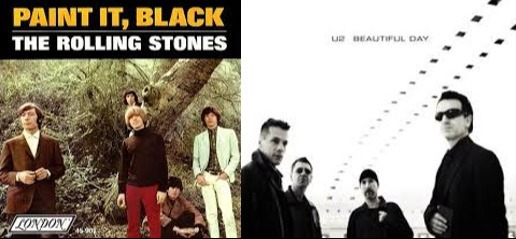
Source: Ink Tank & Wikipedia
To help set the tone for today's blog post, I've included YouTube links to both songs below. I encourage you to listen to them as you ponder the question posed in today's title.
The Rolling Stones - Paint It, Black (Official Lyric Video)
U2 - Beautiful Day (Official Music Video)
As America approaches its 250th anniversary, I sometimes wonder which soundtrack best describes our national mood—and perhaps more importantly, which one will shape our future.
If you listen to many of today's headlines, spend too much time scrolling through social media, or watch cable news for a few hours, you'd think we were living through the darkest period in American history. Confidence in our institutions has fallen. Trust in government is low. Political divisions seem wider than ever. Survey after survey shows that Americans feel discouraged about the economy and the future, even as unemployment remains relatively low, innovation continues to improve lives at a breathtaking pace, and household wealth has reached record levels.I first explored this phenomenon in a blog post I wrote last June, titled "Good (vs. Bad) Vibrations." At that time, I highlighted the growing disconnect between negative feelings (bad vibrations) and better-than-expected economic data, as shown below.
Today, the US economy is also working through mixed messages between “good vs. bad vibrations.” Soft economic data, characterized by things such as consumer sentiment and consumer confidence, have decidedly dipped due to “bad vibrations.” However, hard economic data, characterized by corporate profits, weekly unemployment claims, and inflation data, have all held up surprisingly well and are creating “good vibrations.”
If you would like to explore the background for today's update, you can read the entire Good (vs. Bad) Vibrations post at the link below:
https://www.impelwealth.com/blog/good-vs-bad-vibrations
Fast forward to today, and a recent article in The Atlantic explored this contradiction, arguing that Americans may be entering what the author calls a "Permacession." Not necessarily an economic recession, but a permanent recession of the national mood. One summary of the article captured the idea perfectly:
Americans may be experiencing prosperity, but they've lost the ability to enjoy it.
There is certainly some truth to that observation.
Housing affordability has become a serious challenge for many young families. Our national debt deserves serious attention. Political polarization has become exhausting. Social media often rewards outrage more than understanding, and algorithms have become remarkably effective at convincing us that the world is constantly on the verge of collapse.
Those are real problems, and pretending otherwise doesn't help anyone.
But neither does pretending those problems are the whole story.
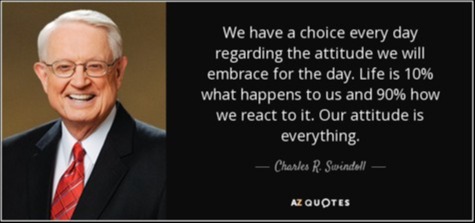
One of my favorite quotes comes from pastor and author Chuck Swindoll, who wrote:
Source: A-Z Quotes
Whether the exact percentages are correct is beside the point. The principle is timeless. We don't control every circumstance, but we do control the lens through which we choose to view them. What we consistently feed our minds ultimately shapes our attitudes, our decisions, and our outlook on life.
I was taught this lesson very early in my professional career, when my first sales manager in the financial services industry said to me, "Stay away from the negative people who gather around the water cooler and coffee pot to complain about everything. They will bring you down to their level faster than you can bring them up.
Instead, find the happiest and most successful people in the office, make friends with them, and learn everything you can from them. You will be better for it!” Thank you, Michael Sekara, CLU, ChFC.
Optimism isn't believing everything is fine.
Optimism is believing tomorrow can be better than today.
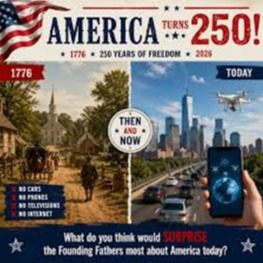
That belief has been one of America's defining characteristics since its founding nearly 250 years ago.
Source: Instagram
Think about what this country has accomplished in just two and a half centuries. From electricity to antibiotics, from modern aviation to space exploration, from the internet to artificial intelligence, from advanced agriculture to life-saving medical technologies, generation after generation has refused to accept that today's limitations have to become tomorrow's reality.
The remarkable thing isn't simply that these innovations created wealth. They expanded opportunity. They made lives longer, healthier, safer, and more productive for billions of people around the world.
It's easy to look at today's widening wealth gap and conclude that prosperity is a fixed pie, where one person's success necessarily comes at someone else's expense. But history tells a different story.
The greatest breakthroughs don't simply redistribute wealth differently. They create entirely new value—and with it, entirely new wealth—that didn't previously exist. They make the pie larger for everyone.
A century ago, even the wealthiest people on earth could not have imagined the standard of living that many middle-income families enjoy today. Today, many ordinary people genuinely enjoy things that Rockefeller, Vanderbilt, Churchill, Roosevelt, and even kings never experienced.
Instant communication across the globe. Clean drinking water delivered directly into our homes. Antibiotics. Air conditioning. GPS navigation. Medical imaging. Organ transplants. Commercial air travel. Access to nearly all of humanity's knowledge from a device that fits into a pocket.
These aren't luxuries reserved only for royalty… or the rich. They have become part of everyday life for millions of ordinary people because innovation relentlessly lowered costs, increased access, and improved our collective quality of life.
Now imagine the next 100 years… or the next 250.
Artificial intelligence may help scientists discover treatments for diseases that have plagued humanity for centuries. Robotics may perform dangerous jobs that place workers at risk today. Advances in energy production could provide cleaner, more abundant power. Precision medicine may allow doctors to tailor treatments to each individual patient.
Technologies that today sound like science fiction may eventually become as commonplace as smartphones are now. Look at the picture below and remember that less than two decades ago, you had to have all of these separate devices to match the smartphone you now carry in your pocket.
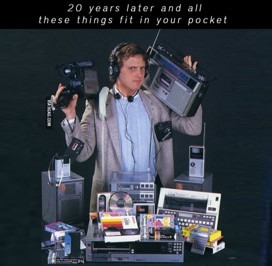
Source: Geckoandfly
None of us knows exactly what the future holds.
But history strongly suggests that free people solving difficult problems have an extraordinary habit of surprising us.
If the last 250 years have taught us anything, it's to be careful betting against human ingenuity.
I've spent nearly four decades helping families navigate markets, recessions, wars, financial crises, terrorist attacks, pandemics, inflation scares, and countless headlines predicting America's decline. Every generation has faced moments when it seemed the country was losing its way.
And yet, generation after generation, Americans continued to build businesses, raise families, discover new medicines, invent new technologies, educate their children, and create opportunities that didn't exist before. They solved problems that previous generations assumed were unsolvable.
Those acts themselves are optimistic. Entrepreneurs don't start companies because they believe tomorrow will be worse. Scientists don't spend decades searching for cures because they think humanity is doomed. Inventors don't build new technologies because they believe the best days are behind us. Progress begins with the belief that improvement is possible.
Investing requires optimism because every investment is ultimately a bet on a better future. You must believe that companies can innovate and create products and services that people will want to buy. When enough companies do exactly that over long periods of time, economies grow, living standards improve, and wealth is created.
Progress has never been a straight line. Neither has America's story.
As we prepare to celebrate our nation's 250th birthday, we shouldn't ignore our challenges. Every generation has inherited problems that needed solving. Ours is no different.
But neither should we lose sight of what has made America exceptional for nearly two and a half centuries: a belief that tomorrow can be better than today if free people are willing to work, innovate, build, and dream. I have often said we should be long on human ingenuity, problem solving, and compassion—and short on bureaucracy, governments, and institutions.
The choice before us isn't whether challenges exist. They always have. The real choice is which soundtrack we want playing in the background as we face them.
Pessimism may dominate the present, but optimism has always built the future.
Do we spend the next chapter trying to Paint It Black?
Or do we remember that even in an imperfect world, filled with unfinished work and difficult problems, it's still possible to look toward the future and say... It's a Beautiful Day!
Two hundred and fifty years ago, the people who founded this country made an extraordinary bet on the future. They believed free people could build something better than had ever existed before. We have inherited the benefits of that optimism.
The best way to honor that legacy isn't by pretending America is perfect, but by believing, as they did, that our best chapters may still lie ahead. And that's exactly how we continue Moving Life Forward.
© 2026 Jesse Hurst
Senior Wealth Manager
Related Content
- Good (vs. Bad) Vibrations
- “If It Is a Good Morning…” — In Which Main Street Develops a Curious Case of Eeyore Economics
The views stated are not necessarily the opinion of Cetera and should not be construed directly or indirectly as an offer to buy or sell any securities mentioned herein. Due to volatility within the markets mentioned, opinions are subject to change without notice. Information is based on sources believed to be reliable; however, their accuracy or completeness cannot be guaranteed. Past performance does not guarantee future results.
Investors cannot directly invest in indices.