


Rocky is a 1976 American independent sports drama film written by and starring Sylvester Stallone. It also stars Talia Shire, Burt Young, Carl Weathers, and Burgess Meredith. In the movie, Rocky Balboa (Stallone), a poor small-time club fighter and loan shark debt collector from Philadelphia, gets an unlikely shot at the world heavyweight championship held by Apollo Creed (Weathers).
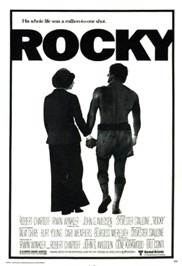
Source: Wikipedia
Rocky entered development in March 1975 after Stallone wrote the screenplay in three days. It had an estimated production budget of under $1 million. Rocky became the highest-grossing film of 1976, earning approximately $225 million worldwide. The film received critical acclaim for Stallone's writing, performances, direction, musical score, cinematography, and editing. It received ten Academy Award nominations and won three, including Best Picture.
Apollo Creed did not take this fight very seriously, taking it as nothing more than an easy tune-up over an unknown opponent. Taking advantage of his overconfidence, Rocky knocks him down in the first round—the first time Creed has ever been knocked down. The fight goes on for the full fifteen rounds, with both fighters sustaining various injuries: Rocky, with hits to the head and swollen eyes, requires his right eyelid to be cut to restore his vision, while Apollo, with internal bleeding and a broken rib, struggles to breathe.
Despite being knocked down several times, Rocky battles on. Toward the end of the 14th round, he sustains what appears to be the final knockout blow from Creed. As he struggles to get up, his manager and mentor, Mickey, urges Rocky to "stay down,” urging him to concede the match because he believes he is seriously injured and can't continue fighting safely. Everybody in the audience is surprised to see Rocky struggle to his feet after such a beatdown. Nobody is more astonished than Apollo. As you can see in the YouTube clip below, Rocky then manages to get Apollo to come in close, where he hits him repeatedly in the rib cage, causing him to break his ribs and spit up blood.
As an 11-year-old 5th grader, this movie, and at least the first two sequels, had an enormous impact on me and my sports-minded friends. We all did boxing training in addition to the traditional sports we played, such as baseball, basketball, and football. Luckily, one of my best friends from junior high’s dad had participated in Golden Gloves boxing. Over the next several years, I had the opportunity to work out and hang out at the Golden Gloves gym. I also got to be a ring boy for several years. This meant that after the fight, I cut the tape and removed the gloves from the sweaty and often bloody boxers so they could be given to one of the next challengers, as they only had three sets of gloves for an entire night of boxing matches.
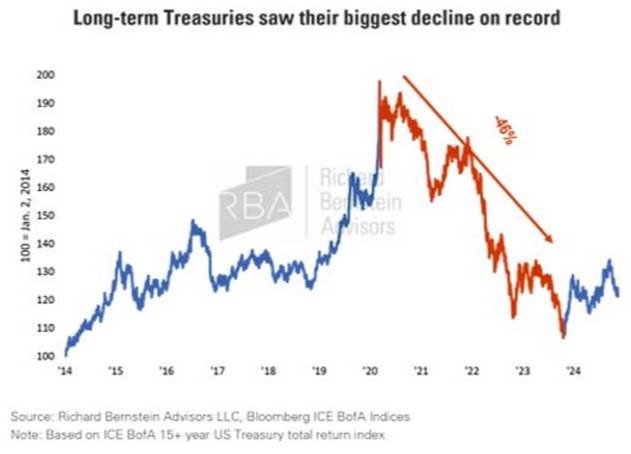
Today, the bond market is attempting its own version of Rocky. The bond market was severely beaten down from 2021 to 2023 as inflation spiked and interest rates rose rapidly. Today, bonds are attempting to get back up and reclaim their rightful position as an asset class and diversification tool within portfolios. How bad was the beating the bond market took? Our first chart from our friends at Richard Bernstein Advisors shows that the Fed went full Apollo creed on the bond market by raising interest rates 11 times in 16 months from March 22 to July 23. This caused long-term Treasury bonds to lose nearly half their value, their worst performance in over 100 years.
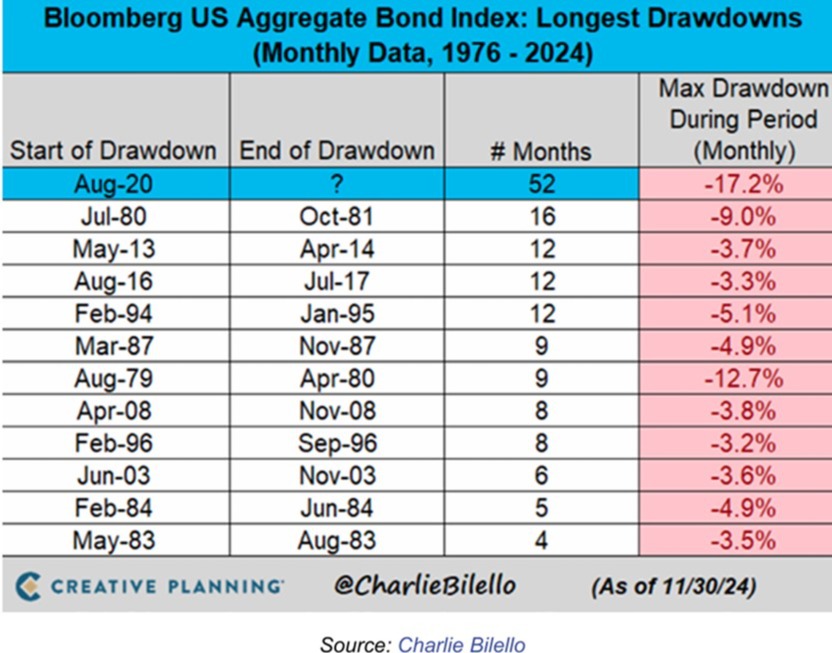
The carnage was just as bad in the more diversified overall bond market. The Bloomberg US Aggregate Bond index, AGG, is made up of 2/3 treasury and agency debt, with the balance invested in investment-grade corporate bonds. As we see in our second chart below, this index last peaked in August 2020 and has now been on a 52-month downturn—longer than any period over the 40 years this chart measures. The decline has been historical in terms of its duration and the amount of drawdown we have experienced.
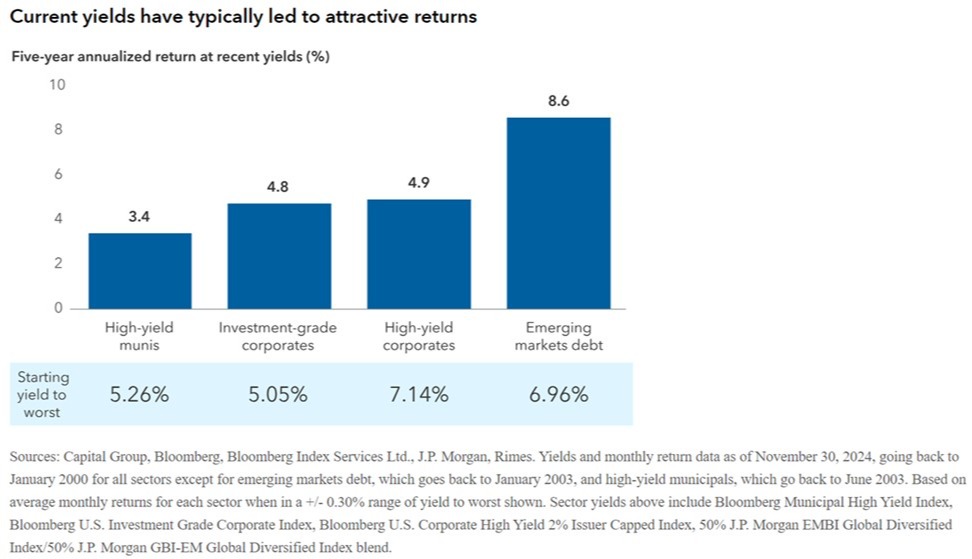
However, today, the economy continues to grow at above-trend levels, supported by consumers who continue to spend, whether by cash or credit card. Despite high inflation and high interest rates, this sustained consumer spending has continued to support corporate earnings and credit fundamentals in the bond market. Moreover, after raising interest rates dramatically to fight persistent inflation, yields on bonds are at the highest level we have seen in more than two decades. Our final chart below shows that when the starting yields are this high, the bond market tends to produce returns that would make them an attractive part of a portfolio over the ensuing five years.
It is also important to remember that the Fed reversed course and started cutting interest rates in September of this year. Just as rising interest rates hurt bond prices over the last few years, falling interest rates could create capital appreciation in the bond market in addition to the yields listed above. The CFPs of Impel Wealth Management are watching this closely, especially as inflation seems to be stuck above the Federal Reserve Bank's target level. We are also aware that the pro-growth initiatives of the new administration could put upward pressure on both inflation and economic growth in the future.
As the fight drew to a close, Rocky did not listen to his trainer, Mickey. He got up, fought back, and went the distance. We will watch to see if the bond market can do the same. I thought this was a great analogy and picture of what bond investors have lived through over the last few years. Hopefully, the bond market will get back up. It would be great if, like Rocky, the bond market could say, “YO Adrian, I did it.” Understanding this story in the context of your portfolio is essential as we continue “Moving Life Forward.”
© 2024 Jesse Hurst
Senior Wealth Manager
Related Content
The views stated are not necessarily the opinion of Cetera and should not be construed directly or indirectly as an offer to buy or sell any securities mentioned herein. Due to volatility within the markets mentioned, opinions are subject to change without notice. Information is based on sources believed to be reliable; however, their accuracy or completeness cannot be guaranteed. Past performance does not guarantee future results.
Neither Cetera Advisors LLC nor any of its representatives may give legal or tax advice. This information is not intended as tax or legal advice. Please consult legal or tax professionals for specific information regarding your individual situation.
Investors cannot directly invest in indices.
Featured Blog Image Source: iStock.com/FOTOKITA