


In Part 1 of this series, I posited that it had been a long lonely, lonely, time since international stocks had bested their US brethren. In fact, we have experienced nearly 14 years of U.S. stock outperformance. Today, in Part 2 of this series, I will share with you some of the factors that are finally allowing foreign stocks to show signs of life and pull their weight in diversified portfolios.
"Alive and Kicking" is a song released by the Scottish rock band Simple Minds as the lead single from their seventh album, Once Upon a Time. Following the success of their previous non-album single, "Don't You (Forget About Me)", which many people remember from the movie The Breakfast Club, the song reached #3 on the US Billboard Hot 100 and #1 on the Top Rock Tracks chart. The song was released in September 1985, during the fall of my sophomore year at the University of Akron. It is by far my favorite song from the band Simple Minds. I distinctly remember breaking my hairbrush in two while drumming along to the music while driving in my 1976 Ford Pinto (for those of you who know my hairline, you probably think this is hilarious. Obviously, the brush in my car was much more for drumming than brushing.)

Source: YouTube
The music video for "Alive and Kicking" was filmed near the town of Hunter, at North–South Lake in the Catskill Mountains of Upstate New York. A portion of the video was filmed on the overlook at the site of the old Catskill Mountain House. As many of you may not remember the song or video, I have included a link for your viewing pleasure below. You will see how easy it is to drum along to…
Simple Minds - Alive And Kicking
After disappointing investors for many years and causing some to wonder whether it still made sense to maintain an international allocation in their diversified portfolios, foreign stocks are indeed “Alive and Kicking” and have significantly outperformed their US counterparts by a wide margin in the first half of 2025. This year, investors, businesses, and consumers have had to weigh the impact of tariffs that have been implemented, paused, de-escalated, and challenged in court. The worst-case scenarios proposed in early April, which caused U.S. markets to briefly drop by 20% or more, may currently be off the table, but trade uncertainty remains.
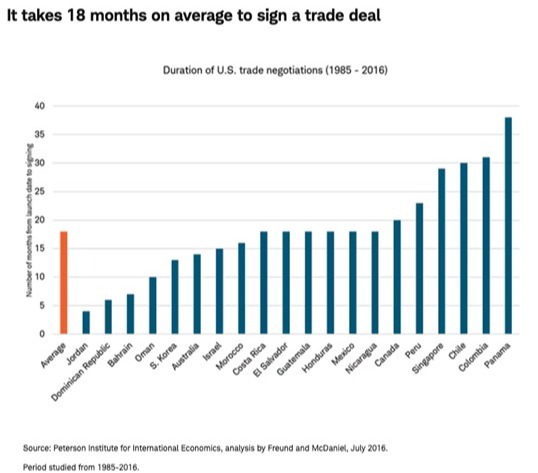
Uncertain U.S. policy and lagging U.S. stock performance have prompted investors to look overseas for opportunities. The first half of 2025 should serve as a case study on why investors should consider international diversification to help manage market volatility. As you will see in our first chart below, U.S. trade deals have typically taken an average of 18 months for both parties to sign an agreement. However, investors may be adapting. Stock markets are now higher than they were on April 2nd, when President Trump announced the Liberation Day tariffs. Trade deals with the U.K. and China have been viewed by market participants as progress, even if they are less comprehensive than had been hoped for or advertised.
The US-China trade war has led the Bloomberg consensus of economists to lower their estimates for global growth in 2025, in part due to the impact of tariffs on imports between the two countries. As a result, both the US and China are expected to experience the most significant negative economic impacts from the trade war. Despite the reduced growth outlook, neither the global economy nor China nor the US is expected to fall into a recession in 2025. Growth acceleration in many smaller economies is anticipated to help offset the predicted slowdown in the world's two largest economies.
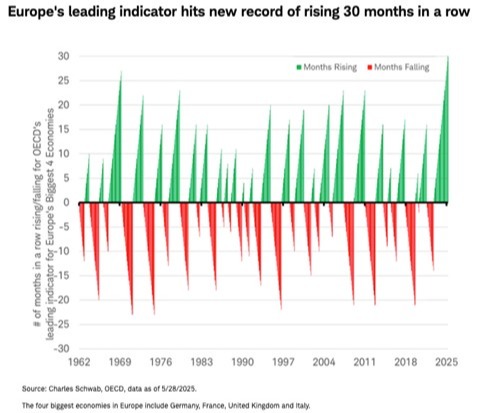
Recent Eurozone economic data has been surprising to the upside, while the US leading economic indicator is showing signs of weakness. The Citigroup Eurozone Economic Surprise Index, which measures how actual economic data releases compare to forecasts, indicates that Eurozone data has been coming in better than expected. As you will see in our following chart, the OECD Leading Economic Indicator (for Germany, France, UK, Italy) suggests continued expansion in Europe, with a record 30-month consecutive increase in April.
Importantly, the U.S. trade war has motivated countries outside of the U.S. to accelerate trade with each other. Already this year, the U.K. and India have made a free trade deal, and the U.K. and EU have struck a landmark post-Brexit reset agreement. China has also signed cooperation agreements with Vietnam and Malaysia.
Additionally, fiscal policy stimulus, including tax cuts and spending increases, is gaining momentum globally. Examples include Canada's plans for tax cuts and spending growth, Australia's proposed tax cuts and energy cost support for households, and Japan's $6.3 billion spending package to aid businesses and families affected by U.S. tariffs.
Germany is undergoing a notable shift away from its historically conservative fiscal approach, embracing sizable stimulus, which could influence other European nations. In the first half of the year, Germany passed a potentially trillion-euro stimulus package. This package includes €500 billion for infrastructure over the next decade, as well as an estimated €500 billion from the removal of strict budget caps on military spending. The possibility of the U.S. reducing military guarantees to other countries is leading NATO as a whole to increase defense spending. This potential increase reflects a shift in global security strategy and could lead to significant investments in modernizing critical infrastructure and enhancing cybersecurity resilience.
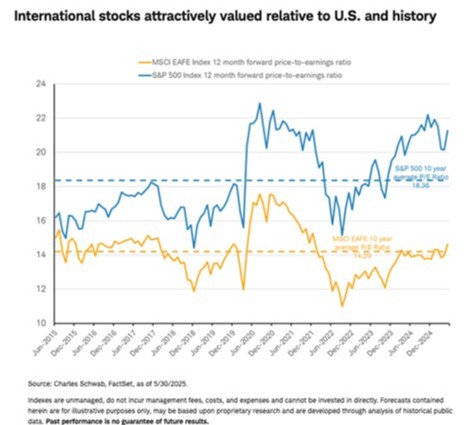
The first quarter earnings season in Europe was the best in years, with 59% of companies in the Europe STOXX 600 Index beating estimates, according to data from earnings tracker London Stock Exchange Group. In addition, as you will see in our final chart today, attractive valuations may persuade investors to reallocate money away from the U.S. in their portfolios. International stocks are currently valued close to their historical averages, whereas U.S. stocks are above historical evaluation measures. The combination of earnings growth and lower valuations may imply greater price appreciation potential for non-U.S. stocks.
While it has been a long, lonely time since international stocks contributed to the performance of diversified, asset allocation portfolios, they appear to be “Alive and Kicking” based on their performance during the first half of 2025. The CFPs of Impel Wealth Management will continue to watch this closely to see if the trend persists into the future. This is a story we wanted to share with you, our trusted friends and clients, as we continue “Moving Life Forward.”
© 2025 Jesse Hurst
Senior Wealth Manager
Related Content
The views stated are not necessarily the opinion of Cetera and should not be construed directly or indirectly as an offer to buy or sell any securities mentioned herein. Due to volatility within the markets mentioned, opinions are subject to change without notice. Information is based on sources believed to be reliable; however, their accuracy or completeness cannot be guaranteed. Past performance does not guarantee future results.
Neither Cetera Advisors LLC nor any of its representatives may give legal or tax advice. This information is not intended as tax or legal advice. Please consult legal or tax professionals for specific information regarding your individual situation.
Investors cannot directly invest in indices.
The Citigroup Economic Surprise Index for the Eurozone measures how economic data releases compare to pre-release expectations. A positive value indicates that data are generally exceeding forecasts, while a negative value suggests they are falling short. For example, a sharp rise in the index, as seen at the beginning of the year, suggests that economic data is performing better than anticipated.
The STOXX Europe 600, also called STOXX 600, SXXP, is a stock index of European stocks designed by STOXX Ltd. This index has a fixed number of 600 components representing large-, mid- and small-capitalization companies among 17 European countries, covering approximately 90% of the free-float market capitalization of the European stock market (not limited to the Eurozone).
The MSCI EAFE Index is a widely recognized stock market index that measures the performance of large- and mid-cap companies in developed markets outside of the U.S. and Canada.
Featured Blog Image Source: iStock.com/fcscafeine