


Source: YouTube
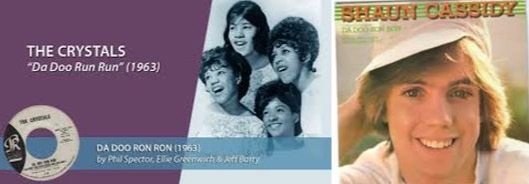
"Da Doo Ron Ron" is a song written by Jeff Barry, Ellie Greenwich and Phil Spector. On June 8, 1963, it reached #3 on the Billboard Hot 100 for the girl group The Crystals. American teen idol Shaun Cassidy recorded the song in 1977, and his version hit number one on the Billboard Hot 100 chart. My wife, Rachel, doesn't always love it when I tell people that her first concert was seeing Shaun Cassidy in New York City in 1979, when she was 12 years old. The song was composed over two days in Spector's office in New York. The title "Da Doo Ron Ron" was initially just nonsense syllables used as a dummy line to separate each stanza and chorus until proper lyrics could be written, but Spector liked it so much that he kept it.
“That's gold. That's solid gold coming out of that speaker.”
— Spector to Sonny Bono, after listening to the final playback of "Da Doo Ron Ron".
For those of you who would like a reminder or need an early morning pick me up, a YouTube link to Shaun Cassidy, as Joe Hardy from The Hardy Boys, doing his version of the song below.
Shaun Cassidy as Joe Hardy - "Da Doo Ron Ron" - The Hardy Boys S1E9 (1977)
In Part 1 of my three-part examination of the recent resurgence of international stocks, we determined that it had been “A Long, Lonely Time” since they had gone through a period of outperformance versus their United States brethren. In Part 2, we reviewed why international stocks were “Alive and Kicking” and positively contributing to portfolio performance in 2025. In our final segment today, we will examine whether this phenomenon can continue to “Da Do Ron Ron” in the future.
International stocks have outperformed US stocks so far this year due to a combination of factors, including cheaper valuations overseas, a weakening US dollar, and a potential shift in investor sentiment regarding US markets. While past performance is not indicative of future results, these trends suggest that international equities may continue to offer attractive opportunities, as well as non-correlated diversification benefits, into the future.
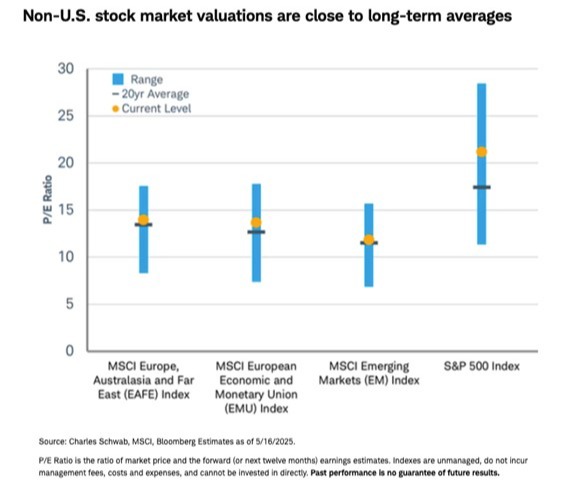
International stocks are trading at lower valuations compared to those in the US, making them more attractive to investors seeking value. This valuation gap has made international stocks more appealing for those looking to diversify their portfolios with lower-priced stocks, as shown in our first chart below. ( FYI- the black hash line is the 20-year average valuation, and the yellow dot is the current level of valuation).
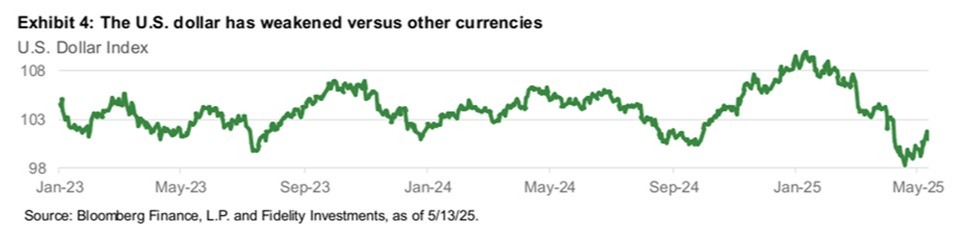
A weaker US dollar makes international investments more attractive to foreign investors. Conversely, a stronger dollar can make US assets more expensive for foreign investors, potentially leading to reduced investment flows into the US market. After remaining strong for the last few years, the US dollar has generally been weakening. A weaker dollar tends to work in favor of international equities by making borrowing cheaper for foreign companies, which, in turn, can help boost profits.
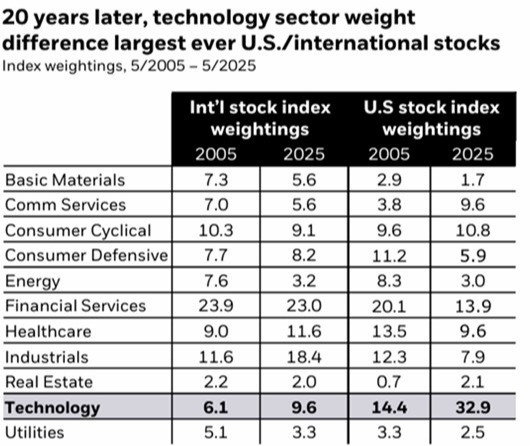
While volatility is an inevitable part of investing, foreign markets don’t always rise and fall in sync with US markets. International investing can help mitigate the risks of high market concentration in the US, which may lead to a more balanced and resilient portfolio. Since the 1970s, US and international markets have traded multi-year periods of outperformance. Historical data shows that the average outperformance cycle has lasted over eight years, which may indicate that the tide is turning to the next cycle. While domestic investors have enjoyed US outperformance for more than a decade, as shown in the chart below, the significant overweight of technology stocks in US stock indexes has contributed significantly to this.
Source: BlackRock
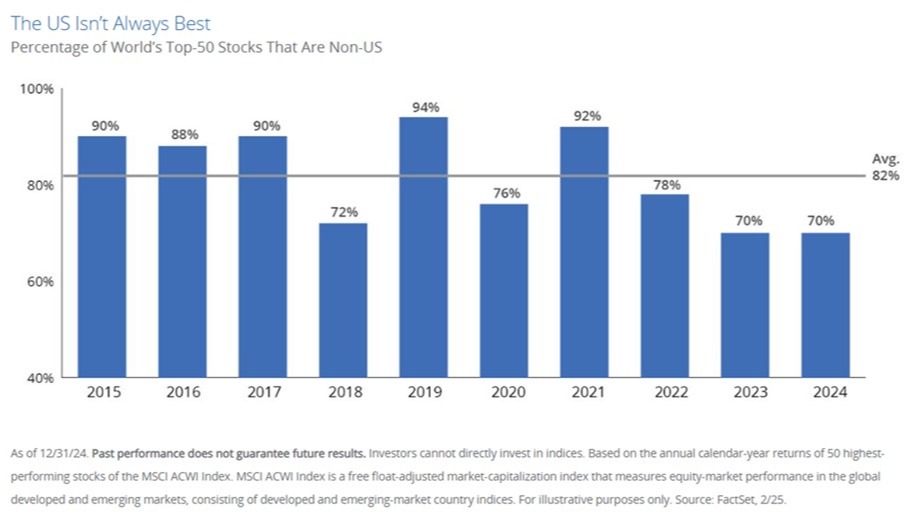
Finally, although US stocks have had a long run of strong performance, the majority of the world’s top-performing individual stocks have consistently been international. The United States does not have a monopoly on the best-run and most profitable companies in the world. On average, 82% of the top-50 stocks globally were from non-US companies, as you can see in our final chart below.
Of course, no blog post that uses the song “Da Do Ron Ron” would be complete without sharing my favorite version with you. In the 1981 comedy classic Stripes, Russell Ziskey, played by the completely underappreciated comedy genius Harold Ramis, uses the song to teach English as a second language. Even though I have seen this clip dozens of times, I still laugh every time I see it, much to Rachel’s chagrin. A final YouTube clip of the scene is included below. This scene clearly demonstrates the power of a great song and that music is truly a universal language.

Source: YouTube
As I conclude this three-part series, I believe that it makes sense for international stocks to be part of your asset allocation to enhance diversification, potentially reduce portfolio volatility, and access global growth opportunities. By including international stocks, you can mitigate the risk of overconcentration in your domestic market and potentially benefit from the growth of different economies and sectors worldwide.
While it's impossible to predict the future, the current trends suggest that international stocks may continue to “Da Do Ron Ron” in the coming years. I thought this would be a fun way to share this important lesson with you, our trusted friends and clients, as we continue “Moving Life Forward”.
© 2025 Jesse Hurst
Senior Wealth Manager
Related Content
The views stated are not necessarily the opinion of Cetera and should not be construed directly or indirectly as an offer to buy or sell any securities mentioned herein. Due to volatility within the markets mentioned, opinions are subject to change without notice. Information is based on sources believed to be reliable; however, their accuracy or completeness cannot be guaranteed. Past performance does not guarantee future results.
Neither Cetera Advisors LLC nor any of its representatives may give legal or tax advice. This information is not intended as tax or legal advice. Please consult legal or tax professionals for specific information regarding your individual situation.
Investors cannot directly invest in indices.
The performance of any index is not indicative of the performance of any investment and does not take into account the effects of inflation and the fees and expenses associated with investing.”.The performance of any index is not indicative of the performance of any investment and does not take into account the effects of inflation and the fees and expenses associated with investing.
Additional risks are associated with international investing, such as currency fluctuations, political and economic stability, and differences in accounting standards.
A diversified portfolio does not assure a profit or protect against loss in a declining market.
The MSCI EAFE Index is designed to measure the equity market performance of developed markets (Europe, Australasia, Far East) excluding the U.S. and Canada. The Index is market-capitalization weighted.
The MSCI EMU Index (European Economic and Monetary Union) captures large and mid cap representation across the 10 Developed Markets countries in the EMU. With 219 constituents, the index covers approximately 85% of the free float-adjusted market capitalization of the EMU.
The MSCI Emerging Markets Index is designed to measure equity market performance in global emerging markets. It is a float-adjusted market capitalization index.
The MSCI All-Country World Index is a free float-adjusted market capitalization weighted index that is designed to measure the equity market performance of developed and emerging markets. The MSCI ACWI consists of 47 country indexes comprising 23 developed and 24 emerging market country indexes. The developed country indexes include: Australia, Austria, Belgium, Canada, Denmark, Finland, France, Germany, Hong Kong, Ireland, Israel, Italy, Japan, Netherlands, New Zealand, Norway, Portugal, Singapore, Spain, Sweden, Switzerland, the United Kingdom, and the United States. The emerging market country indexes included are: Brazil, Chile, China, Colombia, Czech Republic, Egypt, Greece, Hungary, India, Indonesia, Korea, Kuwait, Malaysia, Mexico, Peru, Philippines, Poland, Qatar, Saudi Arabia, South Africa, Taiwan, Thailand, Turkey, and United Arab Emirates.
Featured Blog Image Source: iStok.com/:msan10