


Willy Wonka & the Chocolate Factory is a 1971 American musical fantasy film based on a screenplay by Roald Dahl and his 1964 novel Charlie and the Chocolate Factory. It stars Gene Wilder as chocolatier Willy Wonka. The film tells the story of a poor child named Charlie Bucket who, upon finding a Golden Ticket in a chocolate bar, wins the chance to visit Willy Wonka's chocolate factory, along with four other children from around the world. The movie was remade and reimagined as Charlie and the Chocolate Factory in 2005. Tim Burton directed the newer version, which stars Johnny Depp as Willy Wonka and Freddie Highmore as Charlie Bucket.

Sources: Spotify & Amazon
Both movies portray the character of Veruca Salt as a greedy, demanding, spoiled brat. She demands everything she wants and everything she sees. Veruca is the second person to find a Golden Ticket and the third to be eliminated from the factory tour. In the 1971 movie, Veruca has a fiery temper and rudely demands various desires nonstop. In this film, Veruca is eliminated at the end of her musical number, "I Want It Now," after climbing a machine designed to determine whether the golden eggs are "good" or "bad." The machine judges her as a "bad egg", and she disappears down the garbage chute.
For those of you who would like a reminder of this sad and funny scene, I have included a YouTube link to the video from the movie below.
Veruca Salt - I Want It Now (Willy Wonka and the Chocolate Factory)
Many of you may not know that Harry Connick, Jr. and his big band also recorded a version of the song for his album Songs I Heard. It is a combination of "(I’ve got a) Golden Ticket" and "I Want It Now. " A YouTube clip for that song is included below for those of you who are curious or just enjoy listening to Harry Connick's big band play.
In the United States, the U.S. Bureau of Economic Analysis (BEA) creates the Gross Domestic Product (GDP) report. BEA is an agency within the U.S. Department of Commerce and is the official source of economic statistics for the country. The US GDP for the fourth quarter of 2024 showed a growth rate of 2.4%. At the end of 2024, the U.S. GDP was around $29 trillion. The U.S. economy experienced real GDP growth of 2.8% for the full year, which was driven by increases in consumer spending, investment, government spending, and exports. The first estimate for the 2025 first-quarter GDP report will be released on April 30, 2025, at 8:30 a.m.
However, getting GDP data quarterly is not fast enough for some economists and Federal Reserve Bank officials. Just like Veruca Salt, "they want it now." As a result, both the Atlanta Federal Reserve Bank and the New York Federal Reserve Bank have created real-time GDP forecasts based on high-frequency data that are updated regularly. Because there is a lot of uncertainty and curiosity created by the current administration's tariff rollout and what the impact will be on economic growth and inflation, we wanted to let you know about these new GDP forecasts, which you may hear about in the news over the coming weeks.
The Atlanta Fed GDPNow economic forecasting tool is currently projecting an imminent recession, which is making investors and market strategists nervous. However, the New York Fed Nowcast predicts continued economic growth in the first quarter. How can this be, and what does it mean for those economists who want their data now?
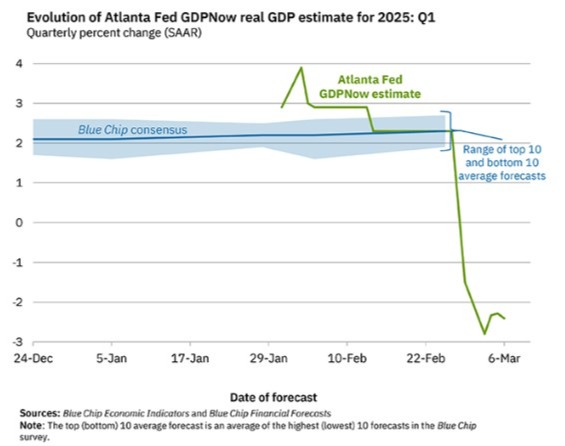
The Atlanta Fed's GDPNow uses an equation similar to the one used by the BEA. It uses a "bridge equation," which includes regression analysis and other statistical tools that link data released at different time frequencies to predict quarterly GDP. The GDPNow model mimics the methodology used by the BEA. However, because GDPNow estimates at the beginning of the quarter are based on a limited amount of data, the result can produce very volatile forecasts. For example, the GDPNow forecast fell from a +2.5 % growth to -1.8% growth in late February, based solely on trade balance data, as shown in the chart below.
In contrast, the New York Fed Nowcast is a dynamic factor model that utilizes a wide range of economic data and statistical models to determine the relationships between the data and GDP. It also uses data not included by the BEA or the Atlanta Fed. Results show that the large amount of data used smooths out its results over time, but its final estimates tend to be more prone to error than those of GDPNow.
To illustrate, let's look at the current forecast from March 24, 2025:
- Atlanta Fed GDPNow -1.8%
- New York Fed Nowcast + 2.72%
The following table summarizes the pros and cons of each model.
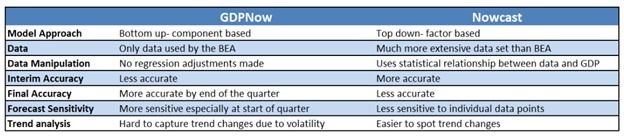
Which of these models is better? Depends on who you ask. Some economists rely on both models for a more complete insight and a balanced view. My primary purpose in sharing this with you is to illustrate that the Fed Banks have created different issues and inconsistencies in their forecasting models in their quest to get their information now. This is why it is essential not to take any headline, tweet, or social media post at face value. It is always important to question where the data came from and how it was collected before determining whether things are getting better or worse economically.
While Veruca Salt wanted things now because she was a spoiled brat, the Atlanta and New York Federal Reserve Banks want things now so they can create better forecasts and monetary policies for everyone. Unfortunately, that is easier said than done, as you can see from the data above. As we head into the summer months, there will be significant discussion about the economy, income tax legislation, the debt ceiling, inflation, and other important economic data points. As always, the CFPs of Impel Wealth Management will do our best to keep you informed as we continue "Moving Life Forward."
© 2025 Jesse Hurst
Senior Wealth Manager
Related Content
The views stated are not necessarily the opinion of Cetera and should not be construed directly or indirectly as an offer to buy or sell any securities mentioned herein. Due to volatility within the markets mentioned, opinions are subject to change without notice. Information is based on sources believed to be reliable; however, their accuracy or completeness cannot be guaranteed. Past performance does not guarantee future results.
Neither Cetera Advisors LLC nor any of its representatives may give legal or tax advice. This information is not intended as tax or legal advice. Please consult legal or tax professionals for specific information regarding your individual situation.
Investors cannot directly invest in indices.
Featured Blog Image Source: iStock.com/AndreyPopov