


"I Wish It Would Rain Down" is a song by English musician Phil Collins from his fourth solo studio album, ...But Seriously, in 1989. The song was a chart success in early 1990, peaking at No. 3 on the US Billboard Hot 100. Collins felt that it was as close as he had ever got, at the time, to writing a blues song. Eric Clapton plays lead guitar throughout the song, which also features a large gospel choir. Regarding Clapton's contribution, Collins recalls, “I said,' Eric, have I never asked you to play? "' Come on, I've got a song right up your street.'"

Source: YouTube
The 8:30-minute-long black-and-white music video contains 2:30 minutes of acting before the music begins. The setting is a theatre in the 1930s, parodying "Gone with the Wind", and actor Jeffrey Tambor plays a hyper-critical, unhappy theatre director. He is rehearsing some dancers (who are dancing to the guitar/bass guitar riff from the song "Sunshine of Your Love" by the band Cream, in which Eric Clapton played guitar). The director complains that the girls can neither dance nor sing, and then discovers that his star has appendicitis.
Eric Clapton, seated on a stool, says that Billy (played by Collins) used to be the drummer in a good band and assumed singing responsibilities when the original singer departed—an in-joke referencing Collins' tenure with the band Genesis, in which he played drums and then became the lead singer when Peter Gabriel exited the group. For those of you who have never seen the video or are unfamiliar with this song, I encourage you to click the link below and watch the entire YouTube video, which features a significant amount of self-deprecating humor aimed at almost everyone involved.
Phil Collins - I Wish It Would Rain Down (Official Music Video)
You said you didn't need me in your life
Oh, I guess you were right, yeah
Ooh, I never meant to cause you no pain
But it looks like I did it again, yeah
Now I, now I know I wish it would rain down, down on me
Ooh, yes, I wish it would rain, rain down on me now
Ooh, girl, I wish it would rain down, down on me
Ooh, yes, I wish it would rain on me
Instead of wishing it would rain, what if companies or municipalities could press a button to make it rain, right where it’s needed? This idea is no longer science fiction. A bold startup is working to turn water into a programmable resource.
Water scarcity is no longer just a climate issue—it’s a bottleneck for innovation. From AI data centers to semiconductor fabs, modern infrastructure relies on millions of gallons of water a day. AI datacenters in Oregon consume a quarter of the region’s water. A chip plant in Arizona needs millions of gallons daily. And cities like Phoenix are freezing new building permits because they can’t guarantee water for future residents.

Source: Substack
Cloud seeding has been in existence since the 1950s, but a breakthrough occurred in 2017, when scientists demonstrated that it could reliably induce rain. The insight? Over 90% of water vapor in clouds never falls—it evaporates. The new technology targets that wasted vapor using high-resolution radar and AI-guided drones. With just a few grams of silver iodide (a compound studied for safety for over 80 years), they trigger snowflakes that fall and melt into rain.
This is weather modification without any conspiracy theories. There are no 'chemtrails' or solar dimming, only precise engineering. The drones cost just $20 an hour to operate, which is much less than traditional cloud seeding methods that used expensive jet fuel and lacked accuracy.
The company is moving beyond theory and working at a large scale. Utah has hired them to help refill the shrinking Great Salt Lake, with a goal of generating 10 billion gallons of water in six months. That matches the output of America’s largest desalination plant. If successful, they will run the most extensive weather modification program in the world outside China.
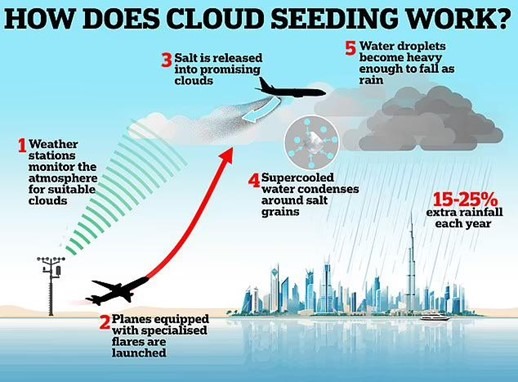
Source: Reddit
I thought a visualization of this process may be helpful. The diagram above outlines the steps and process for cloud seeding. However, you can tell it is somewhat dated as it is using airplanes instead of much cheaper drone technology.
Their goal is clear: make Arizona green within ten years. Imagine lakefront homes in the desert and wildfires prevented by targeted rainfall, changing the region’s future.
This new technology is more than a climate solution; it’s a new kind of utility. Water could become as abundant, reliable, and programmable as electricity. This could transform agriculture, real estate, energy, and even geopolitics.
While some climate activists call for using less, this solution focuses on abundance. It’s a bet on human creativity and offers an optimistic answer to environmental challenges.
In the spirit of sticking with our dual themes of rain and Eric Clapton, I would like to close with one other song and video clip that aligns with our story today.
"Let It Rain" is a song and single written and released by the British rock musician Eric Clapton and Bonnie Bramlett; it appears on his 1970 debut studio album, Eric Clapton. In 1972, it was released as a single as part of the promotion for his compilation album Eric Clapton at His Best. A YouTube link to the song is included below, both because of its ties to today's topic and because it's a fantastic song.

Source: YouTube
Eric Clapton "Let It Rain" (1970)
The rain is falling through the mist
Of sorrow that surrounded me
The sun could never thaw away
The bliss that lays around me
Let it rain, let it rain
Let your love rain down on me
Let it rain, let it rain
Let it rain, rain, rain
There will likely be future investment opportunities to consider with this new technology. Water scarcity affects core sectors, including agriculture, technology, real estate, and public health. Solutions for reliable water access are in high demand globally, with economic estimates suggesting that the water solutions market is valued in the hundreds of billions of dollars and is expected to continue growing as climate pressures intensify.
In the very near future, we may no longer have to “Wish it Would Rain.” This tech could become essential infrastructure in a warming world. This isn’t just about rain. It’s about rewriting the rules of nature—and unlocking a new era of growth. I thought this was a remarkable story that highlights how humanity and innovation continue to create new solutions to overcome significant problems. I wanted to share this with you so you can continue to have a more optimistic view of the future as we continue “Moving Life Forward.”
© 2025 Jesse Hurst
Senior Wealth Manager
Related Content
The views stated are not necessarily the opinion of Cetera and should not be construed directly or indirectly as an offer to buy or sell any securities mentioned herein. Due to volatility within the markets mentioned, opinions are subject to change without notice. Information is based on sources believed to be reliable; however, their accuracy or completeness cannot be guaranteed. Past performance does not guarantee future results.
Neither Cetera Advisors LLC nor any of its representatives may give legal or tax advice. This information is not intended as tax or legal advice. Please consult legal or tax professionals for specific information regarding your individual situation.
Investors cannot directly invest in indices.
Featured Blog Image Source: iStock.com/:xphotoz