


"Boom Boom" is a song written by American blues singer and guitarist John Lee Hooker and first recorded in 1961. Music critic Charles Shaar Murray calls it "the greatest pop song he ever wrote". It was both an American R&B and pop chart success in 1962 and a UK top twenty hit in 1992. The song is one of Hooker's most identifiable and enduring songs and "among the tunes that every band on the [early 1960s UK] R&B circuit simply had to play". It has been recorded by numerous blues and other artists.

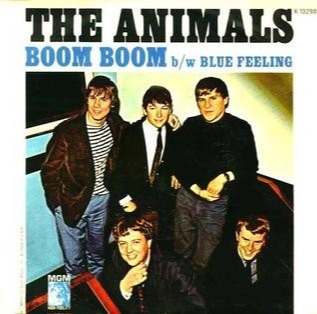
Source: Wikipedia
English rock band the Animals recorded "Boom Boom" for their debut album The Animals. Their blues-rock rendition generally follows John Lee Hooker's original, although they add "shake it baby" as a response to the "come on and shake" refrain in the middle section. The Animals' version was released as a single in North America in November 1964. Over the years, several versions have been recorded by various Animals reunion lineups. In 2012, the original 1964 version was used in the film Skyfall.
For those of you who may not be familiar with this energetic song, I have included links to both the original by John Lee Hooker and the Animals' remake below.
John Lee Hooker - Boom Boom (Official Lyric Video)
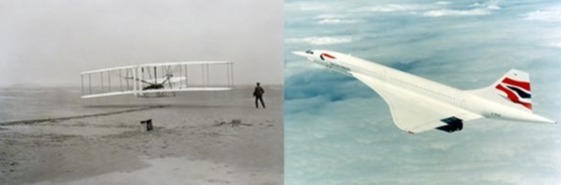
The Wright brothers first sputtered into the air in 1903. Concorde broke the sound barrier in 1969. Only 66 years separate these two photos:
Source: The Rational Optimist
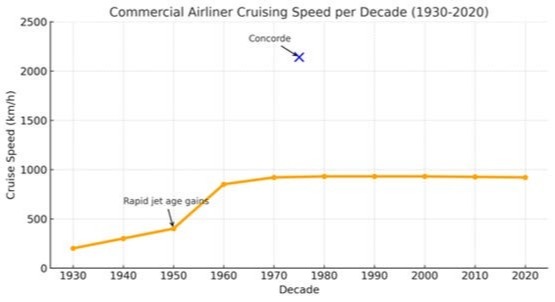
However, in the 56 years since Concorde debuted, aviation innovation has been stuck in a rut. Planes have gotten safer but slower. For decades, air travel has been defined by convenience, safety, and affordability. But one thing has been missing: speed. Believe it or not, the fastest passenger planes flying today are slower than the Concorde, which first broke the sound barrier in the late 1960s. That’s right—our grandparents flew faster than we do, as shown in the chart below.
Source: The Rational Optimist
Our “Boom Boom” theme is essential when we consider the question: Why do we no longer use supersonic airplanes, and what advancements does the future hold for us with new technology? Commercial supersonic airplanes are not in use today primarily because of a combination of economic infeasibility, strict noise regulations (no “Boom Booms”), and environmental concerns that plagued earlier projects like the Concorde.
You see, when an aircraft exceeds the speed of sound, it produces a loud, disruptive shock wave known as a sonic boom, which can rattle windows and disturb people on the ground.
The good news? Supersonic flight is poised for a comeback. And this time, it’s smarter, quieter, cleaner, and more financially viable than ever before. For investors, innovators, and everyday travelers, the return of supersonic travel could reshape not only how we move but also how we think about time, opportunity, and global connection.
The Concorde was a significant engineering achievement. Flying at Mach 2.04 (1,354 mph), it reduced transatlantic flight times by half, such as New York to London in 3.5 hours and Paris to Washington in under four. For 27 years, it transported business travelers across the Atlantic at twice the speed of sound.
However, Concorde was costly, noisy, and faced political challenges. The Federal Aviation Administration banned supersonic flight over U.S. land in 1973 due to concerns about sonic booms. High ticket prices, environmental inefficiencies, and the Air France Flight 4590 crash in 2000 led to its retirement in 2003, ending supersonic commercial travel.
The primary challenge has been eliminating the impact of sonic booms. Concerns about this led the U.S. and many other nations to ban commercial supersonic flights over land, severely limiting potential routes to mostly transoceanic paths.
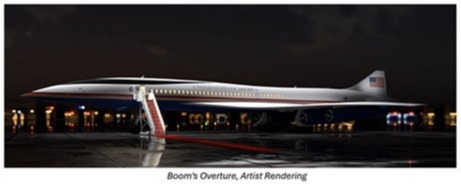
Boom Supersonic has addressed this issue. In February, its test jet broke the sound barrier three times over the Mojave Desert without generating noise on the ground. This was achieved by utilizing Mach cutoff, where sound waves dissipate at high altitudes before reaching the ground. With proprietary engines and AI-powered autopilot systems, Boom’s aircraft can fly nearly 1,000 mph over land without disturbing those below.
Source: The Rational Optimist
Unlike Concorde, Boom’s jets will use artificial intelligence to monitor atmospheric conditions and adjust speed automatically. This approach ensures efficiency, safety, and compliance with noise regulations, representing a significant advancement over 1970s technology.
Concorde consumed two tons of fuel during taxiing alone. Today, innovators are designing aircraft with sustainability as a priority. Advances in engine technology, materials science, and aerodynamics now allow supersonic jets to be both fast and fuel-efficient, which is essential as the world focuses on reducing carbon emissions.
The U.S. continues to ban supersonic flight over land, but there is growing momentum to reconsider these regulations. With new technology addressing noise concerns, regulators have an opportunity to unlock significant economic potential. Streamlined government processes could further accelerate progress.
Supersonic flight offers more than convenience; it presents significant opportunities with broad impacts. Premium routes are likely to command higher margins, and supersonic travel could redefine the competitive landscape. Destinations previously considered too distant for short trips will become accessible, likely resulting in increased global tourism. Advances in artificial intelligence, materials, and propulsion are expected to benefit other industries, creating new investment opportunities.
The Concorde was a government-led initiative, while Boom Supersonic and similar companies are market-driven ventures supported by substantial pre-orders. Of course, hurdles remain. Supersonic jets must prove they can operate profitably, sustainably, and safely. Regulatory approval is essential. And ticket prices must be accessible enough to attract more than just elites.
But history shows that innovation often starts at the top and trickles down. Air travel itself was once a luxury. Today, it’s routine. Supersonic flight will likely follow the same trajectory—premium at first, then mainstream as costs fall and adoption grows.
Progress isn’t inevitable. Concorde reminds us of that. But the innovators are back, and this time they’re building smarter, cleaner, quieter, and cheaper. By the mid-2030s, supersonic travel could be as ordinary as boarding a 747 today. Whisper-quiet jets zipping across continents. Electric air taxis buzzing between skyscrapers. The skies are transforming into the futurists’ dream.
You should fasten your seatbelt. The future of flight is about to get faster without the “Boom Booms”. And that is something that would make even Maverick and Goose happy!

Source: YouTube
This was an important story about the continued technological advancements happening, out of sight and under the radar of the mainstream news media. I want to continue bringing these to you so that you hope for a more optimistic future. It was an important story to share as we continue “Moving Life Forward.”
© 2026 Jesse Hurst
Senior Wealth Manager
Related Content
The views stated are not necessarily the opinion of Cetera and should not be construed directly or indirectly as an offer to buy or sell any securities mentioned herein. Due to volatility within the markets mentioned, opinions are subject to change without notice. Information is based on sources believed to be reliable; however, their accuracy or completeness cannot be guaranteed. Past performance does not guarantee future results.
Investors cannot directly invest in indices.
Featured Blog Image: iStock.com/Eliyahu Parypa