


What Hercules, Greek Mythology, and Behavioral Finance Can Teach Investors About Market Declines- Part 1
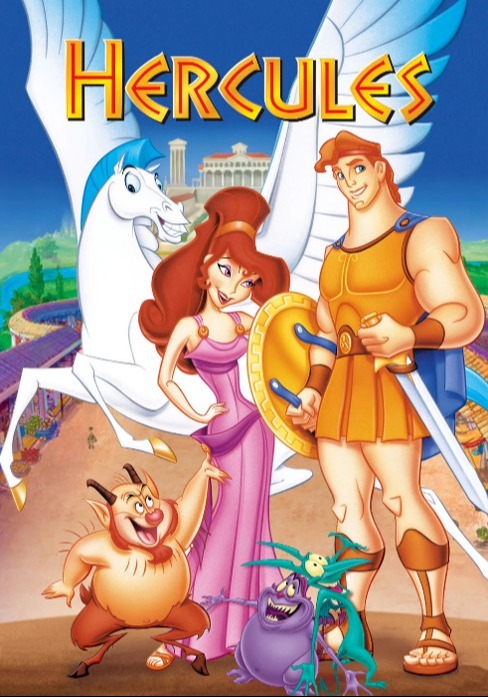
In Disney’s 1997 animated movie Hercules, Hades doesn’t exactly surround himself with the Navy SEALs of the Underworld.
Source: Disney Hercules Wiki
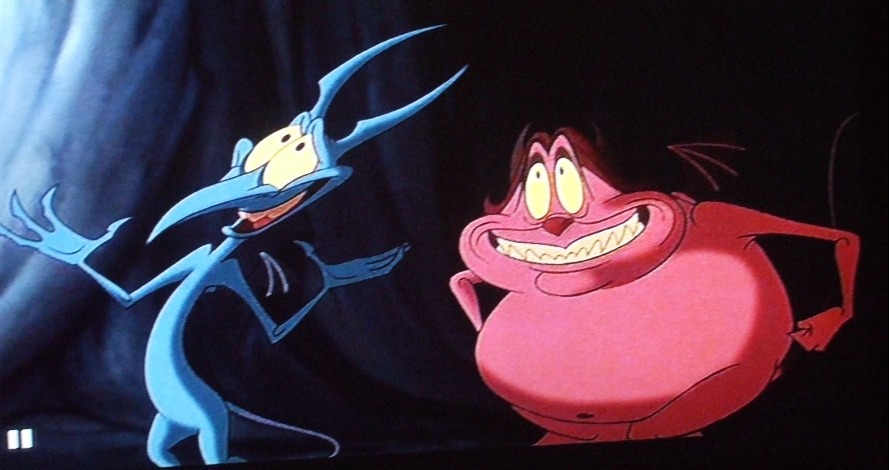
Instead, his two primary assistants are Pain and Panic — a pair of shapeshifting, fast-talking, deeply incompetent henchmen who spend most of the movie creating chaos, overreacting to everything, and making terrible decisions under pressure.
Source: Disney Hercules Wiki
Honestly,if you’ve ever watched financial news during a market correction, they should feel pretty familiar.
What most people don’t realize is that Disney didn’t invent the idea of Pain and Panic out of thin air. The characters were loosely inspired by figures from Greek mythology known as Phobos and Deimos — the gods of fear and terror — who rode alongside Ares, the god of war, spreading dread and emotional chaos before battles even began.
In other words, the Greeks figured out something thousands of years ago that investors still struggle with today:
Fear and panic often do more damage than the event itself.
And nowhere is that more obvious than during market declines.
Over the past several years, investors have endured a series of events that felt, in real time, like the financial world might be coming apart at the seams.
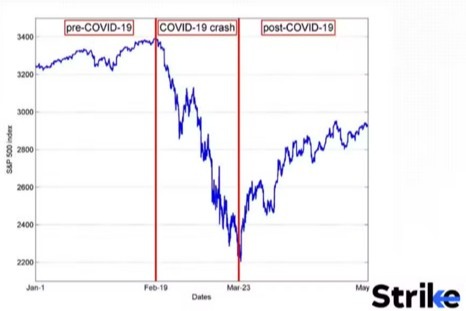
In early 2020, the market collapsed as COVID shut down the global economy. Stores closed. Flights disappeared. Professional sports stopped. People wiped down groceries with disinfectant wipes like they were handling radioactive material. The S&P 500 fell roughly 34% in just over a month, as shown in our first chart below.
Source: Strike Money
Then came 2022. Inflation surged to levels we hadn’t seen in decades. Russia invaded Ukraine. Oil prices spiked. The Federal Reserve began raising interest rates at a pace that made investors feel like Jerome Powell had discovered espresso shots and decided to weaponize them. The market fell roughly 26% from January through October.
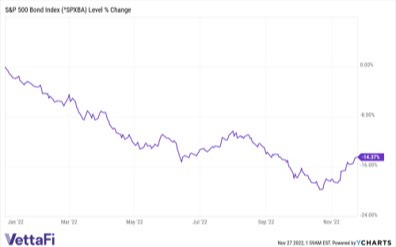
What made 2022 especially painful was that investors weren't just losing money in stocks. Bonds were falling too. Remember, when interest rates go up, bond prices go down. As the Fed finally acknowledged that inflation was not "transitory", it began hiking rates rapidly. This caused the bond market to drop by double digits at the same time the stock market was cratering, as you can see in our second chart below. Investors felt like they had no place to hide.
Source: VettaFi/YCharts
In 2025, investors endured another sharp decline as tariff disputes and “Liberation Day” trade announcements rattled global markets and reignited fears of slowing economic growth and supply chain disruption.
And most recently, markets stumbled again as conflict involving Iran pushed oil prices higher and revived fears about geopolitical instability spreading through global energy markets.
Different headlines. Different causes. Different experts confidently explaining why “this time is different.”
Same emotional cycle.
Because while markets evolve, human nature doesn’t change nearly as much as we think it does.
Why does this cycle repeat itself regardless of whether the catalyst is a pandemic, inflation, tariffs, or war?
Because the biggest risk investors face is often not economic.
It's psychological.
Behavioral economists Daniel Kahneman and Amos Tversky spent decades studying this reality. Their groundbreaking work on Prospect Theory showed that people experience the pain of loss far more intensely than the pleasure of gain. In fact, psychologically speaking, losses hurt roughly twice as much as equivalent gains feel good.
Please remember that volatility swings both ways. However, most investors do not see things this way. Most investors don't think of rising markets as volatility. They simply think of them as good returns and rewards for a well-constructed portfolio. But that's exactly what they are experiencing — the favorable side of volatility. I can tell you from nearly four decades of experience, clients generally equate volatility only with market downturns.
This explains why investors can quietly enjoy a 20% gain over two years…but a 10% decline over two weeks suddenly feels like the opening scene of a disaster movie.
Pain changes perspective.
It narrows time horizons.It amplifies fear. It makes temporary declines feel permanent.
And perhaps most dangerously, it convinces perfectly rational people to make deeply emotional decisions.
I’ve seen this firsthand more times than I can count.
During the COVID crash, I had conversations with clients who were genuinely convinced the financial system itself might not survive. To be fair, when the world is shutting down, the roads are empty, and your neighbor is spraying Lysol on Amazon boxes like they’re carrying ancient curses from a tomb in Raiders of the Lost Ark, it’s understandable that emotions run a little high.
I spent many evenings and every Saturday during March of 2020 proactively reaching out to my clients to see how they were holding up during this period of significant uncertainty and emotional distress. More than one client said something along the line of, “Maybe we should just sell everything and wait until things calm down.”
I heard many of the same fears expressed during the COVID-19 crisis, the Financial Crisis in 2008, the inflation and Russia-Ukraine war in 2022, and the tariff-driven volatility of 2025.
Now, on the surface, that sounds reasonable. Calm sounds good. Rational, even.
The only problem is markets rarely wait for calm.
Historically, they begin recovering long before the headlines improve. The market bottom in 2020 occurred while unemployment was still surging, businesses were still closed, and uncertainty was everywhere. Then, Congress passed the CARES Act, and the Federal Reserve Bank cut interest rates to 0% and opened the floodgates of liquidity. Investors who waited for the “all clear” often missed a significant portion of the rebound.
Remember, if you sell after markets have already fallen because you think you'll buy back in at a lower price, you'll eventually have to make a second decision.
You will have to buy when the news is even worse than it is today. When the financial media is screaming even louder that the sky is falling, and investors are feeling even more Pain in their portfolios.
In nearly four decades of doing this, I have never seen an investor successfully navigate that premise.
This brings us to one of the cruel ironies of investing:
Pain feels safest when you’re doing something. Even when doing something is exactly the wrong move.
It is natural to want to do something or change something when you are feeling pain. Famed investor, Shelby M.C. Davis, the founder of Davis Selected Advisers, once said, “You make most of your money in a bear market, you just don’t realize it at the time.”
And this is where Pain — the emotional force — quietly enters the portfolio.
It encourages behavior... usually the wrong behavior at the wrong time.
Pain whispers: “Make it stop.”
Sell. Go to cash. Wait until things feel better. The problem is that markets do not reward comfort nearly as often as they reward discipline. Below is a reminder of Warren Buffett's views on risk and market downturns.
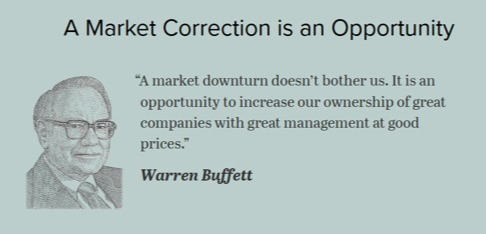
Source: Wisdom of Great Investors, Davis Funds
That doesn’t mean investors should ignore risk. It doesn’t mean declines are fun. Nobody enjoys opening statements during a correction and pretending it feels fantastic. I can tell you this from experience. The dot-com, 9/11, Enron, and WorldCom market drop, which started in March 2000 and ended in October 2002, saw the S&P 500 decline by 47%. Investors, who at that time typically got quarterly statements, saw their portfolio values decline 8 out of 10 quarters during that stretch.
As their advisor, it was not always fun to sit on the other side of the desk as your clients and friends were fearful that their hard-earned retirement assets were disappearing. Anyone who says they love bear markets is either lying or owns a vineyard that’s somehow hedged against human emotion.
But discomfort is not evidence that something is broken. It’s often evidence that you are investing in assets capable of generating long-term returns in the first place.
Volatility is not a design flaw of markets. It is the admission price.
That truth becomes especially difficult during moments when the financial media turns every market decline into a cross between a horror movie and a UFC title fight:
Every red day becomes “historic.” Every headline becomes “breaking.” Every strategist suddenly sounds like they’re auditioning to narrate the apocalypse.
Meanwhile, long-term investors are left trying to decide whether to stay disciplined or start building underground bunkers. Anecdotally, nearly 50 of my clients keep some level of cash at home to protect themselves against these doomsday scenarios. Approximately half of those clients also have gold and silver coins. Approximately half of those clients also keep emergency food supplies, generators, and enough equipment to survive a zombie apocalypse...you know who you are.
And yet, despite wars, recessions, inflation spikes, pandemics, political crises, interest-rate shocks, and enough “once-in-a-lifetime events” to completely destroy the mathematical meaning of the phrase, markets have historically continued moving higher over time.
Not in a straight line. Not comfortably. Not predictably.
But persistently. From a historical standpoint, we have never seen a stock market drop that hasn't ultimately been followed by a new all-time high. However, only those who stayed invested benefited from these rebounds.
That doesn’t eliminate Pain from the investing experience. It simply reminds us that Pain has always been part of the journey.
The Greeks understood this thousands of years ago. Fear and dread always arrive before the battle. Markets are no different.
Pain will show up again someday. It always does. Another headline. Another crisis. Another moment where investors become convinced the future has permanently changed.
Pain has been showing up in markets for as long as markets have existed. The Greeks gave it a name thousands of years ago. Disney gave it a face.
Investors still wrestle with it today.
And when that happens, it’s worth remembering something incredibly important: Pain is temporary.
But the decisions we make during moments of pain, and their financial repercussions, can become permanent... for you and your family.
That’s why successful investing often has less to do with avoiding fear… and more to do with learning how to live through it without letting Pain take control of the portfolio.
Because if Pain is difficult… Panic may be even worse.
We will explore the impact of Panic on investors in part two as we continue "Moving Life Forward."
© 2026 Jesse Hurst
Senior Wealth Manager
Related Content
The views stated are not necessarily the opinion of Cetera and should not be construed directly or indirectly as an offer to buy or sell any securities mentioned herein. Due to volatility within the markets mentioned, opinions are subject to change without notice. Information is based on sources believed to be reliable; however, their accuracy or completeness cannot be guaranteed. Past performance does not guarantee future results.
Investors cannot directly invest in indices.
Featured Blog Image Source: iStock.com/Kateryna Dudkina