


Over my 38-year career as a financial advisor and Certified Financial Planner, I have been blessed to have incredible clients to work with. Many of which I have worked with for several decades. I have watched their kids and grandkids grow up, and I am lucky to call many of them friends, not just clients. They have shared incredible stories from their lives, and I would like to share one with you today.
My client Frank was both an amazing and humble man. While attending college, like so many other men his age, he enlisted in the military after Pearl Harbor, leaving college to do so. Frank wanted to be a pilot. He was trained in Navy Aviation where he learned to fly a variety of different aircraft and to navigate by the stars, earning his wings in Pensacola. He was assigned to a Martin PBM Mariner as part of the VH4 Rescue Squadron, which mostly conducted search and rescue missions.

Source: Wikipedia
When Frank was being discharged from the Navy, he was on a C130 transport plane flying back to the United States from Okinawa, Japan. Unfortunately, somewhere over the Pacific Ocean, the plane’s navigation system went out, and the pilots were literally “flying blind”. Knowing that they had Navy pilots on board who had been trained to navigate by the stars, they woke Frank and his companions, who successfully landed the plane in the dark on an island in the middle of the Pacific Ocean for repairs and refueling.
They don't make men like Frank anymore. I was incredibly fortunate to be able to work with Frank for nearly 30 years. Even though Frank was a devout Michigan fan, we developed a great relationship and shared many stories over the years. Frank passed On February 11th, 2022, at age 98. Three days after he passed, Valentine's Day flowers showed up at the home of his longtime companion Evelyn. That's just the kind of guy he was.
Currently, economists, investors, and most importantly, Federal Reserve Bank policymakers are also “flying blind”. With government shutdowns, low survey response rates, and heightened political tensions, the release of official economic data has been sharply reduced. Except for one delayed inflation report, the federal government has not published significant economic data in over a month. As a result, experts are struggling to assess the current state and outlook of the U.S. economy.
Liz Ann Sonders, Chief Investment Strategist at Charles Schwab, described the situation as a “data desert.” She anticipates that, even when government data resumes, investors will increasingly depend on private sources such as ADP payroll reports, PMI surveys, and regional Federal Reserve outlooks. This shift toward what she terms “parallel analysis” involves cross-checking government data with independent sources. As statistician George Box noted, “All models are wrong, but some are useful.” This observation is especially relevant now.
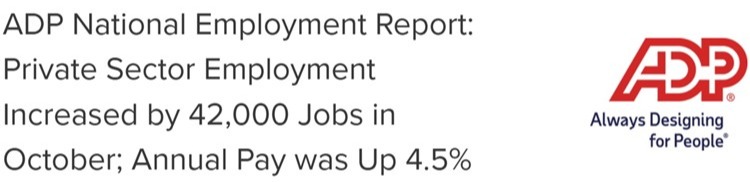
Source: ADP, November 5, 2025
So, how are economists coping in this environment? They’re turning to private-sector data to fill information gaps. Payroll estimates from ADP and job postings from Indeed have become more important. Real-time consumer spending data from credit and debit card transactions now inform forecasts. Housing market indicators from Zillow and the Mortgage Bankers Association, along with high-frequency data such as airline passenger traffic, restaurant bookings, and hotel occupancy rates, offer further insights into economic conditions.
The Federal Reserve, operating independently of Congress, continues to publish its own data. Reports on manufacturing output and consumer credit are particularly valuable, and anecdotal insights from its regional branches, known as the Beige Book, also assist experts. Despite these resources, economists are adjusting their models to rely more heavily on available data, recognizing that this approach is not ideal.
The problem is that private data can’t fully replace the breadth and consistency of government statistics. It’s hard to find reliable private data on things like service prices. Comprehensive GDP measures are also hard to obtain. That means forecasts are built on a patchwork of proxies, which increases uncertainty. When policymakers, such as the Fed, make decisions about interest rates or inflation, that lack of clarity can lead to market volatility.
There’s also a compounding issue: many private data sources calibrate their models using government statistics. So, the longer the shutdown lasts, the more distorted even the private data becomes. It’s like trying to navigate with a map when the candle is slowly fading.

Source: iStock.com/undefined undefined
Economists estimate that each week of the shutdown reduces annual GDP growth by 0.1 to 0.2 percentage points. However, without real-time data, it is difficult to measure the exact impact or to forecast the pace of economic recovery once the government reopens. In short, while alternative data offers some visibility, it’s no substitute for the full picture.
Economists and the Fed are doing their best to adapt, but they’re still “flying blind”. Unfortunately for them, they can't go to the back of the plane and wake Frank and his Navy buddies up to save them. For investors and our clients, this means being aware, monitoring multiple data sources, and acknowledging that uncertainty is part of the landscape…until the government reopens and we escape this “data desert”. I thought it was important to give you more background and understanding around this important topic as we continue “Moving Life Forward”.
© 2025 Jesse Hurst
Senior Wealth Manager
Related Content
The views stated are not necessarily the opinion of Cetera and should not be construed directly or indirectly as an offer to buy or sell any securities mentioned herein. Due to volatility within the markets mentioned, opinions are subject to change without notice. Information is based on sources believed to be reliable; however, their accuracy or completeness cannot be guaranteed. Past performance does not guarantee future results.
Investors cannot directly invest in indices.
Featured Blog Image Source: iStock.com/francescoch