


Rock'n'roll music was born out of multiple genres that preceded it, including gospel, country, and the blues. Blues rock typically combines blues chords, scales, and instrumental improvisation with rock. It's often played by an electric ensemble with instruments like electric guitar, electric bass, drums, keyboards, and harmonica. A great deal of early rock music from English rock bands based their sounds and their early recordings on blues songs recorded in previous decades. Great examples of this can be found in the musical catalogs of The Rolling Stones, The Yardbirds, Cream, The Who, and Led Zeppelin.
In today's blog post, I will give you a couple of my favorite examples. The first is "Crossroads," a song by American blues artist Robert Johnson. He performed it solo with his vocal and acoustic slide guitar in the Delta Blues style. It was part of his musical repertoire as early as 1932. On November 27, 1936, he recorded the song, which was released in 1937. A YouTube link to the song is included below.
In early 1966, while still with John Mayall's Bluesbreakers, Eric Clapton adapted the song for a recording session with an ad hoc studio group, dubbed Eric Clapton and the Powerhouse. Elektra Records producer Joe Boyd brought together Steve Winwood on vocals, Clapton on guitar, Jack Bruce on bass guitar, Paul Jones on harmonica, Ben Palmer on piano, and Pete York on drums for the project. “Crossroads" became a part of Cream's repertoire when Clapton began performing with Jack Bruce and Ginger Baker in July 1966. Their version features a prominent guitar riff with hard-driving, upbeat instrumental backing and soloing. A YouTube link to their version of Robert Johnson's classic is included below.
Blues music often includes themes of love, loss, hardship, and social and political commentary. It frequently expresses feelings of sadness, melancholy, or hope. However, today, I wanted to show you that the blues are not always sad and depressing. Our first chart below, from our friends at the Capital Group and American Funds, shows how the stock market, as represented by the S&P 500 index, has performed during economic growth and recession. As you can see, periods of growth, represented by the blue, have lasted longer and produced substantial positive returns over time. Perhaps this chart will show you that “the blues” aren't so bad.
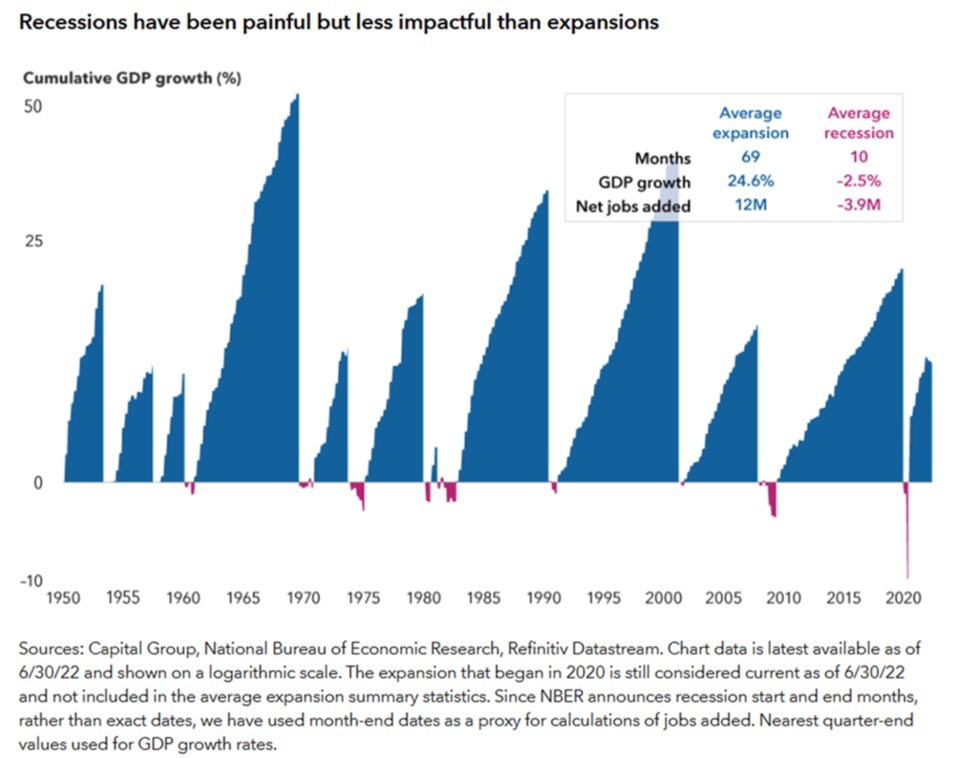
Their analysis of 11 cycles since 1950 shows that recessions, represented by the red, have persisted between two and 18 months, with the average spanning about 10 months. That can feel like an eternity for those directly affected by job loss or business closures. However, investors with a long-term investment horizon would be better served looking at the whole picture. Recessions have been relatively small blips in economic history. Over the last 70 years, the U.S. has been in an official recession less than 15% of all months. Moreover, their net economic impact has been relatively small. The average expansion increased economic output by almost 25%, whereas the average recession reduced GDP by 2.4%. Equity returns can even be positive over the entire length of a contraction since some of the most substantial stock rallies have occurred during the late stages of a recession.
A second chart from Hartford Funds further shows the dispersion of stock market returns since 1926. It shows the year-by-year returns grouped into different groupings based on their average annual return. The S&P 500 index has averaged 10.42% over the last nearly 100 years. However, you will note from the shaded area in the chart below there have only been six years during that time frame that the stock market has produced an annual return between 8% and 12%. For many years, it has been much better or worse than that. You should also notice the number of years skewed to the right side of the chart under the exceptional years.
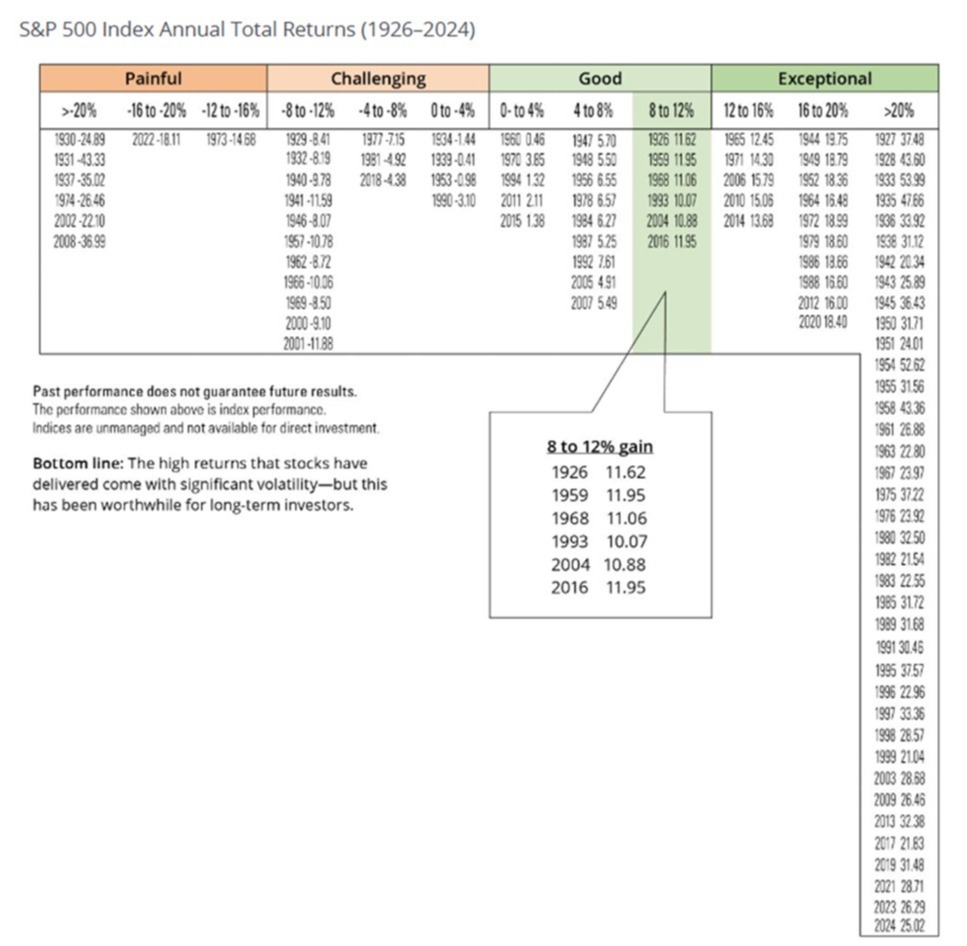
The above chart shows that, once again, you must endure the painful and challenging periods in order to experience the Good and Exceptional periods, which occur much more often. You could summarize the two charts by saying, “You must live through the reds if you want to get the blues.”
Before finishing, I wanted to give you one additional example of a Blues song that became a rock classic. “Bring It On Home" is a blues song written by American music arranger and songwriter Willie Dixon. Sonny Boy Williamson II recorded it in 1963, but the song was not released until 1966. In 1969, English rock band Led Zeppelin recorded a version of "Bring It On Home" for their second album Led Zeppelin II. The intro and outro were deliberate homages to the Sonny Boy Williamson song, whereas the rest of the track was an original composition by Jimmy Page and Robert Plant. YouTube links to both versions of the song are included below.
Sonny Boy Williamson - Bring It On Home
Led Zeppelin - Bring It on Home (Official Audio)
This is an important reminder, as we have experienced two years of back-to-back 20% returns in the S&P 500. While the economy appears to be in good shape, we will go through another recession and stock market downturn at some point. When that happens, many people will want to sell their stocks and bail out of the market because of a brief period of red. Unfortunately, those who take this course of action will also likely miss the next period of blue.
This was a great lesson to share with you, our trusted friends and clients. While blues songs often include themes of sadness and loss of hope, the information above shows you that the blues are not always bad. I wanted to share this information with you while we are still going through good times in the stock market and the economy. We want you to be ready to do the right thing during our next bout of volatility or downturn. It's important to know this as we continue “Moving Life Forward.”
© 2025 Jesse Hurst
Senior Wealth Manager
Related Content
The views stated are not necessarily the opinion of Cetera and should not be construed directly or indirectly as an offer to buy or sell any securities mentioned herein. Due to volatility within the markets mentioned, opinions are subject to change without notice. Information is based on sources believed to be reliable; however, their accuracy or completeness cannot be guaranteed. Past performance does not guarantee future results.
Neither Cetera Advisors LLC nor any of its representatives may give legal or tax advice. This information is not intended as tax or legal advice. Please consult legal or tax professionals for specific information regarding your individual situation.
Investors cannot directly invest in indices.
Featured Blog Image Source: iStock.com/fotocelia